Thought Leadership

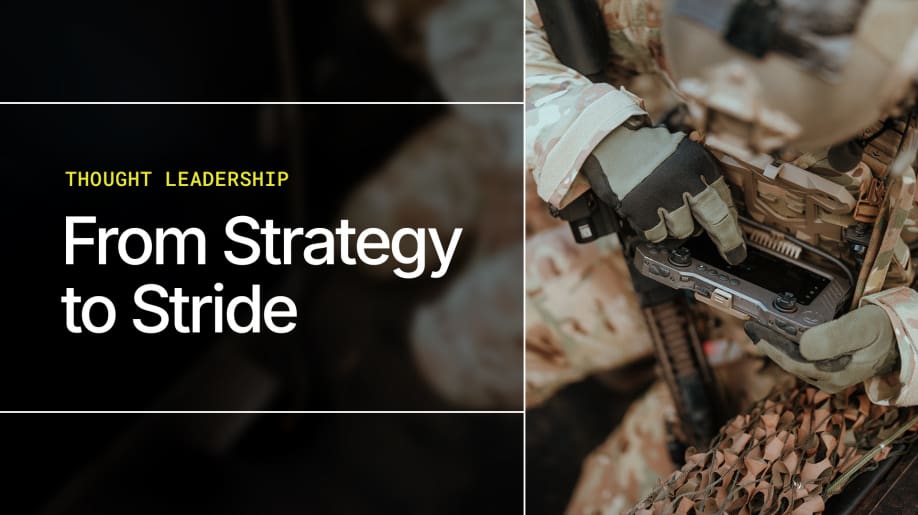
From Strategy to Stride, Modernization That Matters: Common Control, Rapid Prototyping, and the Accelerated Training

01/08/2026

From Strategy to Stride, Modernization That Matters: Common Control, Rapid Prototyping, and the Accelerated Training

Not a day goes by in DC without someone grabbing a microphone, stepping to a podium—or settling into a cushy seat on a panel—to declare the need for “more innovation” and a “revitalized industrial base.”

It’s become a ritual without results.

However, with the recent release of the U.S. Department of War’s (DoW) Acquisition Transformation Strategy, we have a real chance to drive meaningful change. It’s more than a political directive; it’s a blueprint for the leaders within the defense industrial base to make it a reality.

Secretary of War Pete Hegseth has just thrown the game-winning pass into the air. Scoring means turning strategy into capability, which hinges on how quickly industry can prepare the operating forces to receive Hegseth’s pass. With DoW and Congress behind this effort, the question becomes simple: how do we continue to move the ball down the field and get it over the goal line? Industry can do that in three ways.

First, we need a true, shared tactical command-and-control backbone across the Services—replacing today’s patchwork of soldier-level controllers and incompatible software that can’t integrate with other Service-level C2 systems.

Second, we need rapid-fire prototyping that puts hardware into soldiers’ hands, rather than abandoning promising tech in the Valley of Death—or worse, shrink-wrapped in warehouses.

Third, we need Field Service Representatives (FSR) who can accelerate the DOTMLPF-P process through hands-on training in the field and by providing feedback to develop doctrine for the force. It’s the process no one budgets for, even though it ultimately determines whether anything reaches the fight or adds any real value once it gets there. (Lay readers: DOTMLPF-P is the framework for planning and building capabilities that aligns new technology with the American way of fighting, policy, resources, training, and manning.)

This is the beginning of a shift from ritual to results, and it’s going to reshape how our troops score touchdowns in the years ahead.

1. Common Control: The New Rifle and Radio

The next war will be fought by squads remotely commanding robotic systems: unmanned ground vehicles hauling gear, drones scouting ahead, loitering munitions circling above… Incredible capability, cognitive overload.

If we expect troops to fight and manage all that tech simultaneously, we need a single pane of glass—one intuitive control platform that feels as natural as a rifle and radio. Common control isn’t about user interface design; it’s about survival under pressure.

Key philosophy is ‘one-to-many.’ There will be a sharp rise in the number of ground, aerial, and maritime robotics systems procured and deployed across the Department.  As the number of systems employed by the soldier increases, we should avoid the desire to give every soldier a controller. One soldier can control a swarm of one-way attack systems while employing the ISR to initiate and close the kill chain. Also, systems that are fully autonomous won’t require ‘control,’ but they will need to be tracked in and out of the battlespace, which is why interoperable software like Android Tactical Assault Kit (ATAK) will be critical.

Programs like the U.S. Army’s Human Machine Integrated Formations (HMIF), under the newly established Portfolio Acquisition Executive Fires (PAE Fires), are pushing in the right direction with modular architectures and open APIs. But let’s stop pretending interoperability can be bolted on later. If a system can’t plug into a common architecture from day one, it shouldn’t make it past the gate.

In the end, command-and-control is the real high ground and the side that seizes it early will shape the fight long before the first shot is fired.

2. Prototype Like You Mean It

Ukraine proved what most of us already knew: Concepts are validated in contact, not in meetings.  

The U.S. can’t wait for perfect requirements or five-year procurement cycles. It needs continuous experimentation, real soldiers, Marines, and special operators running gear hard in dirty conditions, feeding lessons back to designers in real time. Because the truth is brutal: our adversaries iterate faster than our acquisition system, and the first time that gap shows up will be in combat, not a conference room.

We finally have alignment: Congress, the Pentagon, and industry all want faster prototyping. The fix is to make it permanent. Here’s how:

1. Expand Research, Development, Test, and Evaluation (RDT&E) contracts. Fund multiple vendors per capability. 

2. Push prototypes to more units by shifting early S&T funding into applied research for more testing and experimentation. 

3. Take advantage of units the Army, Air Force, and Marines have stood up for this purpose. 

The Army’s Transformation in Contact initiative to adapt its organizations and technologies rapidly and continuously on the modern battlefield is a glimpse of the future: brigades re-organizing on the fly, integrating manned and unmanned assets, building strike companies where scouts, EW teams, and loitering munitions operate as one lethal formation.

We need to embrace that future and put the hardware in the dirt. Let the warfighters break it, tweak it, and own it. That’s how we’ll close the gap between PowerPoint and performance—and how we’ll keep that gap from becoming a battlefield surprise.

3. Bring Back the FSRs (to accelerate fielding)

We used to know how to do this. When M-ATVs and MRAPs rolled into Afghanistan, the only reason they worked was because industry flooded the fight with FSRs. They taught troops how to operate this lifesaving equipment quickly and effectively and kept them in the fight.

Unfortunately, the FSR experience in Iraq and Afghanistan exposed poignant shortcomings of relying on civilian contractors on a battlefield. Today, adding FSRs into a contract can get a bad rap as the Services seek self-reliance in operation and repair of systems.

That’s a valid critique, maintaining equipment at the lower echelons should be a given. But the battlefield we’re preparing for, including autonomy at the edge, open architectures, and rapid software pushes, moves too fast for traditional schoolhouse training to keep up. As we field systems from multiple vendors, ideally all riding on a common control platform, units will be asked to self-train across half a dozen new interfaces at once. Therefore, DoW should embrace FSRs for training and fielding new systems in user-friendly ways so that FSRs are not required to operate those systems in theater. For its part, industry must be ready to provide FSRs early, hit the ground running with new equipment training teams, and turn complex unfamiliar gear into usable combat power on day one.

Vendors need to be prepared to hire and bake FSRs into every major test, experiment, and early fielding event. These embedded experts will accelerate the DOTMLPF-P as they close the loop between design and doctrine, between factory and foxhole.

If a system shows up to a battalion and no one knows how to use it, that’s not on the operator, that’s on the planners, acquirers, and vendors.

CONCLUSION: Modernize the modernization

It’s easy to mock Pentagon flow charts and acronyms like DOTMLPF-P, but those structures exist for a reason: to protect our troops. We can’t just give soldiers new equipment without the opportunity to learn and train. When it comes to combat, brilliance in the basics keeps Americans alive. Rigorous training on common platforms in peace is the operating system of war.

Secretary Hegseth’s pass is already in the air, and for the first time in a long time the field is wide open. If industry leans in now to build common control from the start, push prototypes into the dirt, and embed the experts who turn complexity into confidence, the force will catch that ball at full stride. That’s how we move from strategy to capability, from talking about modernization to living it. This moment is an opportunity disguised as a challenge, and if we seize it, the next generation of warfighters won’t just be better equipped, they’ll be decisively ahead.


ABOUT THE AUTHOR 

Chris Meyers is a Senior Director at AV. He is a retired Marine Colonel who served as an Armor Officer, a Joint Terminal Attack Control (JTAC), Legislative Liaison, and Program & Budget Officer. He deployed to Iraq and Afghanistan, commanded 1st Tank Battalion, and led the Marine Corps’ liaison office to the U.S. House of Representatives.


ABOUT AV — JOINING THE MISSION 

AeroVironment (AV) is a defense technology company with a mission to invent and deliver advantage to U.S. and allied militaries. AV isn’t for everyone. We hire the curious, the relentless, the mission-obsessed.

AV doesn’t just build defense technology; we redefine what’s possible. As the premier autonomous systems company in the U.S., we deliver breakthrough capabilities across air, land, sea, space, and cyber. From autonomy-enabled drones and loitering munitions to integrated autonomy and space resilience, our technologies shape the future of warfare and protect those who serve.

Founded by legendary innovator Dr. Paul MacCready, AV has spent over 50 years pushing the boundaries of what unmanned systems can do. Our heritage includes seven platforms in the Smithsonian—but we’re not building history, we’re building what’s next.

If you’re ready to build technology that matters – with speed, scale, and purpose – come find your people.

Let’s Advance Your Mission

Product Catalog

View the full catalog to explore our solutions in detail.

Thought Leadership

Three Questions About the Future of AI in Defense, Thoughts from the AI lead at AV’s Innovation Center

10/28/2025

Three Questions About the Future of AI in Defense, Thoughts from the AI lead at AV's Innovation Center

By Zarinah Casanova, AI Lead for AV’s Innovation Center 

Artificial intelligence has entered our daily lives—but on the battlefield, its role carries life-and-death consequences. That shift from everyday convenience to mission-critical responsibility is where my work begins.

For the past two decades, I’ve worked across cloud analytics, data science, and machine learning operations. Today, I lead AV’s Innovation Center in Annapolis Junction, Maryland, where we’re developing next-generation AI to keep our country safe. My own journey—from a high school work-study student to helping grow our lab from a single computer into a full data center—has reinforced a simple truth: in defense, AI is about responsibility. Systems must be reliable, explainable, and resilient because lives and missions depend on them.

The future of defense AI won’t be built by one person or one lab. It will come from collaboration across disciplines, communities, and nations. And as the technology races ahead, we have to stop and ask the toughest questions—the ones that will define whether AI strengthens our defenses or puts them at risk. AV’s Innovation Center was built for answers and there are three high-priority questions we’re working to address every day:

1. As national security missions grapple with the challenge of processing massive amounts of data, how can cutting-edge AI innovations be harnessed to make timely and impactful decisions?

Our missions are becoming more data-hungry, making breakthroughs in data collection, cleaning, and processing for AI an operational imperative. The traditional, time-consuming method of collecting all data and returning it to a central source for processing is no longer viable. By the time the data is ingested, the window for actionable intelligence has often passed. This inefficiency highlights the critical importance of decentralized, real-time data processing.

We are shifting towards architectures where processing and intelligence occur at the edge. This evolution involves deploying AI on low-resource or non-specialized hardware and utilizing it to process diverse raw data streams, such as those from sensors and network traffic, directly on site. The AV Innovation Center is on the cutting edge of this transformation, actively developing and testing these edge AI solutions to ensure timely and potentially autonomous actions in reaction to observations.

Additionally, innovative methods for data processing are essential. In our lab, we have prototyped an AI-driven data normalization process that automates the handling of rapidly changing data. This innovation addresses the ongoing struggle to keep pace with the ever-changing data landscape. The future of AI in defense hinges on these advancements, driving towards a paradigm of scalable, efficient, and real-time data processing that meets mission-critical needs with precision and speed.

 2. In the next five years, how far can we push AI at the edge—running on drones, satellites, or sensors in contested environments?

We’re actively working to translate the remarkable advances in artificial intelligence, particularly the reasoning and analytical capabilities demonstrated by large language models, into practical applications at the edge. While these publicly available Large Language Models (LLMs) are impressive, their size and general-purpose training present two key hurdles for deployment at the edge. First, their resource demands are often prohibitive for edge devices, and reliable network connectivity can’t be guaranteed. Second, they lack the specialized domain expertise necessary to interpret raw sensor data or contribute to real-time tactical decision-making.

The AV Innovation Center is focused on addressing these challenges by dramatically reducing model size while simultaneously ‘teaching’ those models to natively understand raw sensor data, recognize critical patterns, and enable proactive decision-making. In the next five years, this will lead to a significant leap in autonomous edge capabilities, enabling platforms to make complex, context-aware decisions in the most challenging environments.

3. How do we ensure that Autonomous AI systems behave as expected and remain responsible in critical scenarios?

Building autonomous AI for defense carries a significant responsibility, one we don’t take lightly. We proactively design for safety through monitoring and traceability right from the start. We also build in layers of oversight to keep the AI in check, ensuring it operates as intended. These factors are integral to our development process, ensuring our systems are transparent and accountable.

We establish evaluation frameworks early in the development process to rigorously assess safe operation of our AI systems. To support this, we engage with an AI review board composed of technical, legal, and compliance experts. This diverse oversight provides critical perspectives and helps us navigate complex challenges related to safe and responsible deployment.

These questions are not easy to solve – nor should they be. AV’s Innovation Center works to answer these questions by fostering a culture that welcomes critical thinking, especially when it comes to responsible innovation. We’re looking for people who are not only brilliant engineers but also deeply committed to building AI systems that operate reliably and as intended. By integrating these principles into our innovation process, we aim to develop AI systems that are both cutting-edge and responsible. If this sounds like you, explore opportunities and join me at AV as we ask – and answer – the questions most critical to protecting our nation.


ABOUT AV — JOINING THE MISSION

AV isn’t for everyone. We hire the curious, the relentless, the mission-obsessed. The best of the best.

We don’t just build defense technology—we redefine what’s possible. As the premier autonomous systems company in the U.S., AV delivers breakthrough capabilities across air, land, sea, space, and cyber. From AI-powered drones and loitering munitions to integrated autonomy and space resilience, our technologies shape the future of warfare and protect those who serve.

Founded by legendary innovator Dr. Paul MacCready, AV has spent over 50 years pushing the boundaries of what unmanned systems can do. Our heritage includes seven platforms in the Smithsonian—but we’re not building history, we’re building what’s next.

If you’re ready to build technology that matters—with speed, scale, and purpose—there’s no better place to do it than AV.
Let’s Advance Your Mission

Product Catalog

View the full catalog to explore our solutions in detail.

Thought Leadership

Opening Statement: Industry Perspectives on How Drone Warfare Abroad Is Transforming Threats at Home

07/16/2025

Opening Statement: Industry Perspectives on How Drone Warfare Abroad Is Transforming Threats at Home Church Hutt

Chairman Gimenez, Ranking Member McIver, and Distinguished Members of the Subcommittee: 

Thank you for the opportunity to testify on how drone warfare abroad is informing domestic investments to prepare for threats here in the United States. I commend the committee’s focus on these challenges and your efforts to enhance the safety of the American people and the U.S. transportation systems. My name is Church Hutton, and I serve as the Chief Growth Officer for AV, formerly AeroVironment. It is my pleasure to testify alongside industry partners as we highlight associated challenges, opportunities, and the importance of providing effective capabilities to our servicemembers and first line responders. 


Let’s Advance Your Mission

Product Catalog

View the full catalog to explore our solutions in detail.

Event

Industry Panel Event: Asymmetrical Challenges in the Pacific: Expect the Unexpected

09/21/2023

Tensions throughout the Asia-Pacific region heighten more every day. It’s expected that a potential China-Taiwan or other Asia-Pacific conflict would be different than the current war inflicted by Russia on Ukraine. But would it be? What key learnings from the Russia-Ukraine war can be applied to an Asia-Pacific type of war? What do we expect will be different and how should the U.S. Department of Defense and its allies prepare for the unexpected? What military technologies are making a difference in Ukraine and how can they be used in an Asia-Pacific conflict that would have more emphasis on naval capabilities?

Join moderator Admiral Phil S. Davidson (Retired) and an intriguing panel as they address these questions and others, including questions from the audience, on October 18, 2023, at 9:00 a.m. Pacific Time.

Let’s Advance Your Mission

Product Catalog

View the full catalog to explore our solutions in detail.