News

The Ongoing Triumph of Ingenuity

04/22/2024

The Ongoing Triumph of Ingenuity
By William Pomerantz, AeroVironment

This is my love letter to Ingenuity.

I remember when I first heard about the concept of a small helicopter designed to catch a ride with a rover bound for the Martian surface. At the time, my wife worked as part of the ‘Mars Mafia’ at NASA Jet Propulsion Laboratory — a wonderful job that meant she got to bring intriguing ideas and fascinating discoveries home from work regularly. My first reaction to the idea of a Martian drone was a quick sequence: No way! Could that even work? There’s barely any atmosphere there. But could you imagine if it did work? No one has ever seen anything like that before. That would be incredible!

As I learned more about the idea, I marveled at the balance between the simplicity of the overall concept and the complexity of some of the engineering specifics required to make a helicopter fly on a planet where the atmospheric pressure at the surface is only 1% of what it is here on Earth (where it’s already extremely challenging to make helicopters fly!).

While many people, myself included, were wondering what was possible, small teams at JPL and AeroVironment were creating what was possible. A quick, hardware-rich sprint by a team of incredible engineers, technicians, and project managers allowed the Ingenuity Mars helicopter project to be completed on schedule– words we too rarely get to say in the world of space exploration.

As the landing date for Perseverance and Ingenuity approached, I asked my JPL friends for their guesses as to how many times the helicopter would fly. By far the most common answer was that it would never make it off the ground in one piece. Another subset of people thought Ingenuity might fly once or twice.

After the nerve-wracking deployment of the helicopter from under the belly of Perseverance, followed by a few weeks of wiggling rotors and commissioning the vehicle, the world was treated to what you see in this GIF: the first aircraft to perform powered, controlled flight on a planet other than Earth.

This was a “Wright Brothers moment,” happening in our lifetimes, on another world. The impossible becoming possible. A new mode of peaceful exploration, coming online right before our eyes, in glorious full-color video.

Over the next three Earth years, Ingenuity would go on to surpass every expectation. From an initial target of five flights and 30 Martian days (sols), Ingenuity achieved 72 flights and about 1,000 sols. Ingenuity flew higher, faster, and further over more hazardous terrain than ever imagined. It returned first-of-its-kind images of the Perseverance rover, its backshell, and more. It gave us up-close images of Martian vistas that we’re currently unable to explore by rover or with orbiters. The little helicopter that could survived a Martian winter with barely any damage. Every day, every flight, every image brought us precious new knowledge and expanded the horizons of humanity’s understanding of our closest planetary neighbor.

Along the way, some of the rover-centric teammates who had first seen Ingenuity as a distraction came to view the helicopter as an incredible new tool. The operations team is constantly faced with deciding between sending the rover to explore the most interesting territory and avoiding those same areas if the landscape might damage and strand the rover. It’s a tension that the JPL team is extraordinarily good at managing – but a tension nonetheless.

About sixty flights into Ingenuity’s planned five-flight mission, I had the great honor of joining AeroVironment to run the team responsible for our contributions to Ingenuity and the next generation of Mars helicopters. Ingenuity was still in excellent condition and was responding to every new challenge we gave it, making aerial exploration of Mars seem almost easy. But still, as we started what was effectively our twelfth victory lap after a race well run, we knew that every day Ingenuity phoned home was a gift.

As I got to know the team at AeroVironment and as I became reacquainted with the JPLers on the mission, one of the questions I asked was how people would like to see the mission end. We all wanted to see Ingenuity complete as many flights as possible; but I wanted to hear what the people who quite literally built Ingenuity thought. Should Ingenuity earn a quiet retirement in some picturesque location? Or should we push the edges of the envelope until at last we ask Ingenuity to do something it can’t manage, and see it fail in flight?

I received a range of strongly-held responses to my question, but the overwhelming majority of the Ingenuity team was aligned. They reinforced that this mission was designed as a technology demonstration, and the best way to honor the spirit of Ingenuity was to ensure that the vehicle kept teaching us new things about flight on Mars, right up to the end. If the choice ever became stand down or keep pushing, the team wanted to keep pushing.

And that’s exactly what happened. After more than seventy flights, we encountered a technical challenge that was simply beyond Ingenuity’s capabilities. The helicopter’s visual navigation system couldn’t distinguish the features of a very monotonous landscape well enough to consistently track them. Lacking that information, the vehicle essentially became confused about where it was and where it was going. As it descended, it may have begun to chase its own shadow.

At some point during the flight and landing, Ingenuity sustained significant damage to its rotor blades; and yet, somewhat miraculously, it survived that landing and came to rest upright on the Martian surface. Ingenuity is still alive and sending home data from its onboard systems – something it may continue to do for years to come. Perhaps if the Perseverance rover drives back by Valinor Hills Station (Ingenuity’s final airfield, named for Tolkien’s Undying Lands), Ingenuity will be able to phone home again and relay years’ worth of weather data to scientists on Earth. But unfortunately, it will never fly again.

Seventy-two flights. More than two hours of flying time. Over 1,000 sols after arriving on Mars. Eleven miles (17.7 kilometers) covered.  All this from a helicopter that weathered rocket launch loads, Martian dust storms, and more without a single opportunity for in-person inspection or servicing – something you’d never expect of a helicopter here on Earth. Ingenuity gave us everything we asked for and more.

True to its spirit and its mission, even Ingenuity’s final flights have made us smarter. There’s more yet to learn, but from what I’ve seen, I believe the challenge that grounded Ingenuity will be relatively easy to overcome with future Mars helicopters, thanks to what we’ve now learned. Yes, Ingenuity reached a limit; but that limit can and will be conquered. Flight 72 marked an end, but not the end.

The true conclusion of the Ingenuity mission will come when its hard-earned lessons are next put into practice by another Mars helicopter – one that will be even more ingenuous than its predecessor, thanks to how much wiser we are after seventy-two flights.

AeroVironment has continued to invest funds and time into dreaming up new capabilities for future Mars helicopters. Engineers at AeroVironment, JPL, and NASA Ames are now thinking about helicopters and other aerial vehicles that could someday carry scientific instruments, fetch sample tubes, or explore difficult to access locations such as valleys and lava tubes.

Additionally, elsewhere in the world, others are following Ingenuity’s lead. In 2021, China announced its plans to fly a helicopter on Mars, and more recently, India has revealed more about its plan to fly a Martian helicopter with a variety of weather and atmospheric sensors within the next eight years. With a growing community of international space agencies interested in the exploration of the red planet, helicopters may become an affordable and attractive option for space discovery and diplomacy.

When the Ingenuity mission began, NASA’s leaders often compared it to the Wright Brothers 1903 Flyer – and indeed, Ingenuity carried a small piece of fabric from that historic aircraft to Mars. Now that the Martian equivalent of the Kitty Hawk flight has occurred, the successors to Orville and Wilbur at NASA JPL and AeroVironment are itching to embark on the next great endeavor that will forever change the future of planetary exploration.  Planetary exploration helicopters have made their impact and are here to stay, and those in government, academia and industry who embrace and support the inclusion of these systems in future missions will surely reap the benefits.

Another novel forebearer of Ingenuity is Sojourner, the first successful Mars rover. Like Ingenuity, Sojourner was the lighter, smaller vehicle that hitched a ride with another mission to the red planet. Both programs had small budgets, but delivered huge results.

I believe the impactful legacy of Ingenuity will do for aerial mobility on Mars what Sojourner did for ground mobility: leave such an impactful legacy that at every future Martian launch window, and with every future call for proposals, this new form of exploration demonstrated by Ingenuity is considered a critical enabling technology for future discovery.

As Ingenuity’s flying campaign comes to an end, and as the era of aerial Mars exploration begins in earnest, my hat is off to the people who made this possible, including brilliant NASA and JPL colleagues like Bob Balaram, Charles Elachi, Mimi Aung, Robert HoggBobby BraunTheodore (Teddy) TzanetosHåvard Grip and more, and AeroVironment colleagues Matt Keennon, Benjamin Pipenberg, Sara Langberg, Jeremy TylerJoey Beckman, and more. Humanity’s best machines reflect the care, cleverness, and curiosity of their makers – and with Ingenuity, each of you has proven to be truly world-class.

Let’s Advance Your Mission

Product Catalog

View the full catalog to explore our solutions in detail.

News

Up Close: AeroVironment CEO Wahid Nawabi

Up Close: AeroVironment CEO Wahid Nawabi

Wahid Nawabi, CEO, AeroVironment, outlines the evolving landscape of autonomous defense, emphasizing the importance of AI, computer vision, and collaborative autonomy in enhancing operational capabilities and addressing the challenges of complex mission environments.

Let’s Advance Your Mission

Product Catalog

View the full catalog to explore our solutions in detail.

News

Switchblade’s Success in Ukraine

Switchblade's Success in Ukraine

As the war in Ukraine has highlighted, not all drones are created equal. Not all drone companies are created equal either. AeroVironment (AV) has a proud 50+ year track record of providing combat-effective unmanned systems to U.S. and allied forces around the world. As such, AV should not have been included in the Wall Street Journal article entitled, “How American Drones Failed to Turn the Tide in Ukraine.”

Currently, thousands of AV unmanned systems, including Switchblades, are employed in Ukraine, successfully operating in the most demanding electronic warfare conditions, and effectively completing their missions. We have been gratified by overwhelming user feedback and demand for additional systems. AV solutions, employed by trained warfighters, are having positive effects on this highly complex battlefield.

AV’s most recent awards to provide Switchblades to both the U.S. Army and U.S. Marine Corps highlight AV’s continued partnership and inherent trust to support the country’s warfighters with precision strike systems. My pledge is that AV will continue to advance the state of the art and provide the best tools to U.S. servicemembers and in defense of American allies’ sovereignty.

–Wahid Nawabi


Let’s Advance Your Mission

Product Catalog

View the full catalog to explore our solutions in detail.

News

Hoisting a Glass – Saluting the Accomplishments of Ingenuity

01/30/2024

Two hundred seventeen or so million miles from Earth, Ingenuity rests motionless on the bleak Martian sand. One of the specially crafted rotor blades that’s provided the autonomous helicopter’s lift in the planet’s negligible atmosphere is bent after an abortive descent. Now only its shadow accompanies it.

Let’s Advance Your Mission

Product Catalog

View the full catalog to explore our solutions in detail.

News

Army Looks to Field Loitering Munitions Next Year

12/13/2023

The Army may start fielding loitering munitions by the middle of next year amid a push to adopt innovative technology seen in Ukraine, the head of Army Futures Command said Wednesday.

“I think you’ll see those start delivering in the first half of next year,” Gen. James Rainey said at a media roundtable at the Pentagon. The Army sees the acquisitions process as an “iterative” task, in which the munitions become better and better with each purchase, he added.

The Army in July announced a program for equipping Army brigades with loitering munitions. The effort, dubbed Project LASSO, seeks to put more weapons capable of destroying enemy tanks into the hands of average infantry units.

Let’s Advance Your Mission

Product Catalog

View the full catalog to explore our solutions in detail.

News

President of Ukraine met with executives of U.S. defense companies

12/12/2023

During his visit to the United States, President of Ukraine Volodymyr Zelenskyy met with executives of U.S. defense companies.

In particular, the meeting held at Ukraine House in Washington, DC, was attended by BAE Systems President Tom Arseneault, Day & Zimmermann Chair and CEO Harold Yoh, Boeing President Theodore Colbert, CEO of Sierra Nevada Corporation Fatih Ozmen, Northrop Grumman Vice President Stephen O’Bryan, RTX Vice President Jeff Shockey, Lockheed Martin Vice President Raymond Piselli, General Dynamics Vice President Mark Roualet, D&M Holding CEO Daniel Powers, AeroVironment Vice President Charles Dean.

President of Ukraine met with executives of U.S. defense companies

Let’s Advance Your Mission

Product Catalog

View the full catalog to explore our solutions in detail.

News

Switchblade Kamikaze Drone-Armed Uncrewed Fast Boat Tested

11/02/2023

The U.S. Navy drone speedboat armed with Switchblade 300 loitering munitions was able to successfully destroy multiple mock targets at sea during a recent test. A combination like this could be useful in various contexts, including providing close-in protection against swarms of small crewed and uncrewed boats. This also underscores the Navy’s interest, as well as that of the U.S. Marine Corps, in various tiers of armed drone boats capable of carrying out defensive and offensive missions.

Let’s Advance Your Mission

Product Catalog

View the full catalog to explore our solutions in detail.

News

‘Critical’ Tank-Killer Switchblades Will Boost Ukraine’s Drone Stocks

10/11/2023

‘Critical’ Tank-Killer Switchblades Will Boost Ukraine’s Drone Stocks

Ukraine is set to receive further deliveries of the Switchblade 600 suicide drone, according to its manufacturer, in a move that could boost Kyiv’s ability to take out Russian assets far behind the heavily fortified front lines.

Read the full article at newsweek.com

Let’s Advance Your Mission

Product Catalog

View the full catalog to explore our solutions in detail.

News

Creativity and Boldness Will Win the Wars of the 21st Century

08/10/2023

Creativity and Boldness Will Win the Wars of the 21st Century

Ukraine’s success in countering Russia’s invasion can be attributed to its willingness to embrace and deploy new technologies, becoming a technology disruptor in the realm of warfare.

The relentless, bloody battle in eastern Ukraine is reminiscent of old-world warfare, with miles of trenches, tanks, howitzers, and pounding artillery turning cities to rubble, evoking memories of WWII or even WWI battles.

It’s not surprising that many consider war in the 21st century similar to major land, sea, and air battles of 80 years ago. However, the general public is only getting a glimpse of what today’s new technologies are bringing to the battlefield.

Let’s Advance Your Mission

Product Catalog

View the full catalog to explore our solutions in detail.

News

AeroVironment CEO Provides Testimony to U.S. Congress on the Capabilities of Unmanned and Robotic Systems in Support of National Security

06/22/2023

AeroVironment CEO Provides Testimony to U.S. Congress on the Capabilities of Unmanned and Robotic Systems in Support of National Security

On June 22, AeroVironment’s Chairman, President and CEO Wahid Nawabi testified before the House Subcommittee on Cyber Security, Information Technology and Government Innovation. The hearing, titled “Using Cutting-Edge Technologies to Keep America Safe,” explored how new and innovative technology – such as unmanned aircraft systems (UAS) and intelligent robotic systems – are helping our military, law enforcement, and border security officials protect our citizens and borders.

Please see below for Mr. Nawabi’s full prepared remarks presented before the subcommittee. A video of the hearing in its entirety is available here.

Let’s Advance Your Mission

Product Catalog

View the full catalog to explore our solutions in detail.

News

Ukraine’s Next-Generation Drone Fleet Is Packed With Upgrades

03/01/2023

Ukraine’s effective use of drones was one of the revelations of the first year of the war, from Bayraktar TB2s hitting Russian convoys to quadcopter scouts to long-range loitering munitionsmulticopter bombers and FPV kamikaze racing drones. Most significantly, drone artillery spotters have found targets and adjusted aim, multiplying Ukraine’s firepower, erasing Russia’s advantage in artillery and halting new advances. Ukraine is now committed to building an Army of Drones, putting more robots and fewer humans in the front lines. And in the second year of the war, Ukraine’s drone forces are getting upgrades in capability as well as numbers.

Let’s Advance Your Mission

Product Catalog

View the full catalog to explore our solutions in detail.

News

Switchblade kamikaze drone production to ramp up following Ukraine use

10/11/2022

Switchblade kamikaze drone production to ramp up following Ukraine use

WASHINGTON — AeroVironment, the maker of the Switchblade loitering munition Ukraine has used against Russia in recent months, is planning to ramp up production of the heavier-duty version.

Ukraine has had repeated battlefield successes with the Switchblade 300 since the United States shipped it 400 of the lighter-weight loitering munition earlier this year, Charlie Dean, AeroVironment’s vice president of sales and business development, said in an interview with Defense News at the Association of the U.S. Army’s conference on Monday.

And with the larger, more powerful Switchblade 600 on its way to Ukraine — Dean said the first batch of 10 would likely be in the country in the next few weeks — and growing visibility and interest in the weapon, AeroVironment is making preparations to produce more.

Dean said Ukraine has “considerable interest” in getting and using the Switchblade 600. Today, AeroVironment can produce more than 2,000 Switchblade 600 systems annually; within a few months, he said, the company hopes to roughly triple that to about 6,000.

To do that, he added, the company is working to obtain more supplies to build the 600 version as well as adding new lines dedicated to the heavier-duty loitering munition.

Right now, he explained, AeroVironment only has one shift building the 600 systems, but could add a second shift if necessary.
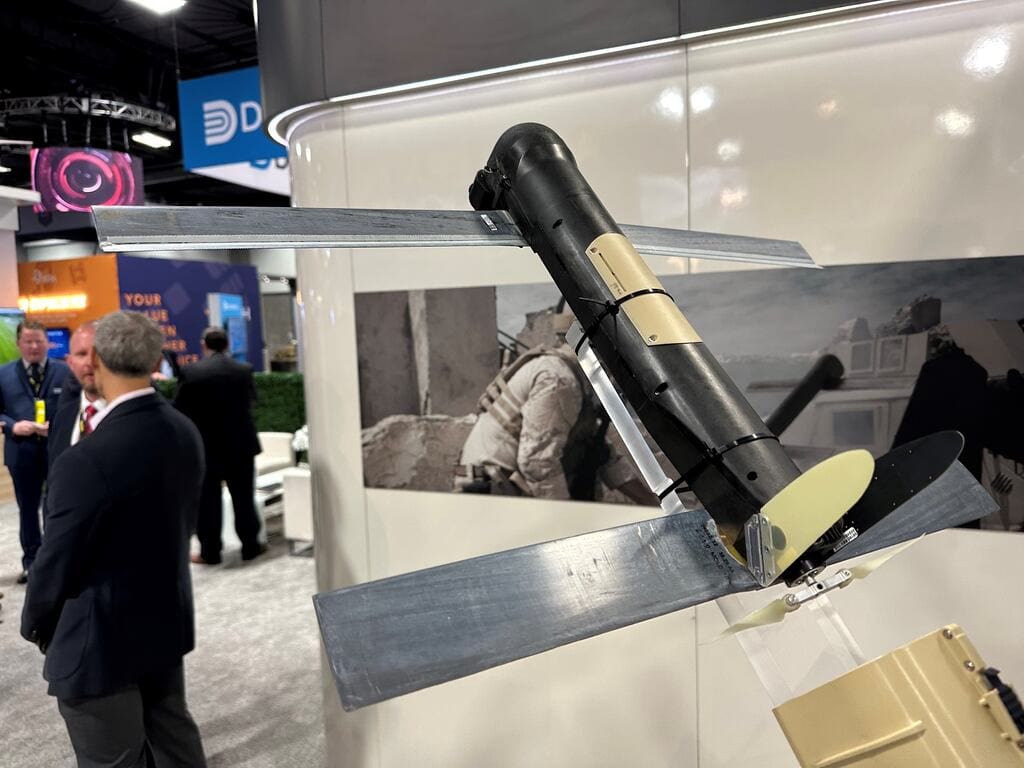
AeroVironment showed off several systems in use by Ukraine, including the Switchblade 300, during the 2022 AUSA conference. (Stephen Losey/Staff)

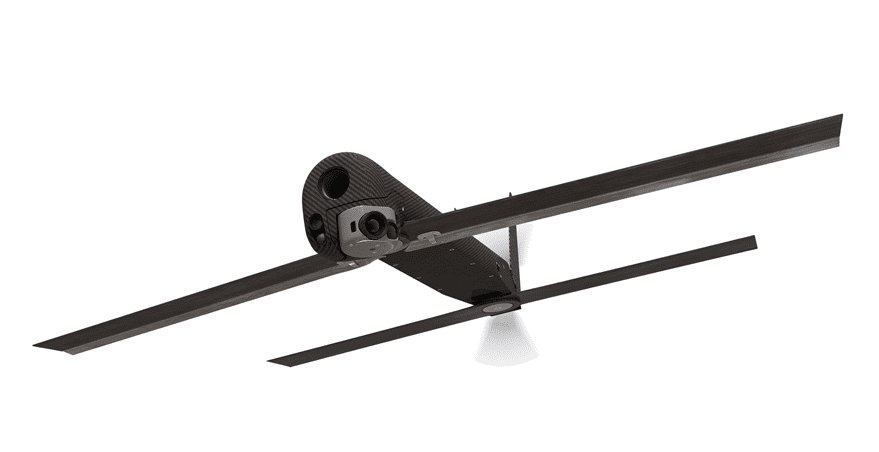
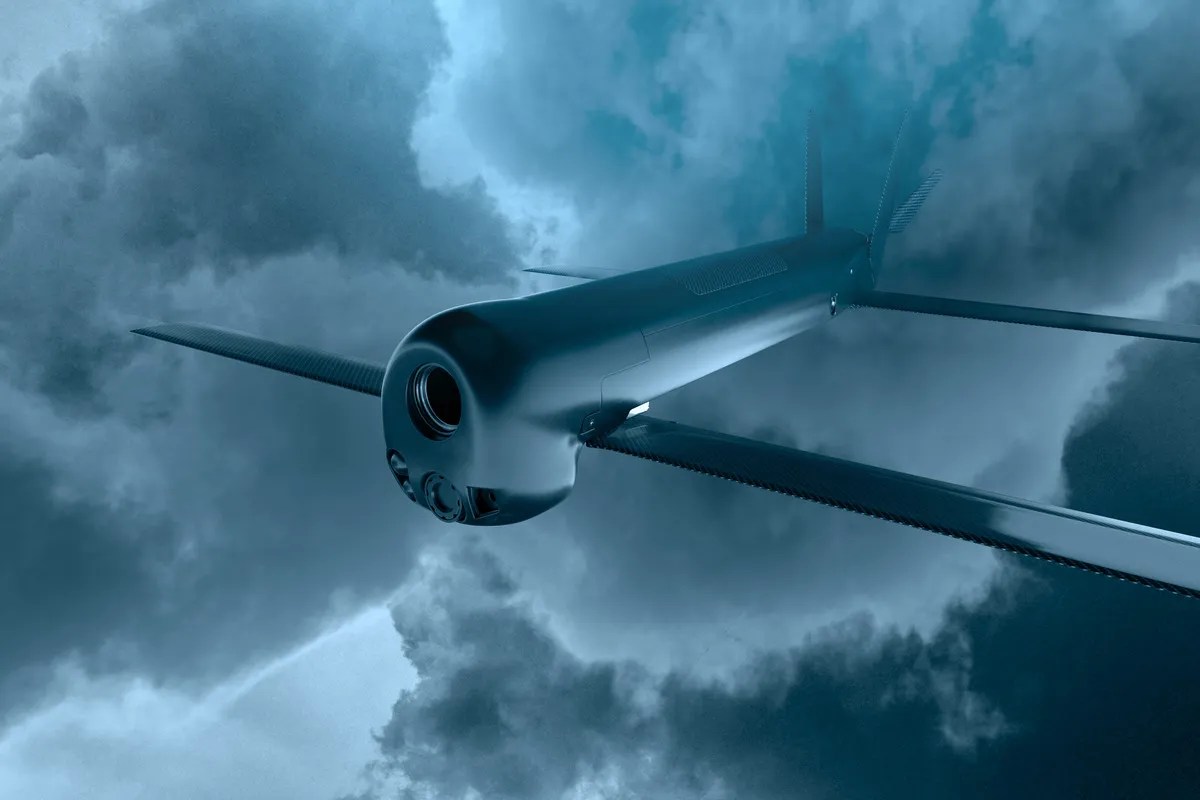
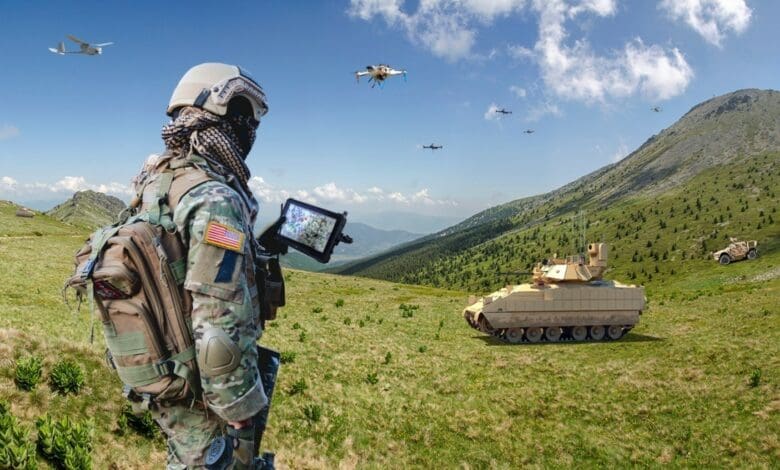
Switchblade loitering munitions are essentially a combination of a reconnaissance drone and guided missile.

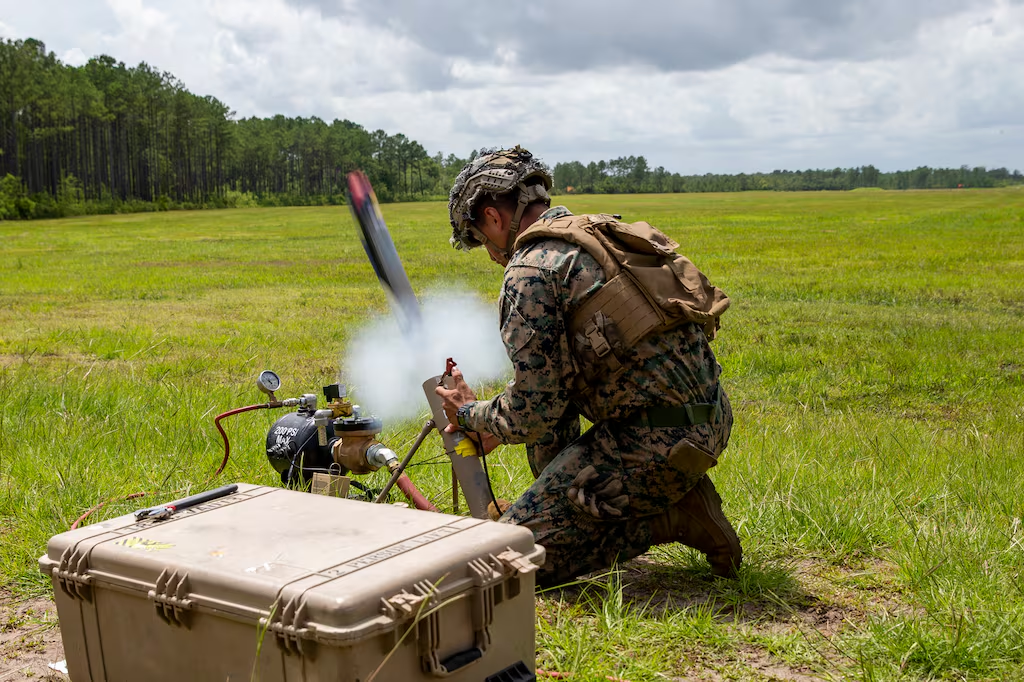
The smaller Switchblade 300 is small enough that a soldier can carry several in a backpack, set up its launching tube within a few minutes, and fire it off, with its folded wings snapping out like its namesake knife.

The soldier would then fly the 5.5-pound Switchblade 300 up to 10 kilometers, or about 6 miles, sweeping the area with the munition’s camera and looking for a target.

Let’s Advance Your Mission

Product Catalog

View the full catalog to explore our solutions in detail.