News

Ready for Orbit: BlueHalo Announces Breakthrough in Long-Haul Laser Communication Capabilities

03/20/2025

Albuquerque, NM – BlueHalo, the company transforming the future of global defense through mission-critical innovation in the space domain, today announced the successful milestone demonstration of its two-terminal long-haul, multi-orbit laser communication system. The achievement marks a significant breakthrough in the development of space-based laser communication technology with far-reaching implications for national security and commercial sectors.

During the demonstration, two laser communication optical terminals completed pointing, acquisition, and tracking sequences at transmit power levels supporting multi-orbit, space-to-space satellite crosslink amidst simulated challenges experienced in space environments, including jitter, extreme temperatures, and lack of atmosphere.

The demonstration’s success highlights new capabilities for transferring high bandwidth data in space – enabling the secure exchange of more data at a faster rate across further distances, including LEO, MEO, GEO orbits and beyond. With the successful prototype demonstration in an operational environment, BlueHalo has matured its optical communication terminals to Technology Readiness Level (TRL) 6.

“I’m incredibly proud of our team, whose dedication to the mission has led to this milestone – developing a space-based laser communication capability that is orders of magnitude greater than existing technology on orbit today,” said Mary Clum, President of the Product & Space Systems Portfolio. “With the technology validated, BlueHalo is ready to begin quickly producing these advanced optical terminals for deployment on satellites across all echelons of space. It’s an urgent need to enhance our nation’s security posture – in space and on the ground – and support the rapidly accelerating demand for rapid transport of high-bandwidth, mission-critical data. We’re ready.”

BlueHalo’s laser communication terminals are suitable for both national security operations and commercial satellite bus providers, offering a longer range, greater accuracy, and higher reliability for free-space optical communications. The capability builds upon and advances systems previously developed and deployed by BlueHalo, many of which remain on orbit today.

###

About BlueHalo

BlueHalo is purpose-built to provide industry-leading capabilities in the areas of Space, C-UAS and Autonomous Systems, Electronic Warfare & Cyber, and AI/ML. The company develops and brings to market next-generation capabilities to support customers’ critical missions and national security. Learn more at http://www.bluehalo.com and follow BlueHalo on LinkedIn.

Let’s Advance Your Mission

Product Catalog

View the full catalog to explore our solutions in detail.

News

BlueHalo Conducts Successful Test Launch of FE-1 Next-Gen C-UAS Missile

03/13/2025

ARLINGTON, VA — BlueHalo, the company transforming the future of global defense with actively deployed and operationally proven Counter-Uncrewed Aerial System (C-UAS) solutions, announced today the successful live fire demonstration of its Next-Generation C-UAS Missile (NGCM)–Freedom Eagle-1 (FE-1), addressing the critical need for munitions industrial base expansion to meet the rapidly evolving advanced aerial threats.

“In light of recent global events, including activities in Europe, the Red Sea and Taiwan, we’re taking a proactive stance–increasing internal investments to advance our FE-1 system and leaning in to meet the demand signal on an expedited timeline,” said Jonathan Moneymaker, BlueHalo Chief Executive Officer. “Our investments and development progress, including this successful CTV test launch, underscore BlueHalo’s dedication to addressing evolving threats and ensuring that warfighters have access to critical capabilities sooner rather than later.”

During the first Controlled Test Vehicle (CTV) live fire demonstration held in January at Yuma Proving Ground, Team BlueHalo conducted three missile test flights. In each of the three tests, FE-1 launched successfully and performed its flight as planned, affirming BlueHalo’s commitment to a rapid development schedule. The team collected video, system and sensor data logs, radar tracks, and RF diagnostics data from each flight test to evaluate the missile’s guidance, navigation, and control systems and analyze aerodynamic models to drive down significant technical risk associated with the program.

“Going three for three on the first ever launch during the development of a new kinetic missile program is an astounding engineering feat and a testament to our team’s incredible dedication and expertise,” said James Batt, BlueHalo Chief Growth Officer. “FE-1 is a superior solution to address critical gaps in our nation’s C-UAS and air defense arsenal. We are thrilled to get it one step closer to the frontlines, where it will protect our warfighters and ensure mission success.”

The recent demonstration is the latest in a string of FE-1 milestones, highlighting its rapid development timeline:

Last June, BlueHalo announced its selection as one of two vendors chosen to continue development of the NGCM by the U.S. Army Combat Capabilities Development Command Aviation & Missile Center (CCDC AvMC) Aviation & Missile Technology Consortium® (AMTC).

In August, the company announced the completion of multiple rounds of testing for the FE-1, including the successful firing of its dual-thrust, solid rocket motor.

In December, BlueHalo successfully completed warhead detonation testing, which collected impact data against simulated targets. Test data included penetration depths, velocities, impacts, and panel frag patterns, which will be used to confirm FE-1’s lethality predictions and support continued warhead development.

“While competitors in the NGCM program remain focused on conceptual presentations, BlueHalo is actively building and testing flight hardware,” said Batt. ” Team BlueHalo went from paper design to first flight in 107 days, demonstrating incredible innovation and a commitment to the NGCM program. This success not only indicates our readiness but also significantly reduces the technical and schedule risks associated with the NGCM program.”

BlueHalo’s continued investment and acceleration in the development of FE-1–with a planned customer live-fire demonstration in 3Q 2025–is in response to legislative affirmation to this capability is a priority of growing importance. In the recently passed FY25 National Defense Authorization Act (NDAA).  FE-1 is a critical response to the evolving UAS threat landscape. Supported by Congressional oversight, significant budgetary allocations, and the recognition of current system limitations, it addresses the need for enhanced range, lethality, and adaptability. This missile ensures a layered, cost-effective defense strategy, protecting national security interests against increasingly sophisticated drone threats.

“It’s clear that the new administration wants middle-tier acquisition going faster and fielding technology quicker,” said Moneymaker. “Additionally, Congress is supportive of additional effectors to get longer range, at higher altitudes, against a threat that is evolving faster than we can keep pace with current systems. We’re moving at the speed necessary to meet the need, even if it requires our own internal funding to make it happen.”

BlueHalo’s FE-1 is designed to counter larger UAS (Group 3 and above) with enhanced maneuverability, range, and rapid launch capabilities. This addresses the limitations of current systems, which cannot effectively engage advanced, larger drones.  It rapidly and affordably enhances warfighter lethality, survivability, and combat effectiveness, providing an agile and disruptive new technology to the munition industrial base and expanding national security air defense capabilities.

###

About BlueHalo

BlueHalo is purpose-built to provide industry-leading capabilities in the areas of Space, C-UAS and Autonomous Systems, Electronic Warfare & Cyber, and AI/ML. The company develops and brings to market next-generation capabilities to support customers’ critical missions and national security. Learn more at http://www.bluehalo.com and follow BlueHalo on LinkedIn.

Domains

Capabilities

Let’s Advance Your Mission

Product Catalog

View the full catalog to explore our solutions in detail.

News

AeroVironment introduces customizable AI UAV to the battlefield: Weapon of the Week

12/11/2024

AeroVironment, a leading defense contractor based in Virginia, had a bustling 2024. Known for designing and producing unmanned aerial vehicles (UAVs), the company saw significant milestones this year.

In May, AeroVironment’s Switchblade 600 loitering munition system was selected for Tranche 1 of the Department of Defense’s Replicator Initiative. By June, these systems were already deployed and in the hands of American troops.

Let’s Advance Your Mission

Product Catalog

View the full catalog to explore our solutions in detail.

News

NASA and Partners Scaling to New Heights in Air Traffic Management

10/18/2024

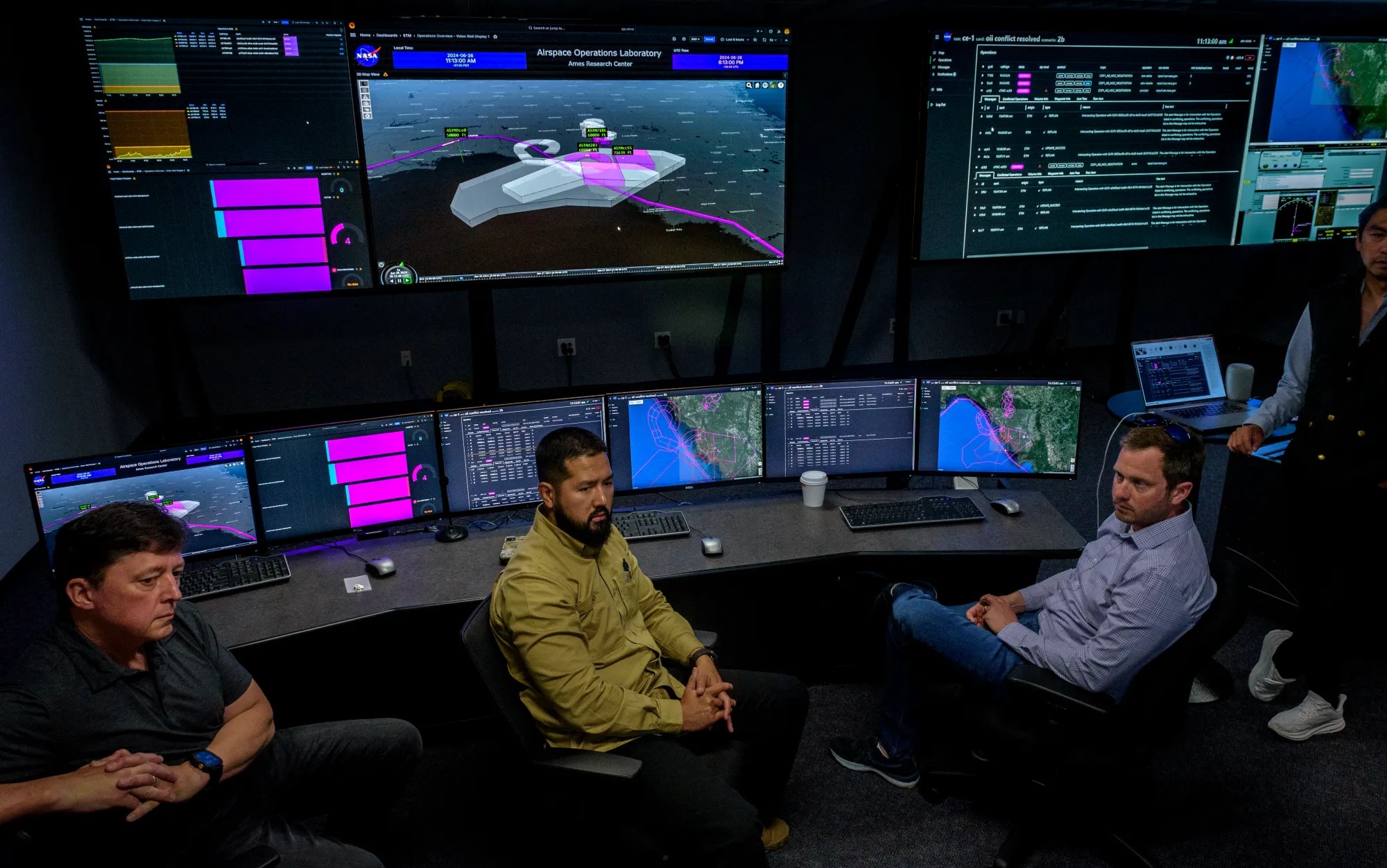
NASA and partners from Aerostar and AeroVironment discuss a simulation of a high-altitude air traffic management system in the Airspace Operations Lab at NASA’s Ames Research Center in California’s Silicon Valley. NASA / Don Richey

NASA, in partnership with AeroVironment and Aerostar, recently demonstrated a first-of-its-kind air traffic management concept that could pave the way for aircraft to safely operate at higher altitudes.

This work seeks to open the door for increased internet coverage, improved disaster response, expanded scientific missions, and even supersonic flight. The concept is referred to as an Upper-Class E traffic management, or ETM.

Let’s Advance Your Mission

Product Catalog

View the full catalog to explore our solutions in detail.

News

Leonardo DRS and BlueHalo Successfully Demonstrate New Counter-UAS Directed Energy Stryker, Shooting Down Drones in Live-Fire Engagement

10/14/2024

ARLINGTON, VA — Leonardo DRS, Inc. (NASDAQ: DRS) and BlueHalo announced today the successful live-fire demonstration of a new Counter Unmanned Aircraft System (C-UAS) Directed Energy (DE) Stryker designed to defeat Group 1-3 UAS with multiple kinetic and non-kinetic defeat technologies.

During last month’s demonstration for U.S. Army officials in Socorro, N.M., the mobile C-UAS capability successfully destroyed numerous drones using BlueHalo’s 26kW LOCUST Laser Weapon System.  Additionally, the demonstration included near-simultaneous C-UAS and ground engagements with the laser and a 30mm remote weapon station (RWS).  The C-UAS DE Stryker successfully destroyed every drone over the two-day demonstration.

Leonardo DRS has deep experience in developing, integrating, and fielding mobile air defense and C-UAS solutions for the U.S. Army. The demonstration is the latest step in a process that started with the company identifying the need for a directed energy multi-layered mobile C-UAS system built around best-of-breed technologies from strong partners.

“In just eight months, Leonardo DRS and our outstanding industry partners designed, built, and tested this Stryker-based Directed Energy Counter-UAS prototype.  We were able to move quickly by leveraging DRS’s proven experience building a cohesive team of partners to rapidly deliver air defense capabilities to the Army,” said Aaron Hankins, Senior Vice President and General Manager of Leonardo DRS Land Systems.  “Our C-UAS Directed Energy Stryker is a future capability available to warfighters today, and we’re excited to display it during the 2024 AUSA Annual meeting.”

The Stryker includes two primary kinetic effectors – EOS Defense Systems’ USA R400 30mm RWS with Northrop Grumman’s XM914 cannon and BAE Systems’ 2.75” Advanced Precision Kill Weapon System fired from an Arnold Defense launcher.  The on-board radar is DRS’ RPS-92 nMHR which provides long-range detection, continuous tracking, and weapon system cueing.   As the lead vehicle integrator, DRS Land Systems worked across the coalition to integrate their “best-of-breed” technologies.

Non-kinetic effectors include BlueHalo’s LOCUST LWS, which is stored inside the Stryker and deployed when a threat is detected. The 26-kilowatt LWS combines precision optical and laser hardware with advanced software and processing to enable and enhance the directed energy “kill chain”.  It tracks, identifies, and defeats Group 1-3 UAS and other threats.  In addition to the LOCUST LWS, the Stryker employs BlueHalo’s Titan C-UAS™ and Titan-SV non-kinetic technologies, delivering comprehensive 360° surveillance and threat detection and mitigation of Group 1 and 2 drone threats.

“BlueHalo’s LOCUST Laser Weapon System is operationally deployed, proven, and trusted. Its modularity and ease of integration across platforms makes it a great fit for the Stryker armored vehicle,” said Mary Clum, BlueHalo Portfolio President and Corporate Executive Vice President. “BlueHalo is thrilled to lean forward with our partners at Leonardo DRS and the incredible coalition of industry leaders that has come together. Our unique combination of operational know-how and innovation has enabled us to rapidly develop a critical capability that directly addresses the challenges our warfighters are facing daily in contested environments. We are excited to share this progress with customers and roll these systems out to the frontlines in support of our nation’s most critical missions.”

The C-UAS DE Stryker provides soldiers with the mobility, firepower, and protection required to maneuver, fight, and survive at the tactical level in contested environments. The Stryker has enhanced lethality to defeat ground and air threats, and it is fully integrated with the US Army’s Forward Area Air Defense Command and Control (FAAD C2) network, ensuring it is interoperable with other Air Defense systems.

The new C-UAS DE Stryker brings together best-of-breed technologies from a coalition of industry partners. In addition to Leonardo DRS and BlueHalo, the coalition includes EOS Defense Systems USA, Northrop Grumman, BAE Systems, Digital Systems Engineering, Arnold Defense, and AMPEX.

###

About Leonardo DRS

Headquartered in Arlington, VA, Leonardo DRS, Inc. is an innovative and agile provider of advanced defense technology to U.S. national security customers and allies around the world. We specialize in the design, development and manufacture of advanced sensing, network computing, force protection, and electric power and propulsion, and other leading mission-critical technologies. Our innovative people are leading the way in developing disruptive technologies for autonomous, dynamic, interconnected, and multi-domain capabilities to defend against new and emerging threats. For more information and to learn more about our full range of capabilities, visit www.LeonardoDRS.com.

About BlueHalo

BlueHalo is purpose-built to provide industry-leading capabilities in the areas of Space, C-UAS and Autonomous Systems, Electronic Warfare & Cyber, and AI/ML. The company develops and brings to market next-generation capabilities to support customers’ critical missions and national security. Learn more at http://www.bluehalo.com and follow BlueHalo on LinkedIn.

Domains

Solutions

Let’s Advance Your Mission

Product Catalog

View the full catalog to explore our solutions in detail.

News

AV Secures $54.8 Million Contract Modification for Switchblade Loitering Munition Systems

10/09/2024

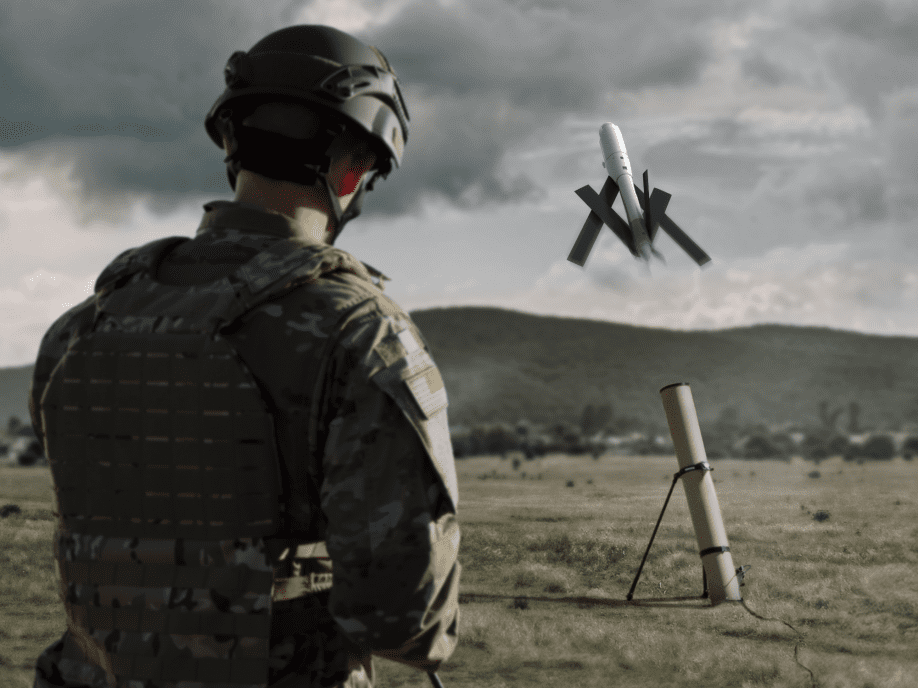
Switchblade Launch

AeroVironment (AV), a global leader in intelligent, multi-domain robotic systems, announced today that the U.S. Army has awarded a $54.8 million contract modification for the production of Switchblade® loitering munition systems. This modification, issued as part of a broader indefinite delivery, indefinite quantity contract, ensures continued support for both the U.S. Army and several allied partners, including Lithuania, Romania, and Sweden.

Work on this contract will be performed in Simi Valley, California, with an estimated completion date of June 30, 2026. The award, which leverages fiscal 2023 and 2024 Army funds along with Foreign Military Sales, highlights AV’s ongoing commitment to delivering proven, battlefield-ready technology that meets the evolving needs of modern armed forces.

“This contract modification allows us to continue delivering Switchblade systems to the U.S. Army and allied partners at speed with upgraded capabilities based on real-time battlefield feedback,” said Brett Hush, AV’s senior vice president and general manager of Loitering Munition Systems. “We are honored to provide the U.S. Army and our international partners with battle-proven technology.”

AV remains focused on providing warfighters with superior, reliable, affordable systems at scale to meet the evolving requirements of its global defense customers.

Let’s Advance Your Mission

Product Catalog

View the full catalog to explore our solutions in detail.

News

BlueHalo Accelerates Production for USSF SCAR Program with Key Supply Chain, Manufacturing Automation Investments

09/10/2024

BlueHalo Accelerates Production for USSF SCAR Program with Key Supply Chain, Manufacturing Automation Investments

ARLINGTON, VA — BlueHalo, the company transforming the future of global defense by modernizing satellite operations, announced today its expanded supply chain and manufacturing investments to support the U.S. Space Force (USSF) Space Rapid Capabilities Office (RCO) Satellite Communication Augmentation Resource (SCAR) program. These investments will ensure quality and reduce both risk and cost for customers while enabling BlueHalo to manufacture and deliver an increasing number of its BADGER ground terminal systems. Together with Space RCO, BlueHalo is building a more resilient space architecture to maintain our national security posture in an increasingly contested, congested and competitive space domain.

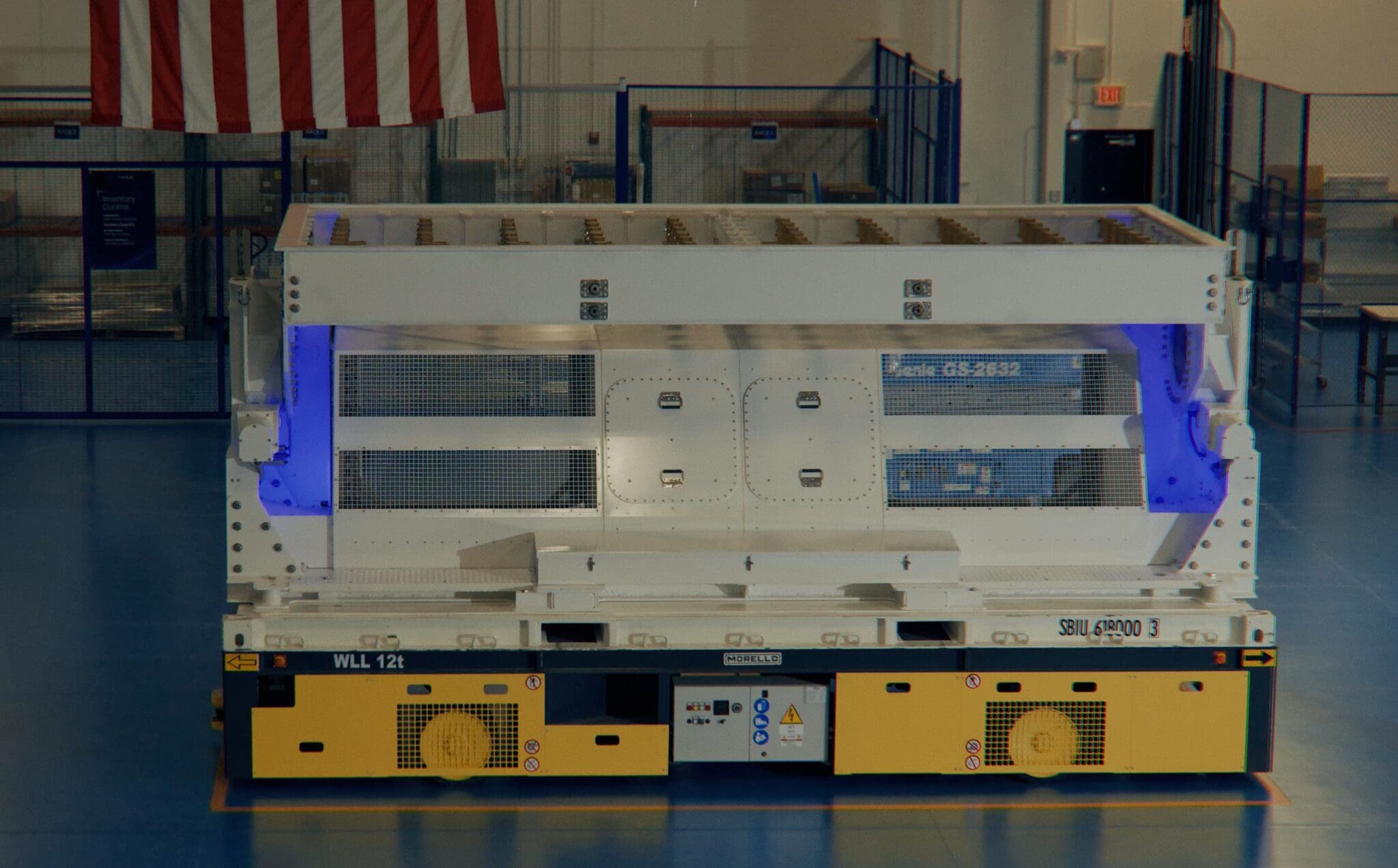
To expand production capacity, BlueHalo has invested in automated testing capabilities within its state-of-the-art manufacturing campus in Albuquerque, New Mexico. The integrated testing technology allows for large-scale testing to be completed within days as opposed to a full month required for manual testing–reducing production timelines, lowering labor and facility costs, and providing more reliable and consistent quality across production.

“BlueHalo is investing in innovation that is transforming our nation’s space communications capabilities, but it doesn’t end there,” said Mary Clum, BlueHalo Portfolio President and Corporate Executive Vice President. “Our strategic investments in automation and robotics on the manufacturing lines are expanding our ability to produce at scale and meet the demands of the future while maintaining high standards of affordability, safety, and quality. Side-by-side with Space RCO, we are incredibly proud of the work we have done to reduce costs and risk while delivering one of the most critically urgent national security priorities of our time.”

BlueHalo is also driving delivery of the SCAR program with supply chain investments, pre-purchasing integral components with long lead times to prepare for increased production and take advantage of economies of scale. Key suppliers have adopted similar early purchasing strategies for enhanced supply chain alignment across the SCAR program–providing further cost and schedule savings and reduced risk for the customer.

“The SCAR Program will significantly enhance our satellite communication capabilities. By leveraging cutting-edge technology, we’re not only increasing capacity but also building a more resilient and responsive network,” said Dr. Kelly Hammett, Director of the Space Rapid Capabilities Office. “Developing these capabilities ensures Space Force is equipped to face global challenges in a contested space environment.”

BADGER is a multi-band, deployable ground communications system built upon BlueHalo’s core MSDA technology, a scalable phased array solution that simplifies mission operations through agile and re-configurable beamforming tiles. The SCAR program, announced in May of 2022, covers initial design through full-rate production of BADGER to deliver a fleet of transportable, ground-based phased-array antennas. Other primary components of the SCAR program include the development and delivery of accompanying ground electronics and software to provide robust, flexible communications capabilities for USSF satellites.

BlueHalo previously announced other key program milestones, including the USSF Guardian orientation held earlier this year and the successful demonstration of BADGER’s satellite tracking and signal processing last fall. The program is planning for initial delivery in 2025.

Domains

Solutions

Let’s Advance Your Mission

Product Catalog

View the full catalog to explore our solutions in detail.

News

AeroVironment’s Tomahawk Ecosystem Unifies Command and Control

07/10/2024

AeroVironment’s Tomahawk Product

Let’s Advance Your Mission

Product Catalog

View the full catalog to explore our solutions in detail.

News

With AI and computer vision, almost any platform can be autonomous

06/18/2024

The use of computer vision and perceptive autonomy can have a profound impact on speeding the Observe, Orient, Decide and Act (OODA) loop.

Adding these technological capabilities to robotic systems of all sorts will completely change the way analysts work with sensor feeds and images. We discussed this boon to autonomy with AeroVironment’s Scott Newbern, vice president and chief technology officer, and Timothy Faltemier, vice president and general manager of Learning and Active Perception (LEAP).

Let’s Advance Your Mission

Product Catalog

View the full catalog to explore our solutions in detail.

News

Excited by Ingenuity: Mars helicopter model demonstration wows Flory Academy students

05/02/2024

Ingenuity: Mars helicopter model

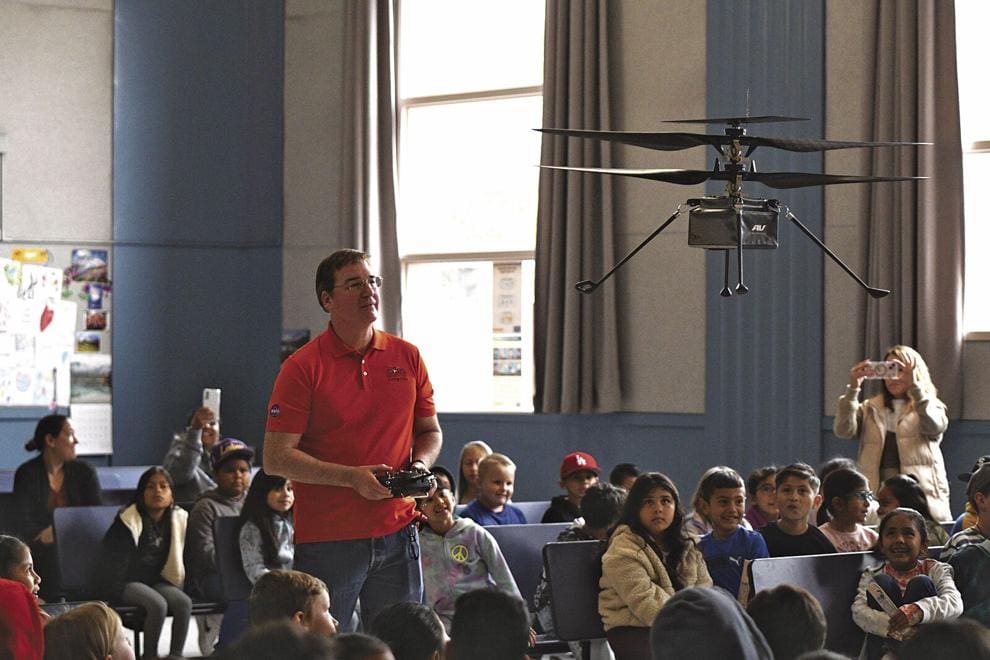
Students at a Moorpark school may be inspired to dream of careers in the aerospace industry after witnessing an exciting demonstration of a remote-controlled helicopter similar to the first one to ever fly over the planet Mars.

Students at a Flory Academy of Sciences and Technology assembly watched an April 23 demonstration of an identical model of the Ingenuity Mars Helicopter which was deployed above the red planet in 2021.

Let’s Advance Your Mission

Product Catalog

View the full catalog to explore our solutions in detail.

News

Inflection Point: Increasing the Global Military Prowess Gap

04/29/2024

Inflection Point: Increasing the Global Military Prowess Gap

A recent report highlighted the disturbing fact that the militaries of Russia and China now follow closely behind the United States in terms of military prowess. The Global Firepower rankings were determined by a variety of factors, including but not limited to troop numbers, military equipment, and available resources. The bottom line is that our near-peer adversaries are trailing closely behind in their military capabilities, and if we do not put the necessary investment into further strengthening our defense industrial base, our national security will be put at risk. Rather than scaling back, the U.S. needs to invest in, develop, and field disruptive capabilities to increase the military prowess gap, and maintain its military superiority and global leadership.

Thanks to ongoing collaboration between industry, DoD and Congress, we feel confident in the direction the U.S. defense industry is heading – namely, embracing innovative new ideas and working together to overcome perceived and real obstacles to strengthening our national defense.

Recent statements by top Pentagon officials have demonstrated that autonomous systems are becoming a major part of military strategy for both the DoD and our allies. AeroVironment (AV) is the leader in autonomous systems and has delivered reliable, high technology readiness level (TRL), combat tested autonomous systems for over three decades. Our autonomous portfolio includes solutions ranging from stratospheric aircraft to submarine-launched loitering reconnaissance systems, to loitering munitions, to ground robots, and the command-and-control architecture to operate them all.

AV and companies like AV can be instrumental in widening the military prowess gap between the U.S. and our adversaries. Low inventories of fielded systems within the DoD put the U.S. at risk of falling behind in various theatres across the globe. Current and emerging conflicts such as in Ukraine, Israel and Taiwan demonstrate the necessity of reliable, fielded systems available to support from U.S. stockpiles to shore up defenses and maintain a tactical and operational edge on the battlefield. Delays in both contracting and funding are hampering efforts to meet the current threat environment.

Urgency is high across the globe and so is priority of our systems. In an effort to stay ahead of global threats, AV has invested heavily in increasing our production capacity, and we continue to build on this to surpass the current and future demand expectations of our customers.

AV has the manufacturing capacity to deliver distributed intelligent autonomous platforms for warfare at scale today, not tomorrow. We can produce tens of thousands of units at the level of rigor and performance the DoD and our allies have come to expect. We’ve delivered thousands of Switchblades in the last two years alone and believe that we’re the only company that can produce loitering munitions at that rate today. Additionally, we’re looking into new sites, facilities and expansion plans to go above and beyond current abilities.

Our book-to-build timeframe is very fast – a perfect example is when we delivered our first order of Puma UAS for the Ukraine war within 27 days. Our lead times are typically 90 days and we’re continuing to invest in our processes to continue this upward trend. Demand for our solutions is robust across the globe and we’re ready and qualified to rapidly deliver capabilities to warfighters.

By level loading our factories’ production throughout the year, we have achieved greater operational efficiencies while expanding throughput. AV has demonstrated market-leading manufacturing capacity for autonomous systems, and we continue to invest in facilities, people and processes to prepare for even greater demand in the future.

The world is at an inflection point, and the U.S. must be ready and willing to embrace the paradigm shift from traditional battlefield systems toward a distributed autonomous portfolio and affordable loitering munitions to increase operational efficiency. Partnering with companies that provide these disruptive technologies is instrumental in ensuring our troops are appropriately equipped and can be the key to unlocking battlefield superiority across the globe.

Let’s Advance Your Mission

Product Catalog

View the full catalog to explore our solutions in detail.

News

The Ongoing Triumph of Ingenuity

04/22/2024

The Ongoing Triumph of Ingenuity
By William Pomerantz, AeroVironment

This is my love letter to Ingenuity.

I remember when I first heard about the concept of a small helicopter designed to catch a ride with a rover bound for the Martian surface. At the time, my wife worked as part of the ‘Mars Mafia’ at NASA Jet Propulsion Laboratory — a wonderful job that meant she got to bring intriguing ideas and fascinating discoveries home from work regularly. My first reaction to the idea of a Martian drone was a quick sequence: No way! Could that even work? There’s barely any atmosphere there. But could you imagine if it did work? No one has ever seen anything like that before. That would be incredible!

As I learned more about the idea, I marveled at the balance between the simplicity of the overall concept and the complexity of some of the engineering specifics required to make a helicopter fly on a planet where the atmospheric pressure at the surface is only 1% of what it is here on Earth (where it’s already extremely challenging to make helicopters fly!).

While many people, myself included, were wondering what was possible, small teams at JPL and AeroVironment were creating what was possible. A quick, hardware-rich sprint by a team of incredible engineers, technicians, and project managers allowed the Ingenuity Mars helicopter project to be completed on schedule– words we too rarely get to say in the world of space exploration.

As the landing date for Perseverance and Ingenuity approached, I asked my JPL friends for their guesses as to how many times the helicopter would fly. By far the most common answer was that it would never make it off the ground in one piece. Another subset of people thought Ingenuity might fly once or twice.

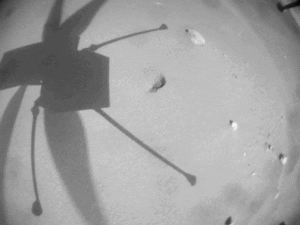
After the nerve-wracking deployment of the helicopter from under the belly of Perseverance, followed by a few weeks of wiggling rotors and commissioning the vehicle, the world was treated to what you see in this GIF: the first aircraft to perform powered, controlled flight on a planet other than Earth.

This was a “Wright Brothers moment,” happening in our lifetimes, on another world. The impossible becoming possible. A new mode of peaceful exploration, coming online right before our eyes, in glorious full-color video.

Over the next three Earth years, Ingenuity would go on to surpass every expectation. From an initial target of five flights and 30 Martian days (sols), Ingenuity achieved 72 flights and about 1,000 sols. Ingenuity flew higher, faster, and further over more hazardous terrain than ever imagined. It returned first-of-its-kind images of the Perseverance rover, its backshell, and more. It gave us up-close images of Martian vistas that we’re currently unable to explore by rover or with orbiters. The little helicopter that could survived a Martian winter with barely any damage. Every day, every flight, every image brought us precious new knowledge and expanded the horizons of humanity’s understanding of our closest planetary neighbor.

Along the way, some of the rover-centric teammates who had first seen Ingenuity as a distraction came to view the helicopter as an incredible new tool. The operations team is constantly faced with deciding between sending the rover to explore the most interesting territory and avoiding those same areas if the landscape might damage and strand the rover. It’s a tension that the JPL team is extraordinarily good at managing – but a tension nonetheless.

About sixty flights into Ingenuity’s planned five-flight mission, I had the great honor of joining AeroVironment to run the team responsible for our contributions to Ingenuity and the next generation of Mars helicopters. Ingenuity was still in excellent condition and was responding to every new challenge we gave it, making aerial exploration of Mars seem almost easy. But still, as we started what was effectively our twelfth victory lap after a race well run, we knew that every day Ingenuity phoned home was a gift.

As I got to know the team at AeroVironment and as I became reacquainted with the JPLers on the mission, one of the questions I asked was how people would like to see the mission end. We all wanted to see Ingenuity complete as many flights as possible; but I wanted to hear what the people who quite literally built Ingenuity thought. Should Ingenuity earn a quiet retirement in some picturesque location? Or should we push the edges of the envelope until at last we ask Ingenuity to do something it can’t manage, and see it fail in flight?

I received a range of strongly-held responses to my question, but the overwhelming majority of the Ingenuity team was aligned. They reinforced that this mission was designed as a technology demonstration, and the best way to honor the spirit of Ingenuity was to ensure that the vehicle kept teaching us new things about flight on Mars, right up to the end. If the choice ever became stand down or keep pushing, the team wanted to keep pushing.

And that’s exactly what happened. After more than seventy flights, we encountered a technical challenge that was simply beyond Ingenuity’s capabilities. The helicopter’s visual navigation system couldn’t distinguish the features of a very monotonous landscape well enough to consistently track them. Lacking that information, the vehicle essentially became confused about where it was and where it was going. As it descended, it may have begun to chase its own shadow.

At some point during the flight and landing, Ingenuity sustained significant damage to its rotor blades; and yet, somewhat miraculously, it survived that landing and came to rest upright on the Martian surface. Ingenuity is still alive and sending home data from its onboard systems – something it may continue to do for years to come. Perhaps if the Perseverance rover drives back by Valinor Hills Station (Ingenuity’s final airfield, named for Tolkien’s Undying Lands), Ingenuity will be able to phone home again and relay years’ worth of weather data to scientists on Earth. But unfortunately, it will never fly again.

Seventy-two flights. More than two hours of flying time. Over 1,000 sols after arriving on Mars. Eleven miles (17.7 kilometers) covered.  All this from a helicopter that weathered rocket launch loads, Martian dust storms, and more without a single opportunity for in-person inspection or servicing – something you’d never expect of a helicopter here on Earth. Ingenuity gave us everything we asked for and more.

True to its spirit and its mission, even Ingenuity’s final flights have made us smarter. There’s more yet to learn, but from what I’ve seen, I believe the challenge that grounded Ingenuity will be relatively easy to overcome with future Mars helicopters, thanks to what we’ve now learned. Yes, Ingenuity reached a limit; but that limit can and will be conquered. Flight 72 marked an end, but not the end.

The true conclusion of the Ingenuity mission will come when its hard-earned lessons are next put into practice by another Mars helicopter – one that will be even more ingenuous than its predecessor, thanks to how much wiser we are after seventy-two flights.

AeroVironment has continued to invest funds and time into dreaming up new capabilities for future Mars helicopters. Engineers at AeroVironment, JPL, and NASA Ames are now thinking about helicopters and other aerial vehicles that could someday carry scientific instruments, fetch sample tubes, or explore difficult to access locations such as valleys and lava tubes.

Additionally, elsewhere in the world, others are following Ingenuity’s lead. In 2021, China announced its plans to fly a helicopter on Mars, and more recently, India has revealed more about its plan to fly a Martian helicopter with a variety of weather and atmospheric sensors within the next eight years. With a growing community of international space agencies interested in the exploration of the red planet, helicopters may become an affordable and attractive option for space discovery and diplomacy.

When the Ingenuity mission began, NASA’s leaders often compared it to the Wright Brothers 1903 Flyer – and indeed, Ingenuity carried a small piece of fabric from that historic aircraft to Mars. Now that the Martian equivalent of the Kitty Hawk flight has occurred, the successors to Orville and Wilbur at NASA JPL and AeroVironment are itching to embark on the next great endeavor that will forever change the future of planetary exploration.  Planetary exploration helicopters have made their impact and are here to stay, and those in government, academia and industry who embrace and support the inclusion of these systems in future missions will surely reap the benefits.

Another novel forebearer of Ingenuity is Sojourner, the first successful Mars rover. Like Ingenuity, Sojourner was the lighter, smaller vehicle that hitched a ride with another mission to the red planet. Both programs had small budgets, but delivered huge results.

I believe the impactful legacy of Ingenuity will do for aerial mobility on Mars what Sojourner did for ground mobility: leave such an impactful legacy that at every future Martian launch window, and with every future call for proposals, this new form of exploration demonstrated by Ingenuity is considered a critical enabling technology for future discovery.

As Ingenuity’s flying campaign comes to an end, and as the era of aerial Mars exploration begins in earnest, my hat is off to the people who made this possible, including brilliant NASA and JPL colleagues like Bob Balaram, Charles Elachi, Mimi Aung, Robert HoggBobby BraunTheodore (Teddy) TzanetosHåvard Grip and more, and AeroVironment colleagues Matt Keennon, Benjamin Pipenberg, Sara Langberg, Jeremy TylerJoey Beckman, and more. Humanity’s best machines reflect the care, cleverness, and curiosity of their makers – and with Ingenuity, each of you has proven to be truly world-class.

Let’s Advance Your Mission

Product Catalog

View the full catalog to explore our solutions in detail.