News

AV Welcomes Stephen Voline as Senior Director, Washington Operations

02/11/2026

AV Welcomes Stephen Voline as Senior Director, Washington Operations

ARLINGTON, Va. — February 11, 2026 — AeroVironment, Inc. (“AV”), a global defense technology leader, today announced that Stephen Voline has joined the company as Senior Director of Washington Operations.

Voline will support AV’s engagement with Congress, the Department of War, and key national security stakeholders, advancing the company’s strategic priorities across defense policy, acquisition, and operational readiness.

“Navigating today’s defense environment requires leaders who understand how policy, operations, and technology come together,” said Blake Souter, Vice President, Washington Operations at AV. “Stephen’s depth of experience at that intersection will strengthen our Washington Operations team as we continue to advance critical national security missions and long-term defense priorities.”

Voline brings more than three decades of experience across military operations, defense policy, and industry advocacy, including senior government relations leadership at Hanwha Defense USA, service on Capitol Hill as National Security Advisor to Senator Joni Ernst (R-IA) and 26 years in the U.S. Army.

“I’m honored to join AV at a time when innovation, speed, and strategic clarity matter more than ever,” said Voline. “AV is delivering capabilities that directly support warfighters and national security stakeholders, and I look forward to helping strengthen the company’s engagement across Washington in support of those missions.”

As National Security Advisor to Ernst, Voline advised on defense and foreign policy and helped shape multiple National Defense Authorization Acts, with a focus on soldier readiness, artificial intelligence, intelligence operations, and special operations forces.

As Director of Government Relations at Hanwha Defense USA, Voline led advocacy across Congress and the Administration in support of land systems, munitions, and autonomous platform programs. He advised senior leaders on legislative strategy, helped secure an Enhanced Use Lease agreement with the U.S. Army enabling a $1.3 billion propellant production facility, and facilitated the first significant contract award in Hanwha’s history.

Voline’s distinguished career in the service includes senior intelligence and targeting roles within the Army’s 75th Ranger Regiment, battalion-level operations and intelligence leadership within the 173rd Airborne Brigade Combat Team, and command of a Military Intelligence company supporting global and interagency operations. He deployed multiple times in support of operations in Afghanistan and Iraq and served with elite and interagency organizations. He spent nearly 14 years as an enlisted infantryman, achieving the rank of Master Sergeant.

He holds a Bachelor of Arts in public relations from the University of West Florida and a master’s degree in legislative affairs from George Washington University.

Capabilities

Let’s Advance Your Mission

Product Catalog

Download the full catalog to explore our solutions in detail.

News

AV’s UES Awarded $75 Million Task Order Extending Contract to Advance Biotechnology and Smart Materials for the U.S. Air Force

01/28/2026

AV’s UES Awarded $75 Million Task Order Extending Contract to Advance Biotechnology and Smart Materials for the U.S. Air Force

ARLINGTON, Va. – January 28, 2026 – The United States Air Force has awarded UES, a division of advanced research and development leader AeroVironment, Inc. (“AV”) (NASDAQ: AVAV), a $75 million task order to modernize defense systems through the development of next-generation biotechnology and materials science under the Functional Responsive Experimentation for Systems and Humans (FRESH) program at Wright Patterson Air Force Base in Dayton, Ohio.

Under Task Order 0003 (TO-03), titled “Biotechnology and Biomaterials and Polymers and Responsive Materials, Research, Development, and Exploration,” AV will develop and evaluate new materials, processing methods, and modeling techniques to create advanced polymers and responsive materials that enhance the performance and resilience of Air Force assets across air, space, and weapons systems, expanding the company’s ongoing work with the Air Force Research Laboratory (AFRL).

“We’re entering an era where biology and materials science are converging,” said Dr. John Hogan, Vice President of Defense and Interagency Services at AV. “Our work under this program explores that frontier—creating responsive systems that enhance human performance, reduce maintenance burdens, and ensure operational dominance for the Air Force.”

Over the 60-month period of performance, AV will advance discovery and innovation in biomanufacturing, polymers, and responsive materials—integrating biologically driven methods for material degradation, rare earth extraction, and human–machine teaming with advances in flexible electronics, additive “smart” materials, biomimetic design, and synthetic biology. This work will accelerate the development of adaptive, high-performance materials and biologically inspired systems that reduce lifecycle costs, increase resilience, and maintain the Air Force’s technological edge over adversaries.

Research and development will also leverage artificial intelligence to speed discovery, testing, and environmental evaluation, in order to sustain and optimize mission-critical assets, enhance human performance through cognitive and physiological monitoring, and ensure breakthroughs transition seamlessly from the laboratory to the field to strengthen America’s operational advantage.

“This award reaffirms the trust the U.S. Air Force has placed in AV to push the frontiers of science in service of national defense,” said Johnathan Jones, Senior Vice President of Cyber and Mission Solutions at AV. “Our collaboration continues to demonstrate how applied innovation in biotechnology and materials science can directly enhance operational capability, extend system lifecycles, and safeguard those who serve.”

Let’s Advance Your Mission

Product Catalog

Download the full catalog to explore our solutions in detail.

News

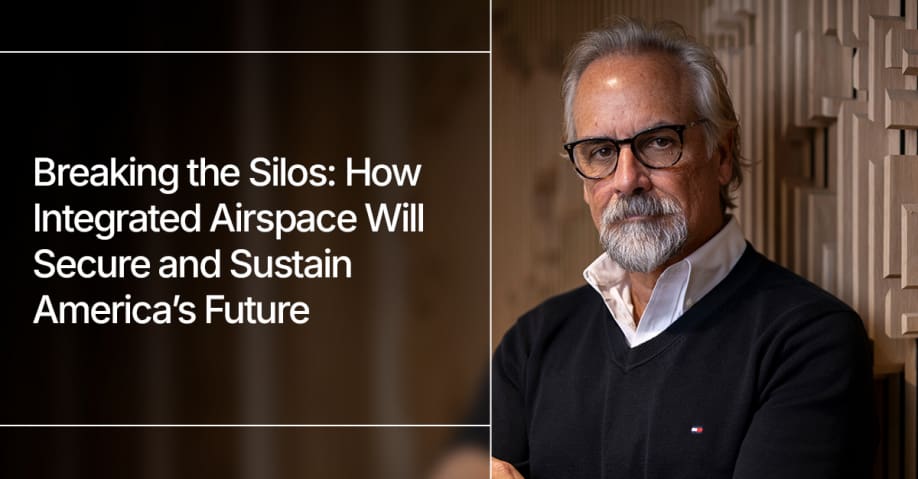
Breaking the Silos: How Integrated Airspace Will Secure and Sustain America’s Future

Stephen Lloyd, Senior Director, C2, Counter-UAS, and Tracking Systems at AV 
Breaking the Silos: How Integrated Airspace Will Secure and Sustain America’s Future

The most transformative leap in aviation will not come from a new aircraft.

It will come from a new way of thinking about airspace itself.

For decades, our skies have been organized in silos, divided by function and ownership – military aviation here, civil aviation there, commercial drones somewhere else, and counter-UAS systems operating in the shadows.

Each domain evolved in isolation with its own systems, protocols, priorities, sensors, rules, and command structures.

That siloed approach delivered progress, but it also introduced risk. When aircraft, sensors, and command systems cannot speak the same language, airspace becomes dangerous, harder to defend, and easier to exploit.

We saw the consequences of that fragmentation in January 2024, when an enemy drone reportedly infiltrated a U.S. military base in Jordan by following one of our own drones through the perimeter in order to attack Tower 22, a logistics outpost near the Syrian border, killing three American soldiers and injuring dozens more. Counter-UAS systems were uncertain whether the enemy drone was friend or foe because there was no shared information set between the base’s air traffic control system and its defensive network.

That tragedy exposed a hard truth: when airspace systems cannot share a common operating picture, even sophisticated defenses can be rendered uncertain by the most rudimentary threats at the worst possible moment.

The same dynamic now threatens civilian airspace at home. Commercial and civil drone activity is expanding rapidly around airports, cities, critical infrastructure, and major events. When a drone appears without clear identification or intent, airports slow or stop operations. Delays cascade. Risks rise. And if intent is malicious, the consequences can be far worse.

If our skies are going to become busier, they must also become smarter—and more integrated.

From Fragmentation to a Shared Airspace Reality

Today’s air traffic systems were designed for crewed aviation. Small uncrewed aircraft often do not appear on traditional radar or Automatic Dependent Surveillance-Broadcast (ADS-B displays). As a result, air traffic controllers frequently learn about potential hazards through slow, late and imprecise visual reports. Meanwhile, counter-UAS systems—often deployed for legitimate protection—may emit effects that air traffic controllers cannot see or account for in real time.

This is not a technology gap. It is an integration gap.

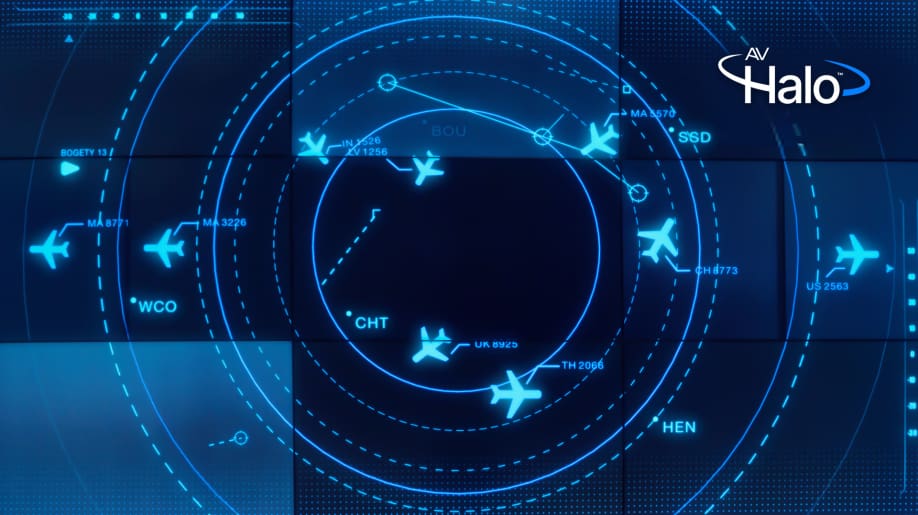
When airspace systems can ingest data from ground radar, ADS-B, commercial sensors, UAS telemetry, and counter-UAS networks, and fuse that information into a single and secure operating picture, the entire dynamic changes. Hazards are detected earlier. Intent is easier to assess. Compliant aircraft fade into the background. Airports keep moving safely and efficiently.

That integrated model is no longer aspirational. It is operational.

That’s exactly what we’re doing in Springfield, Ohio, where we’ve launched a new Beyond Visual Line of Sight (BVLOS) airspace management capability at the National Advanced Air Mobility Center of Excellence (NAAMCE) at Springfield-Beckley Municipal Airport in partnership with the Air Force and Ohio Department of Transportation in collaboration with CAL Analytics.

We are proving that BVLOS operations can be executed safely, predictably, and at scale by routing diverse surveillance and flight data through a unified command-and-control (C2) architecture. The result is a living, real-time view of shared airspace—one that treats crewed aircraft, uncrewed systems, and defensive operations as parts of the same ecosystem.

This is not a demonstration site. Pending regulatory approval, it is an operational blueprint for how airports, states, and federal regulators can manage integrated airspace nationwide.

Ohio is developing sophisticated UAS Traffic Management (UTM) capabilities to safely enable commercial drone delivery and future air taxi operations for companies like Amazon and Uber—where scaling these services depends on collision-free integration with helicopters and other low-altitude aircraft. Getting that integration right does more than improve safety; it opens the door to meaningful economic growth and provides a practical blueprint for managing the increasingly crowded skies communities across the country will soon face.

A New Model for Shared Airspace, Our Approach

The expansion of BVLOS operations depends on Ground-Based Detect and Avoid (GBDAA) and space-based surveillance working in concert with existing air traffic infrastructure.

1. GBDAA systems monitor the airspace using ground and satellite-based sensors and provide real-time situational awareness and maneuver guidance to UAS operators, significantly reducing the risk of collisions. 

2. GBDAA can complement or provide an alternative to onboard systems, offering broader surveillance capabilities and covering larger operational areas. 

3. GBDAA systems can leverage existing Air Traffic Control infrastructure and Commercial Off the Shelf Sensors (COTS) sensors, as a cost-effective, scalable solution for further integrating drones into the National Airspace System. 

By integrating federal and local surveillance feeds, flight intent data, and environmental information into a common platform—AV_Halo™ COMMAND (C2 system) and CAL Analytics’ Advanced Air Mobility (AAM)—operators can safely separate aircraft, avoid conflicts, and transition from segregated to fully integrated airspace operations.

What makes this approach novel is the paradigm shift to a modular, data-driven architecture designed to seamlessly distribute real-time information across a scalable set of interrelated airspace services.

This is how we’ve broken out of the silos and stove-pipes, allowing multi-sensor tracking and fusion to provide the situational awareness needed to detect, classify, and track crewed and uncrewed aircraft across wide areas, while the airspace-management layer translates that awareness into coordinated separation, alerting, and oversight across jurisdictions.

This integrated architecture allows Ground-Based Detect and Avoid to function as a true enabler of scaled BVLOS operations rather than a collection of localized safety tools.

The result is a GBDAA framework that scales from individual operations to regional corridors—supporting safe integration, consistent decision-making, and the data foundation required for broader BVLOS adoption and policy evolution.

From Proof to Policy, Enabling the Economy

This collaboration isn’t theoretical. The AV_Halo COMMAND architecture is already going through operational approvals in Ohio and also in North Dakota, where it will support detect-and-avoid conflict-alerting missions for both military and commercial operators in our work with GrandSKY UAS Flight Operations Center.

GrandSKY serves as a living testbed for integrating military and civilian drone operations into the National Airspace System, leading the Department of War’s Project ULTRA by conducting real-world logistics and cargo flights between military bases to stress-test, validate, and refine UAS traffic management in mixed-use airspace. AV and CAL Analytics’ solutions are also advancing through the FAA’s near-term approval process, undergoing the full rigor of safety risk management review.

Our work in both Ohio and North Dakota is building the data and policy foundations for nationwide BVLOS operations—a future where uncrewed systems can fly beyond the horizon as safely as manned aircraft do today.

These deployments are generating what policymakers need most: real operational data. Data that informs standards. Data that accelerates rulemaking. Data that turns “can we?” into “how fast?”

Living testbeds like Ohio and North Dakota—where military and civilian operations coexist—are shaping the future of UAS traffic management and logistics corridors. They are stress-testing policy in real airspace, not in simulation, and laying the groundwork for national BVLOS integration.

What is at stake is not convenience. It is national resilience.

The ability to defend critical sites, move supplies, support emergency response, and unlock new economic activity depends on shared, resilient airspace infrastructure. Fragmented systems cannot scale to meet that demand. Integrated systems can.

Breaking down the silos between civil and military aviation, between safety and security, between innovation and regulation is no longer optional. It is foundational.

The future of American airspace will be defined not by who owns the sky—but by how well we share it.

About the Author

Stephen Lloyd is a Senior Director, C2 & Tracking Systems at AeroVironment, where he leads development of AV_Halo for air-traffic control, BVLOS drone operations and counter-UAS applications. He retired from the Federal Aviation Administration after a 40-year career, having held senior roles in air traffic operations, safety management systems and the National Airspace System. A former chair of the FAA ATO Safety Committee, he collaborated closely with the National Transportation Safety Board and later joined the Air Force Research Laboratory SkyVision GBDAA team. His contributions have been recognized with awards including the 2019 ATCA Civilian Team Award and the 2020 AUVSI Excellence Award in Technology & Innovation.

Join the AV Mission

AV isn’t for everyone. We hire the curious, the relentless, the mission-obsessed. The best of the best.

We don’t just build defense technology—we redefine what’s possible. As the premier autonomous systems company in the U.S., AV delivers breakthrough capabilities across air, land, sea, space, and cyber. From AI-powered drones and loitering munitions to integrated autonomy and space resilience, our technologies shape the future of warfare and protect those who serve.

Founded by legendary innovator Dr. Paul B. MacCready, Jr., AV has spent over 50 years pushing the boundaries of what unmanned systems can do. Our heritage includes seven platforms in the Smithsonian—but we’re not building history, we’re building what’s next.

If you’re ready to build technology that matters—with speed, scale, and purpose—there’s no better place to do it than AV.

Let’s Advance Your Mission

Product Catalog

Download the full catalog to explore our solutions in detail.

Press Release

AV, Inc. to Present at TD Cowen’s Annual Aerospace & Defense Conference

01/27/2026

ARLINGTON, Va., January 27, 2026 –  AeroVironment, Inc. (“AV”) (NASDAQ: AVAV) will participate in TD Cowen’s upcoming Annual Aerospace & Defense Conference in Arlington, Virginia. AV’s executive vice president and MacCready Works Group General Manager, Jeffrey Rodrian and AV’s Head of Investor Relations, Denise Pacioni, will take part in a fireside chat on February 11, 2026 at 8:30 a.m. ET | 7:30 a.m. CT | 5:30 a.m. PT. The fireside chat will be available by webcast at the times listed above and archived on our website.

Let’s Advance Your Mission

Product Catalog

Download the full catalog to explore our solutions in detail.

News

AV and CAL Analytics Launch Operational BVLOS Airspace Management Facility in Partnership with the U.S. Air Force and Ohio Department of Transportation

AV and CAL Analytics Launch Operational BVLOS Airspace Management Facility in Partnership with the U.S. Air Force and Ohio Department of Transportation

SPRINGFIELD, Ohio – January 27, 2026 – AeroVironment, Inc. (“AV”) (NASDAQ: AVAV), a global defense technology leader delivering software-enabled disruptive autonomous systems, and CAL Analytics, an innovator in advanced airspace management technologies, today announced the completed installation and initial operation of a new Beyond Visual Line of Sight (BVLOS) airspace management facility at the National Advanced Air Mobility Center of Excellence (NAAMCE) at Springfield-Beckley Municipal Airport in Springfield, Ohio.

Initially developed under a Cooperative Research and Development Agreement (CRADA) between the Air Force Research Laboratory (AFRL) and the Ohio Department of Transportation (ODOT), the project now features an upgraded installation that integrates AV_Halo™ COMMAND, AV’s command and control (C2) architecture, with CAL Analytics’ Advanced Air Mobility (AAM) enterprise platform to establish the nation’s premiere test environment and management facility, where Department of War operators can safely conduct BVLOS missions in shared airspace utilizing existing Federal Aviation Administration (FAA) ground radar feeds.

“This installation establishes the blueprint for how airports and states across the country can safely integrate uncrewed aircraft into existing airspace,” said Wahid Nawabi, Chairman, President and Chief Executive Officer at AV. “As the FAA defines the future of BVLOS rule-making, this facility provides the real-world operational data, safety validation, and interoperability framework regulators need. The system we’ve installed in Ohio isn’t just a mock-up or a test site — pending FAA approval it will be an operational and scalable model for nationwide deployment and the foundation for truly integrated air mobility.”

The integration will support flight tests, evaluation, and day-to-day operations by routing AFRL’s access to the FAA’s ground-radar network through AV_Halo™ COMMAND — AV’s modular, software-driven C2 architecture that fuses multiple enhanced sensor feeds, into a single, secure operating picture, giving operators continuous situational awareness for BVLOS mission planning and airspace safety.

“AV_Halo is the connective tissue that turns a collection of sensors, radars, and platforms into a living, breathing airspace system,” said Stephen Lloyd, Senior Director C2, CUAS, and Tracking at AV. “By fusing FAA ground radar, and COTS surveillance sensors into a single, secure operating picture, AV_Halo delivers the assured visibility and machine-speed decision support needed for predictable BVLOS operations—and makes it possible to scale effortlessly from a single site to an entire statewide corridor.”

When combined with CAL Analytics’ AAM enterprise platform, the system unifies radar and advanced DAA into a single real-time airspace view—enabling detect-and-avoid, extending autonomous BVLOS operations with precision and confidence.

“Beyond Visual Line of Sight operations are the key to unlocking the next generation of air mobility,” said Dr. Sean Calhoun, Managing Director of CAL Analytics. “This facility will prove that BVLOS can be executed safely and reliably in shared airspace—and that matters because it sets the foundation for statewide corridors, national standards, and an entirely new layer of transportation infrastructure that will reshape how we move people, goods, data, and critical services across the country.”

Pending full FAA approval, the facility will support local missions and real-time monitoring of UAS activity as AFRL, ODOT, the FAA, AV, and CAL Analytics collaborate to validate airspace-safety technologies, advance air-mobility corridors, drive economic development, and shape national BVLOS rules and integration standards.

Plans are already underway to extend the system to enable corridors between Springfield and Columbus, Ohio, adding new radar sites and expanding detect-and-avoid coverage to support broader BVLOS operations across Ohio and additional sites nationwide.

Let’s Advance Your Mission

Product Catalog

Download the full catalog to explore our solutions in detail.

News

Mission Specialist Wraith Signals AeroVironment’s Next Step in Compact Unmanned Underwater Systems Capability

01/13/2026

Mission Specialist Wraith Signals AeroVironment’s Next Step in Compact Unmanned Underwater Systems Capability

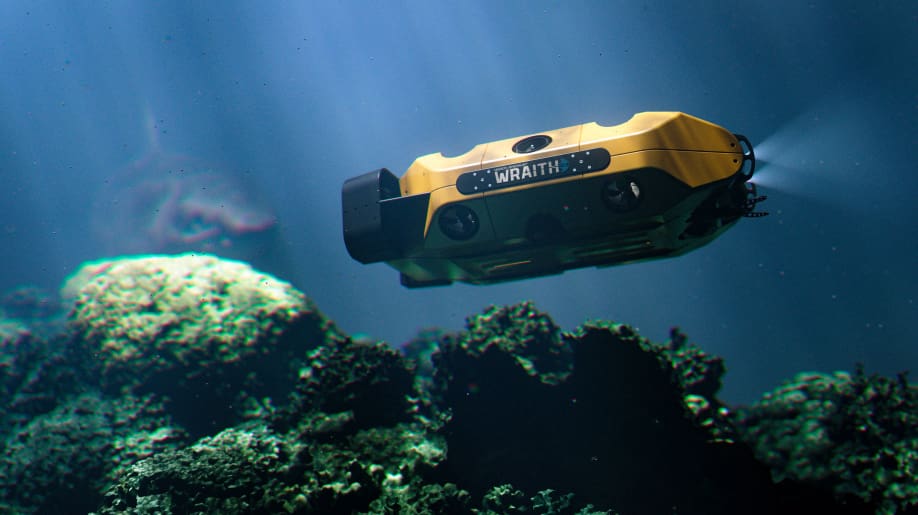
POTTSTOWN, PA — (January 13, 2026) — AeroVironment Inc. (“AV”) (NASDAQ: AVAV), a leading provider of all domain autonomous systems, today announced the launch of the Mission Specialist Wraith, the newest addition to the Mission Specialist Unmanned Underwater Vehicle (UUV) series developed by its wholly owned subsidiary, VideoRay. Designed for demanding subsea operations, Wraith delivers a new level of agility, power, and control in a compact, expeditionary-ready platform.

Engineered for extreme agility and precision in challenging subsea environments, Wraith delivers true six-degree-of-freedom maneuverability through 10 vectored thrusters, allowing it to hold any attitude—vertical, inverted, or fully rolled—while maintaining stability, power, and control in strong currents and at depth. The platform supports a wide range of payloads, including advanced imaging, navigation, and manipulation tools, making it well suited for subsea inspection, defense, and scientific missions.

“Modern operations increasingly depend on access, awareness, and freedom of maneuver below the surface,” said Chris Gibson, Chief Executive Officer at VideoRay. “Wraith gives forces a compact, rapidly deployable system that delivers the precision and control once reserved for much larger vehicles, helping operators extend reach, reduce risk to personnel, and respond faster in complex maritime environments. It expands what compact UUVs can achieve while improving overall mission efficiency.”

Built on VideoRay’s proven open-architecture Mission Specialist design philosophy, Wraith enables rapid reconfiguration, seamless third-party integration, and simplified field serviceability. With up to 80 pounds of forward thrust and simultaneous lift, the platform enables rapid direct-to-target transit and precise station-keeping, even in high-current environments.

The newly released Mission Specialist Wraith Expeditionary configuration marks the first step in a planned spiral development for the product. Future iterations will expand depth capability, payload capacity, endurance, and system flexibility, ensuring the Wraith platform continues to evolve alongside customer requirements and emerging technologies.

Details regarding VideoRay’s Mission Specialist Wraith are available at:
https://videoray.com/products/mission-specialist-wraith

Domains

Capabilities

Solutions

Let’s Advance Your Mission

Product Catalog

Download the full catalog to explore our solutions in detail.

News

From Strategy to Stride, Modernization That Matters: Common Control, Rapid Prototyping, and the Accelerated Training

01/08/2026

Chris Meyers, Col., USMC (Ret)  
From Strategy to Stride, Modernization That Matters: Common Control, Rapid Prototyping, and the Accelerated Training

Not a day goes by in DC without someone grabbing a microphone, stepping to a podium—or settling into a cushy seat on a panel—to declare the need for “more innovation” and a “revitalized industrial base.”

It’s become a ritual without results.

However, with the recent release of the U.S. Department of War’s (DoW) Acquisition Transformation Strategy, we have a real chance to drive meaningful change. It’s more than a political directive; it’s a blueprint for the leaders within the defense industrial base to make it a reality.

Secretary of War Pete Hegseth has just thrown the game-winning pass into the air. Scoring means turning strategy into capability, which hinges on how quickly industry can prepare the operating forces to receive Hegseth’s pass. With DoW and Congress behind this effort, the question becomes simple: how do we continue to move the ball down the field and get it over the goal line? Industry can do that in three ways.

First, we need a true, shared tactical command-and-control backbone across the Services—replacing today’s patchwork of soldier-level controllers and incompatible software that can’t integrate with other Service-level C2 systems.

Second, we need rapid-fire prototyping that puts hardware into soldiers’ hands, rather than abandoning promising tech in the Valley of Death—or worse, shrink-wrapped in warehouses.

Third, we need Field Service Representatives (FSR) who can accelerate the DOTMLPF-P process through hands-on training in the field and by providing feedback to develop doctrine for the force. It’s the process no one budgets for, even though it ultimately determines whether anything reaches the fight or adds any real value once it gets there. (Lay readers: DOTMLPF-P is the framework for planning and building capabilities that aligns new technology with the American way of fighting, policy, resources, training, and manning.)

This is the beginning of a shift from ritual to results, and it’s going to reshape how our troops score touchdowns in the years ahead.

1. Common Control: The New Rifle and Radio

The next war will be fought by squads remotely commanding robotic systems: unmanned ground vehicles hauling gear, drones scouting ahead, loitering munitions circling above… Incredible capability, cognitive overload.

If we expect troops to fight and manage all that tech simultaneously, we need a single pane of glass—one intuitive control platform that feels as natural as a rifle and radio. Common control isn’t about user interface design; it’s about survival under pressure.

Key philosophy is ‘one-to-many.’ There will be a sharp rise in the number of ground, aerial, and maritime robotics systems procured and deployed across the Department.  As the number of systems employed by the soldier increases, we should avoid the desire to give every soldier a controller. One soldier can control a swarm of one-way attack systems while employing the ISR to initiate and close the kill chain. Also, systems that are fully autonomous won’t require ‘control,’ but they will need to be tracked in and out of the battlespace, which is why interoperable software like Android Tactical Assault Kit (ATAK) will be critical.

Programs like the U.S. Army’s Human Machine Integrated Formations (HMIF), under the newly established Portfolio Acquisition Executive Fires (PAE Fires), are pushing in the right direction with modular architectures and open APIs. But let’s stop pretending interoperability can be bolted on later. If a system can’t plug into a common architecture from day one, it shouldn’t make it past the gate.

In the end, command-and-control is the real high ground and the side that seizes it early will shape the fight long before the first shot is fired.

2. Prototype Like You Mean It

Ukraine proved what most of us already knew: Concepts are validated in contact, not in meetings.  

The U.S. can’t wait for perfect requirements or five-year procurement cycles. It needs continuous experimentation, real soldiers, Marines, and special operators running gear hard in dirty conditions, feeding lessons back to designers in real time. Because the truth is brutal: our adversaries iterate faster than our acquisition system, and the first time that gap shows up will be in combat, not a conference room.

We finally have alignment: Congress, the Pentagon, and industry all want faster prototyping. The fix is to make it permanent. Here’s how:

1. Expand Research, Development, Test, and Evaluation (RDT&E) contracts. Fund multiple vendors per capability. 

2. Push prototypes to more units by shifting early S&T funding into applied research for more testing and experimentation. 

3. Take advantage of units the Army, Air Force, and Marines have stood up for this purpose. 

The Army’s Transformation in Contact initiative to adapt its organizations and technologies rapidly and continuously on the modern battlefield is a glimpse of the future: brigades re-organizing on the fly, integrating manned and unmanned assets, building strike companies where scouts, EW teams, and loitering munitions operate as one lethal formation.

We need to embrace that future and put the hardware in the dirt. Let the warfighters break it, tweak it, and own it. That’s how we’ll close the gap between PowerPoint and performance—and how we’ll keep that gap from becoming a battlefield surprise.

3. Bring Back the FSRs (to accelerate fielding)

We used to know how to do this. When M-ATVs and MRAPs rolled into Afghanistan, the only reason they worked was because industry flooded the fight with FSRs. They taught troops how to operate this lifesaving equipment quickly and effectively and kept them in the fight.

Unfortunately, the FSR experience in Iraq and Afghanistan exposed poignant shortcomings of relying on civilian contractors on a battlefield. Today, adding FSRs into a contract can get a bad rap as the Services seek self-reliance in operation and repair of systems.

That’s a valid critique, maintaining equipment at the lower echelons should be a given. But the battlefield we’re preparing for, including autonomy at the edge, open architectures, and rapid software pushes, moves too fast for traditional schoolhouse training to keep up. As we field systems from multiple vendors, ideally all riding on a common control platform, units will be asked to self-train across half a dozen new interfaces at once. Therefore, DoW should embrace FSRs for training and fielding new systems in user-friendly ways so that FSRs are not required to operate those systems in theater. For its part, industry must be ready to provide FSRs early, hit the ground running with new equipment training teams, and turn complex unfamiliar gear into usable combat power on day one.

Vendors need to be prepared to hire and bake FSRs into every major test, experiment, and early fielding event. These embedded experts will accelerate the DOTMLPF-P as they close the loop between design and doctrine, between factory and foxhole.

If a system shows up to a battalion and no one knows how to use it, that’s not on the operator, that’s on the planners, acquirers, and vendors.

CONCLUSION: Modernize the modernization

It’s easy to mock Pentagon flow charts and acronyms like DOTMLPF-P, but those structures exist for a reason: to protect our troops. We can’t just give soldiers new equipment without the opportunity to learn and train. When it comes to combat, brilliance in the basics keeps Americans alive. Rigorous training on common platforms in peace is the operating system of war.

Secretary Hegseth’s pass is already in the air, and for the first time in a long time the field is wide open. If industry leans in now to build common control from the start, push prototypes into the dirt, and embed the experts who turn complexity into confidence, the force will catch that ball at full stride. That’s how we move from strategy to capability, from talking about modernization to living it. This moment is an opportunity disguised as a challenge, and if we seize it, the next generation of warfighters won’t just be better equipped, they’ll be decisively ahead.


ABOUT THE AUTHOR 

Chris Meyers is a Senior Director at AV. He is a retired Marine Colonel who served as an Armor Officer, a Joint Terminal Attack Control (JTAC), Legislative Liaison, and Program & Budget Officer. He deployed to Iraq and Afghanistan, commanded 1st Tank Battalion, and led the Marine Corps’ liaison office to the U.S. House of Representatives.


ABOUT AV — JOINING THE MISSION 

AeroVironment (AV) is a defense technology company with a mission to invent and deliver advantage to U.S. and allied militaries. AV isn’t for everyone. We hire the curious, the relentless, the mission-obsessed.

AV doesn’t just build defense technology; we redefine what’s possible. As the premier autonomous systems company in the U.S., we deliver breakthrough capabilities across air, land, sea, space, and cyber. From autonomy-enabled drones and loitering munitions to integrated autonomy and space resilience, our technologies shape the future of warfare and protect those who serve.

Founded by legendary innovator Dr. Paul MacCready, AV has spent over 50 years pushing the boundaries of what unmanned systems can do. Our heritage includes seven platforms in the Smithsonian—but we’re not building history, we’re building what’s next.

If you’re ready to build technology that matters – with speed, scale, and purpose – come find your people.

Let’s Advance Your Mission

Product Catalog

Download the full catalog to explore our solutions in detail.

Press Release

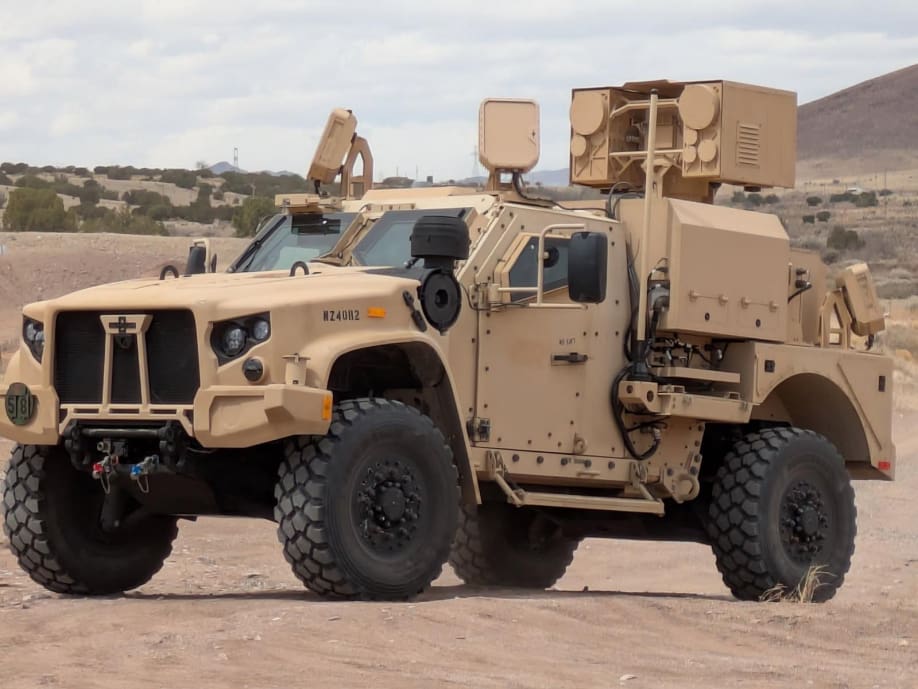
AV Delivers JLTV-Mounted LOCUST Laser Weapon Systems to U.S. Army

12/18/2025

AV Delivers JLTV-Mounted LOCUST Laser Weapon Systems to U.S. Army

ARLINGTON, Va., December 18, 2025 – AeroVironment, Inc. (“AV”) (NASDAQ: AVAV), a leading provider of counter-unmanned aircraft system (C-UAS) technologies, today announced the successful delivery of two Joint Light Tactical Vehicle (JLTV)-mounted mobile C-UAS Laser Weapon Systems (LWS) to the U.S. Army as part of the second increment of the Army Multi-Purpose High Energy Laser (AMP-HEL) prototyping effort. These systems were delivered to the Army’s Rapid Capabilities and Critical Technologies Office (RCCTO), now integrated into the Portfolio Acquisition Executive Fires, reflecting the Army’s ongoing transformation and acquisition reform efforts.

In September, AV announced delivery of the first increment of AMP-HEL prototype systems–two LOCUST LWS integrated on the General Motors Defense Infantry Squad Vehicle (ISV) platform. This second-increment system on the Oshkosh JLTV platform features the same 20kW-class LOCUST LWS with a larger aperture beam director, improving lethality performance.

“AV continues to deliver proven, efficient, modular laser weapon systems that perform and protect in real-world threat environments,” said Mary Clum, President, Space, Cyber & Directed Energy for AV. “Integrated as part of these AMP-HEL systems, LOCUST is a cost-effective, rugged, precise, and scalable solution that is addressing the ever-evolving UAS threats our warfighters are facing on frontlines today. With the technology proven, we remain focused on advancing capabilities while scaling manufacturing to meet the growing demand.”

AV delivered its first LOCUST LWS to RCCTO as part of the Palletized-High Energy Laser (P-HEL) program in 2022. With more than three years of operational deployment outside the United States, these state-of-the-art LWS have demonstrated exceedingly high operational availability rates for prototype systems after first generation lessons learned informed necessary improvements now supporting current technology development efforts. During these deployments, the LOCUST-equipped P-HEL systems, now integrated on AMP-HEL, have performed their designed mission against UAS threats in real world combat.

“Directed energy is no longer a future concept—it is a proven force-protection capability,” said John Garrity, Vice President of AV’S Directed Energy business unit. “Since deployed, LOCUST-equipped P-HEL systems have actively protected warfighters, allies, and critical infrastructure against aerial threats. With LOCUST’s target acquisition, tracking and precision beam control, warfighters have an easy-to-use, reliable, trusted, and proven solution against the very real and evolving threats of modern warfare.”

Designed to be platform-agnostic and rapidly deployable, AV’s directed-energy systems integrate seamlessly with Army command-and-control architectures, providing a critical C-UAS capability that protects Soldiers and assets across a wide range of missions and environments. These systems have been successfully integrated in fixed-site base defense systems and on maneuverable platforms, including the ISV and JLTV, and mounted on the Light Medium Tactical Vehicle for increased mobility.


About AeroVironment, Inc.

AeroVironment (“AV”) (NASDAQ: AVAV) is a defense technology leader delivering integrated capabilities across air, land, sea, space, and cyber. The Company develops and deploys autonomous systems, loitering munitions, counter-UAS technologies, space-based platforms, directed energy systems, and cyber and electronic warfare capabilities—built to meet the mission needs of today’s warfighter and tomorrow’s conflicts. At the core of these technologies lies AV_Halo, a modular, mission-ready suite of AI-powered software tools that empowers warfighters and enables full-battlefield dominance: detect, decide, deliver. With a national manufacturing footprint and a deep innovation pipeline, AV delivers proven systems and future-defining capabilities at speed, scale, and operational relevance. For more information, visit www.avinc.com.


Safe Harbor Statement

Certain statements in this press release may constitute “forward-looking statements” as that term is defined in the Private Securities Litigation Reform Act of 1995. These statements are made on the basis of current expectations, forecasts and assumptions that involve risks and uncertainties, including, but not limited to, economic, competitive, governmental and technological factors outside of our control, that may cause our business, strategy or actual results to differ materially from those expressed or implied. Factors that could cause actual results to differ materially from the forward-looking statements include, but are not limited to, our ability to perform under existing contracts and obtain additional contracts; changes in the regulatory environment; the activities of competitors; failure of the markets in which we operate to grow; failure to expand into new markets; failure to develop new products or integrate new technology with current products; and general economic and business conditions in the United States and elsewhere in the world. For a further list and description of such risks and uncertainties, see the reports we file with the Securities and Exchange Commission. We do not intend, and undertake no obligation, to update any forward-looking statements, whether as a result of new information, future events or otherwise.


CONTACT:

AeroVironment
+1.703.418.2828
pr@avinc.com

Domains

Solutions

Let’s Advance Your Mission

Product Catalog

Download the full catalog to explore our solutions in detail.

Press Release

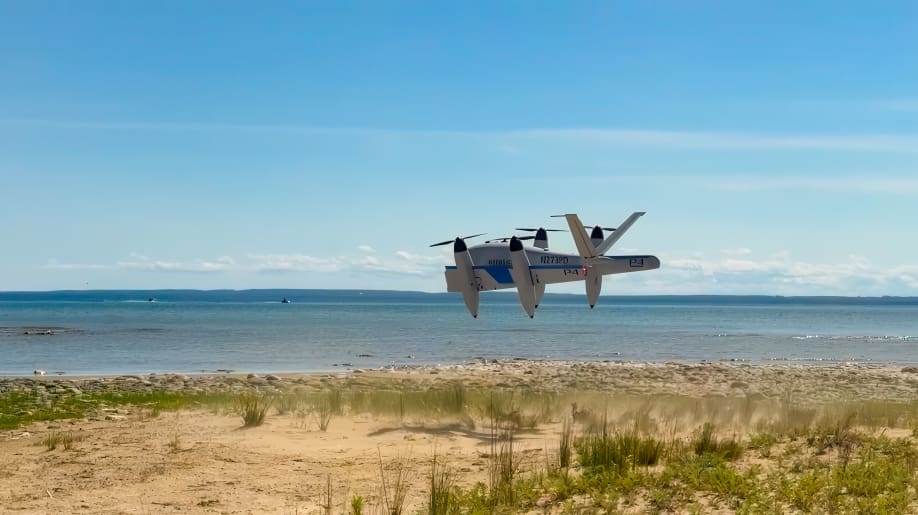
PteroDynamics and AV Demonstrate Integrated EW Capabilities on Transwing® VTOL UAS at U.S. Navy Silent Swarm 25 Exercise

12/16/2025

PteroDynamics and AV Demonstrate Integrated EW Capabilities on Transwing® VTOL UAS at U.S. Navy Silent Swarm 25 Exercise

ALPENA, Mi., December 16, 2025 – PteroDynamics, an innovator in autonomous vertical takeoff and landing (VTOL) aircraft systems, and AeroVironment, Inc. (“AV”) (NASDAQ: AVAV), a leading provider of Electronic Warfare (EW) capabilities, recently collaborated for a joint technology demonstration at Silent Swarm 25, hosted by the Naval Surface Warfare Center (NSWC) Crane Division at the Alpena Combat Readiness Training Center in Alpena, Michigan. The companies integrated multiple industry-leading EW sensors from AV on the PteroDynamics P4 Transwing® autonomous VTOL unmanned aircraft system (UAS), highlighting a spectrum of maneuver capabilities available to warfighters with the combined capabilities.

Equipped with AV’s EW capabilities, the autonomous Transwing VTOL aircraft successfully completed three scenarios in operationally relevant, multi-domain environments–observing, detecting, and effecting various representative threats throughout the theater to inform future U.S. Navy operations for littoral surveillance.

“PteroDynamics’ Transwing VTOL UAS with AV’s EW payloads demonstrated important new capabilities in a realistic and challenging operational environment,” said Tim Whitehand, PteroDynamics vice president of engineering. “We are excited to have worked closely with AV to equip the Transwing with these innovative EW capabilities. The Transwing’s compact footprint, rapid and disturbance-resilient transition, and highly efficient wing-borne flight enable operations from confined or remote locations without runways, making it an ideal platform for maritime littoral operations.”

“Our open, interoperable EW systems are strategically engineered to reduce payload integration timelines for airborne, maritime, and ground ISR platforms, helping us meet unique mission needs with speed and scale,” said Conrad Smith, General Manager of Electronic Warfare Systems at AV. “By participating in events, like Silent Swarm 25, and innovating alongside other industry leaders, like PteroDynamics, we are expanding mission-critical capabilities for the U.S. Navy.”

AV delivers open-architecture EW chassis and sensors to support mission planning and awareness. These tactical solutions are designed and developed for a full spectrum of readiness capabilities, keeping warfighters ahead of global threats with actionable intelligence at the mission’s edge.

PteroDynamics’ Group 3 Transwing platform offers the speed, range, and endurance of fixed-wing systems with superior VTOL performance in a simple, highly efficient autonomous platform. The aircraft unfolds its wings to transition smoothly and quickly between vertical and horizontal flight. It delivers superior VTOL stability and gust tolerance, requires no launch and recovery infrastructure, and occupies one-third or less ground footprint than other VTOL aircraft with a comparable wingspan –   an ideal platform for multi-mission payloads.

During Silent Swarm 25, the Transwing flew from confined launch and recovery zones along the tree line on the shore of Lake Huron, showcasing its inherent expeditionary capabilities and operating envelope, which is unconstrained by wind direction. The team also took advantage of the Transwing’s modular architecture to integrate, and flight test the AV EW payload in a single day.

Transwing Receives FAA Airworthiness Certificate

PteroDynamics received a Special Airworthiness Certificate–Experimental Category (SAC-EC) from the Federal Aviation Administration (FAA) for the P4 Transwing UAS to conduct research and development flights in national airspace near Alpena, Michigan during Silent Swarm 25. Prior U.S. Navy demonstrations were at sea, including those at RIMPAC 2024 and the 2023 Hybrid Fleet Campaign Event.

The SAC-EC allowed PteroDynamics, for the first time, to fly the 89 lb aircraft with an airworthiness certificate in U.S. airspace. The certification review and approval process took over seven months and demonstrated to regulators the maturity and safety of the Transwing and the trust the FAA has in PteroDynamics’ aircraft and processes.


About AeroVironment, Inc.

AeroVironment (“AV”) (NASDAQ: AVAV) is a defense technology leader delivering integrated capabilities across air, land, sea, space, and cyber. The Company develops and deploys autonomous systems, loitering munitions, counter-UAS technologies, space-based platforms, directed energy systems, and cyber and electronic warfare capabilities—built to meet the mission needs of today’s warfighter and tomorrow’s conflicts. At the core of these technologies lies AV_Halo, a modular, mission-ready suite of AI-powered software tools that empowers warfighters and enables full-battlefield dominance: detect, decide, deliver. With a national manufacturing footprint and a deep innovation pipeline, AV delivers proven systems and future-defining capabilities at speed, scale, and operational relevance. For more information, visit www.avinc.com.


Safe Harbor Statement

Certain statements in this press release may constitute “forward-looking statements” as that term is defined in the Private Securities Litigation Reform Act of 1995. These statements are made on the basis of current expectations, forecasts and assumptions that involve risks and uncertainties, including, but not limited to, economic, competitive, governmental and technological factors outside of our control, that may cause our business, strategy or actual results to differ materially from those expressed or implied. Factors that could cause actual results to differ materially from the forward-looking statements include, but are not limited to, our ability to perform under existing contracts and obtain additional contracts; changes in the regulatory environment; the activities of competitors; failure of the markets in which we operate to grow; failure to expand into new markets; failure to develop new products or integrate new technology with current products; and general economic and business conditions in the United States and elsewhere in the world. For a further list and description of such risks and uncertainties, see the reports we file with the Securities and Exchange Commission. We do not intend, and undertake no obligation, to update any forward-looking statements, whether as a result of new information, future events or otherwise.


CONTACT:

AeroVironment
+1.703.418.2828
pr@avinc.com

Domains

Let’s Advance Your Mission

Product Catalog

Download the full catalog to explore our solutions in detail.

News

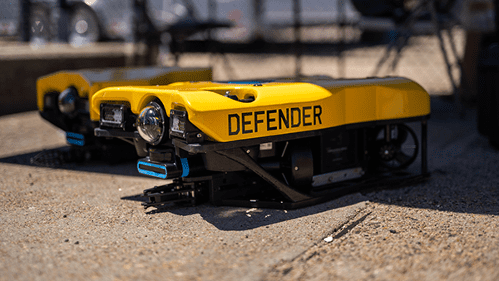
AeroVironment Awarded $4.8 million Contract for ROVs to support U.S. Coast Guard Modernization Plan

12/11/2025

POTTSTOWN, PA – December 11, 2025 — AeroVironment, Inc. (“AV”) (NASDAQ: AVAV), a leading provider of underwater robotic systems, today announced it has been awarded a $4.8 million United States Coast Guard contract through its wholly owned subsidiary, VideoRay, to deliver Mission Specialist Defender remotely operated vehicles (ROVs) as part of the Service’s Force Design 2028 modernization initiative.

The Defender will enhance the Coast Guard’s maritime response capabilities by enabling rapid underwater inspections, pier inspections, hull assessments, subsurface infrastructure surveys, disaster response and search and rescue operations in challenging environments—reducing diver risk while increasing mission safety, operational efficiency, and fleet readiness.

AeroVironment Awarded $4.8 million Contract for ROVs to support U.S. Coast Guard Modernization Plan

“The selection of the Mission Specialist Defender reinforces our ability to deliver proven technology to address the most demanding defense and security missions,” said Chris Gibson, Chief Executive Officer at VideoRay. “Customers have come to depend on VideoRay when failure is not an option. As AV’s maritime pillar, we’re proud to contribute to the organization’s all-domain uncrewed systems strategy to ensure the safety and security of our forces.”

As part of Force Design 2028, the Coast Guard established the Robotics and Autonomous Systems (RAS) Program Executive Office to rapidly integrate unmanned and robotic technologies across all missions, including investments in robotics and autonomous systems designed to build a more agile, technology-enabled, and globally ready force for the evolving maritime domain.

AV’s $4.8 million award—the largest award of the $11 million executed in fiscal year 2025 for rapid autonomous fleet upgrades—will strengthen Coast Guard operations with proven, advanced maritime robotics. The selection of the Mission Specialist Defender builds on the company’s expanding track record with U.S. and allied defense customers, including the Navy’s Maritime Expeditionary Standoff Response (MESR) program.

“These unmanned systems provide increased domain awareness, mitigating risk and enhancing mission success as the Coast Guard continues to operate in hazardous environments,” said Anthony Antognoli, the Coast Guard’s first RAS program executive officer, in a separate release issued by the U.S. Coast Guard in September 2025. “The Coast Guard’s mission demands agility, awareness and adaptability. Robotics and autonomous systems deliver all three, enabling us to respond faster, operate smarter and extend our reach where it matters most. We are not waiting for the future to arrive. We are delivering it to the fleet today.”

Built on a modular, open-architecture design, the Mission Specialist Defender allows operators to easily integrate advanced sensors, manipulators, and specialized payloads. This flexibility ensures adaptability to evolving mission requirements, while field-swappable modules enable on-site maintenance and repairs—minimizing downtime and maintaining operational tempo.

Details regarding the Mission Specialist Defender can be found at: https://videoray.com/products/mission-specialist-defender

Let’s Advance Your Mission

Product Catalog

Download the full catalog to explore our solutions in detail.

News

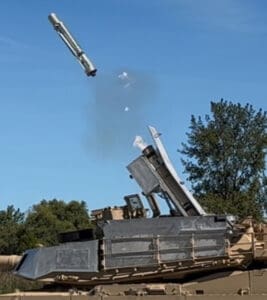
AeroVironment and General Dynamics Land Systems Successfully Demonstrate PERCH Loitering Munitions Launcher

12/10/2025

AeroVironment and General Dynamics Land Systems Successfully Demonstrate PERCH Loitering Munitions LauncherGeneral Dynamics Land Systems today announced a successful demonstration of the Precision Effects & Reconnaissance, Canister-Housed (PERCH) system, codeveloped with strategic partner AeroVironment (AV), at the U.S. Army’s Machine Assisted Rugged Sapper (MARS) event at Fort Hood, Texas.

PERCH is a modular kit that integrates AV’s Switchblade 300 and Switchblade 600 loitering munitions into M1A2 Abrams SEPv3 main battle tanks and Stryker infantry carrier vehicles for beyond-line-of-sight surveillance and lethality. PERCH does not require welding nor cutting for mounting; instead, it replaces the Abrams’ loader sponson box and is bolted into place using existing attachment points. Future iterations will operate on existing vehicle computer systems.

At the MARS demo on Oct. 26-30, users completed a complex obstacle breach with the aid of beyond-line-of-sight reconnaissance and over-the-horizon targeting of high-value targets provided by a Switchblade 300 and a Switchblade 600 launched from an Abrams tank via PERCH.

“PERCH allows units to deploy Switchblade loitering munitions far forward on the battlefield while remaining covered and concealed themselves,” said Jim Pasquarette, vice president, U.S. strategy and business development, General Dynamics Land Systems. “We have seen a lot of Soldier interest in this readymade, effective concept, and we look forward to future demonstrations. With our partners at AV, we’re generating the power to win on the modern battlefield.”

“Integrating Switchblade 300 and 600 into General Dynamics Land Systems platforms through the PERCH modular kit delivers immediate operational advantages – extending reach and enabling rapid, precise effects from protected positions,” said Brian Young, senior vice president, loitering munitions systems at AV. “This demonstration showcased the expanded beyond-line-of-sight precision engagement capabilities available to our military by embedding mature loitering munition systems on combat vehicles. We value our partnership with GDLS and our shared commitment to delivering reliable, field-ready solutions to warfighters.” Learn more.

Let’s Advance Your Mission

Product Catalog

Download the full catalog to explore our solutions in detail.

Press Release

AeroVironment Announces Fiscal 2026 Second Quarter Results

12/09/2025

ARLINGTON, VA, December 9, 2025AeroVironment, Inc. (NASDAQ: AVAV) (“AeroVironment” or the “Company”) reported today financial results for the fiscal second quarter ended November 1, 2025.

Second Quarter Highlights:

  • Record second quarter revenue of $472.5 million up, 151% year-over-year; with BlueHalo contributing $245.1 million and legacy revenue of $227.4 million up 21% year-over year
  • Bookings of $1.4 billion; Book-to-bill ratio of 2.9

“AV is operating from a position of strength as evidenced by our record second quarter results, all-time high bookings and long-term contract wins,” said Wahid Nawabi, AeroVironment chairman, president and chief executive officer. “We have built a portfolio of integrated capabilities and advanced technologies to meet the market’s accelerating demand and serve as a partner of choice in critical moments. While we are pleased with our results for the quarter, we are just getting started. We are confident that our unmatched innovation, strategic partnerships and agility to expand our manufacturing capacity enable us to address evolving defense needs and lead the generational shift in defense over the longer-term.” 

Fiscal 2026 Second Quarter Results

Revenue for the second quarter of fiscal 2026 was $472.5 million, an increase of 151% as compared to $188.5 million for the second quarter of fiscal 2025, due to higher product sales of $173.8 million and higher service revenue of $110.2 million. The acquisition of BlueHalo on May 1, 2025 contributed to $134.4 million and $110.7 million of the current quarter product and service revenue, respectively. From a segment standpoint, Autonomous Systems (“AxS”) recorded revenue of $301.6 million and Space, Cyber and Directed Energy (“SCDE”) recorded revenue of $170.9 million.

Gross margin for the second quarter of fiscal 2026 was $104.1 million, an increase of 41% as compared to $73.6 million for the second quarter of fiscal 2025, reflecting higher product margin of $19.5 million and higher service margin of $11.0 million. Fiscal 2026 second quarter gross margin was negatively impacted by $24.2 million of intangible amortization expense and other related non-cash purchase accounting expenses, as compared to $3.7 million in the second quarter of fiscal 2025. As a percentage of revenue, gross margin fell to 22% from 39%, primarily due to an increase in the proportion of service revenue resulting from the BlueHalo acquisition and the increased amortization and other non-cash purchase accounting expenses.

Loss from operations for the second quarter of fiscal 2026 was $(30.2) million as compared to income from operations of $7.0 million for the second quarter of last fiscal year. The current quarter was negatively impacted by $48.2 million of intangible amortization and other related non-cash purchase accounting expenses as compared to $4.8 million in the second quarter of fiscal 2025. The decrease year-over-year was primarily due to an increase in selling, general and administrative (“SG&A”) expense of $60.4 million, which includes an increase of $24.0 million of intangible amortization expense, incremental headcount resulting from our acquisition of BlueHalo which closed on May 1, 2025, and an increase of $4.6 million of acquisition related expenses; an increase in research and development (“R&D”) expense of $7.3 million; partially offset by an increase in gross margin of $30.5 million.

Other income, net for the second quarter of fiscal 2026 was $9.6 million, as compared to other loss, net of $(0.7) million for the second quarter of fiscal 2025. The increase year-over-year was primarily due to an increase in interest income due to a combination of higher cash and investment balances, lower intertest bearing debt balances and an increase in unrealized gains on equity security investments.

Benefit from income taxes for the second quarter of fiscal 2026 was $(2.3) million, as compared to $(0.2) million for the second quarter of last fiscal year. The increase year-over-year was primarily due to the loss before income taxes.

Net loss for the second quarter of fiscal 2026 was $(17.1) million, or $(0.34) per diluted share, as compared to net income of $7.5 million, or $0.27 per diluted share, in the prior-year period, respectively. The current quarter was negatively impacted by $48.2 million, or $0.77 per diluted share, of intangible amortization and other related non-cash purchase accounting expenses as compared to $4.8 million, or $0.14 per diluted share, in the second quarter of fiscal 2025.

Non-GAAP adjusted EBITDA for the second quarter of fiscal 2026 was $45.0 million and non-GAAP earnings per diluted share were $0.44, as compared to $25.9 million and $0.47, respectively, for the second quarter of fiscal 2025. 

Backlog

As of November 1, 2025, funded backlog (defined as remaining performance obligations under firm orders for which funding is currently appropriated to us under a customer contract) was $1.1 billion, as compared to $726.6 million as of April 30, 2025.

Fiscal 2026 — Outlook for the Full Year 

For fiscal year 2026, the Company now expects revenue of between $1.95 billion and $2.0 billion, net loss of between $(38) million and $(30) million, non-GAAP adjusted EBITDA of between $300 million and $320 million, loss per diluted share of between $(0.76) and $(0.61) and non-GAAP earnings per diluted share, which excludes amortization of intangible assets, other non-cash purchase accounting expenses, equity securities investments gains or losses, and equity method income or loss of between $3.40 and $3.55.

The foregoing estimates are forward-looking and reflect management’s view of current and future market conditions, subject to certain risks and uncertainties, including certain assumptions with respect to our ability to efficiently and on a timely basis integrate acquisitions, obtain and retain government contracts, changes in the timing and/or amount of government spending, react to changes in the demand for our products and services, activities of competitors, changes in the regulatory environment, and general economic and business conditions in the United States and elsewhere in the world. Investors are reminded that actual results may differ materially from these estimates and investors should review all risks related to achievement of the guidance reflected under “forward-looking statements” below and in the Company’s filings with the Securities and Exchange Commission.

Conference Call and Presenation

In conjunction with this release, AeroVironment, Inc. will host a conference call today, Tuesday, December 9, 2025, at 4:30 pm Eastern Time that will be webcast live. Wahid Nawabi, chairman, president and chief executive officer, Kevin P. McDonnell, executive vice president and chief financial officer, and Denise Pacioni, investor relations director, will host the call.

Investors may access the call by registering via the following participant registration link up to ten minutes prior to the start time.

Participant registration URL:

https://register-conf.media-server.com/register/BI46fe71ad422544adbca6658227be91e7

Investors may also listen to the live audio webcast via the Investor Relations page of the AeroVironment, Inc. website, http://investor.avinc.com. Please allow 15 minutes prior to the call to download and install any necessary audio software.

A supplementary investor presentation for the second quarter fiscal year 2026 can be accessed at https://investor.avinc.com/events-and-presentations.

Audio Replay

An audio replay of the event will be archived on the Investor Relations section of the Company’s website at http://investor.avinc.com.

About AeroVironment, Icn.

AeroVironment (“AV”) (NASDAQ: AVAV) is a defense technology leader delivering integrated capabilities across air, land, sea, space, and cyber. The company develops and deploys autonomous systems, precision strike systems, counter-UAS technologies, space-based platforms, directed energy systems, and cyber and electronic warfare capabilities—built to meet the mission needs of today’s warfighter and tomorrow’s conflicts. With a national manufacturing footprint and a deep innovation pipeline, AV delivers proven systems and future-defining capabilities with speed, scale, and operational relevance. For more information visit: www.avinc.com. 

Forward-Looking Statements 

This press release contains “forward-looking statements” as that term is defined in the Private Securities Litigation Reform Act of 1995. Forward-looking statements include, without limitation, any statement that may predict, forecast, indicate or imply future results, performance or achievements, and may contain words such as “will,” “believe,” “anticipate,” “expect,” “estimate,” “intend,” “project,” “plan,” or words or phrases with similar meaning. Forward-looking statements are based on current expectations, forecasts and assumptions that involve risks and uncertainties, including, but not limited to, economic, competitive, governmental and technological factors outside of our control, that may cause our business, strategy or actual results to differ materially from the forward-looking statements.

Factors that could cause actual results to differ materially from the forward-looking statements include, but are not limited to, the impact of our ability to successfully close and integrate acquisitions into our operations and avoid disruptions from acquisition transactions that will harm our business; the recording of goodwill and other intangible assets as part of acquisitions that are subject to potential impairments in the future and any realization of such impairments; any actual or threatened disruptions to our relationships with our distributors, suppliers, customers and employees, including shortages in components for our products, whether due to restrictions and sanctions imposed by foreign governments or otherwise; the ability to timely and sufficiently integrate international operations into our ongoing business and compliance programs; reliance on sales to the U.S. government, including uncertainties in classification, pricing or potentially burdensome imposed terms for certain types of government contracts; availability of U.S. government funding for defense procurement and R&D programs; our ability to win U.S. and international government R&D and procurement programs, including foreign military financing aid; changes in the timing and/or amount of government spending, including due to continuing resolutions and/or changing government priorities; adverse impacts of any U.S. government shutdown; our ability to realize the anticipated benefits of the BlueHalo transaction or other acquisitions; our ability to execute contracts for anticipated sales, perform under such contracts and other existing contracts and obtain new contracts; risks related to our international business, including compliance with export control laws; the extensive and increasing regulatory requirements governing our contracts with the U.S. government and international customers; the consequences to our financial position, business and reputation that could result from failing to comply with such regulatory requirements; unexpected technical and marketing difficulties inherent in major research and product development efforts; the impact of potential security and cyber threats or the risk of unauthorized access to and resulting misuse of our, our customers’ and/or our suppliers’ information and systems; failure to remain a market innovator, to create new market opportunities or to expand into new markets; our ability to increase production capacity to support anticipated growth; unexpected changes in significant operating expenses, including components and raw materials; failure to develop new products or integrate new technology into current products; any increase in litigation activity or unfavorable results in legal proceedings, including pending class actions, or litigation that may arise from or in conjunction with our recent acquisition of BlueHalo; our ability to respond and adapt to legal, regulatory and government budgetary changes; our ability to comply with the covenants in our loan documents, outstanding convertible notes or merger agreement with BlueHalo; our ability to attract and retain skilled employees, including retention of BlueHalo employees; the impact of inflation; and general economic and business conditions in the United States and elsewhere in the world; and the failure to establish and maintain effective internal control over financial reporting. For a further list and description of such risks and uncertainties, see the reports we file with the Securities and Exchange Commission. We do not intend, and undertake no obligation, to update any forward-looking statements, whether as a result of new information, future events or otherwise.

Non-GAAP Measures

In addition to the financial measures prepared in accordance with generally accepted accounting principles (GAAP), this earnings release also contains non-GAAP financial measures. See in the financial tables below the calculation of these measures, the reasons why we believe these measures provide useful information to investors, and a reconciliation of these measures to the most directly comparable GAAP measures.

See full financial tables at investor.avinc.com.


About AeroVironment, Inc.

AeroVironment (“AV”) (NASDAQ: AVAV) is a defense technology leader delivering integrated capabilities across air, land, sea, space, and cyber. The Company develops and deploys autonomous systems, loitering munitions, counter-UAS technologies, space-based platforms, directed energy systems, and cyber and electronic warfare capabilities—built to meet the mission needs of today’s warfighter and tomorrow’s conflicts. At the core of these technologies lies AV_Halo, a modular, mission-ready suite of AI-powered software tools that empowers warfighters and enables full-battlefield dominance: detect, decide, deliver. With a national manufacturing footprint and a deep innovation pipeline, AV delivers proven systems and future-defining capabilities at speed, scale, and operational relevance. For more information, visit www.avinc.com.


Safe Harbor Statement

Certain statements in this press release may constitute “forward-looking statements” as that term is defined in the Private Securities Litigation Reform Act of 1995. These statements are made on the basis of current expectations, forecasts and assumptions that involve risks and uncertainties, including, but not limited to, economic, competitive, governmental and technological factors outside of our control, that may cause our business, strategy or actual results to differ materially from those expressed or implied. Factors that could cause actual results to differ materially from the forward-looking statements include, but are not limited to, our ability to perform under existing contracts and obtain additional contracts; changes in the regulatory environment; the activities of competitors; failure of the markets in which we operate to grow; failure to expand into new markets; failure to develop new products or integrate new technology with current products; and general economic and business conditions in the United States and elsewhere in the world. For a further list and description of such risks and uncertainties, see the reports we file with the Securities and Exchange Commission. We do not intend, and undertake no obligation, to update any forward-looking statements, whether as a result of new information, future events or otherwise.


CONTACT:

AeroVironment
+1.703.418.2828
pr@avinc.com

Let’s Advance Your Mission

Product Catalog

Download the full catalog to explore our solutions in detail.