
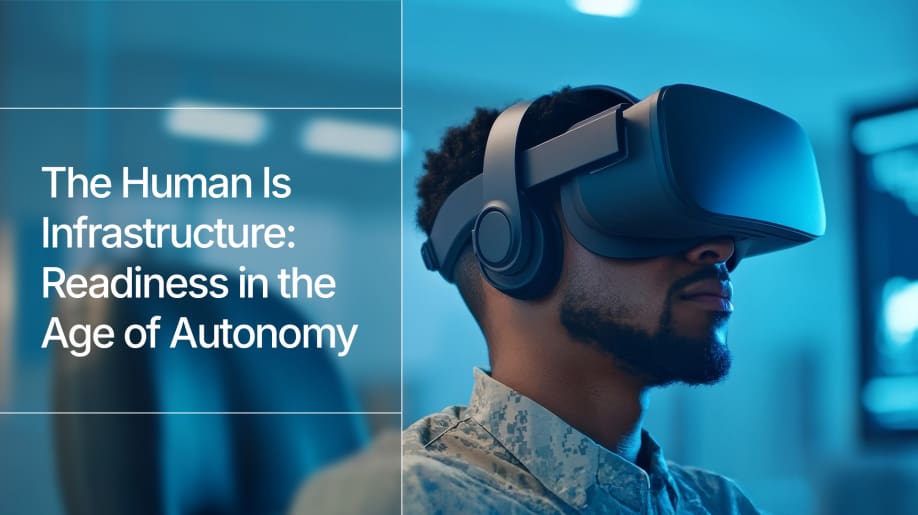
By Dr. Stephaney Shanks, Vice President, Health and Performance Technologies
For decades, military infrastructure has been defined as platforms, networks, logistics, and installations. Yet, as autonomous technologies reshape the battlespace, one truth is increasingly unavoidable, and too often overlooked: The human operator is the most critical element of military infrastructure. The future of readiness will not be defined by machines alone, but by how well we enable the humans who command, control, and collaborate with them.
The warfighter is both person and critical component of the weapons system. That duality shapes how we innovate. It drives us to design technologies that support operator mental and physical performance during their service and throughout their lives. Centering the human in our work acknowledges that warfare is a human endeavor, correctly frames system optimization and, frankly, honors their sacrifice.
I lead AV’s efforts focused on the heart of the human decision-making process. In this work, performance technologies are not ancillary health tools; they are foundational infrastructure. We see the warfighter as a measurable, protectable, and optimizable element of the force, and guide the development of precision medicine, AI/ML-enabled health tools, and wearable and drone-mounted sensing systems that give operators the edge, so when autonomy fails or behaves unexpectedly, the human can act immediately. The technologies pioneered for military health do not stop at the battlefield; they ripple outward, strengthening healthcare for civilians, first responders, families, and communities everywhere. Equipping these groups of incredible people is exactly why I got into this industry.
I began my career grounded in public health and microbiology, focused on environmental exposure and protecting human health. Like many Americans, the events of September 11, 2001 reshaped my sense of purpose. As our nation entered the global war on terror, I felt a profound responsibility to apply my training in service of those who would carry the burden of that conflict. What began as a public health calling evolved into a mission-driven commitment to protect the health and performance of the brave men and women of the U.S. military, who volunteer to put their lives in harm’s way every day and who operate every day under extraordinary physical, cognitive, and environmental stress.
These people’s missions do not execute themselves. Humans remain indispensable for judgment, authorization, adaptation, and accountability. They supervise autonomy, intervene when systems fail, and operate in the ambiguity that machines are not yet equipped to resolve. As autonomy scales, the operator does not disappear from the system. They become the decisive node.
The prevailing assumption is that autonomy reduces human burden. In practice, it often simply redistributes it. Supervising multiple autonomous systems, interpreting AI-driven outputs, and making time-compressed decisions under uncertainty place extraordinary cognitive and physiological demands on operators.
Fatigue, cognitive overload, stress, injury, and environmental exposure are not personal health concerns, they are mission-level risks that propagate across platforms. If aircraft maintenance, fuel supply, and network resilience are infrastructure investments, then operator readiness deserves the same innovation, rigor, instrumentation, and lifecycle management.
Traditionally, human performance is assessed episodically during training, pre-deployment screenings, or post-mission evaluations. This model no longer aligns with modern operations, where stressors accumulate continuously and readiness can change rapidly. The future is persistent, unobtrusive sensing paired with real-time analytics in systems that operate in the background, delivering insight without distracting from the mission. This is not about overwhelming the warfighter with large, complex dashboards. It is about enabling commanders, medics, and operators themselves to identify risks earlier, intervene sooner, and sustain performance during forward, distributed, resource-constrained missions.
A critical enabler of this shift is the maturation of flexible hybrid electronics (FHE). FHE allows sensing, processing, and connectivity to be embedded directly into body-conformal systems, enabling continuous monitoring without compromising mobility, comfort, or compliance. This represents a fundamental change in how infrastructure is deployed. Instead of surrounding the human with systems, we can now integrate infrastructure with the human themselves.
RehabXR, part of AV’s nxtHealth® product line, reflects this approach by combining wearable sensing, immersive environments, and adaptive analytics for concussion and mild traumatic brain injury rehabilitation. It continuously assesses movement quality, neuromuscular performance, and recovery trajectories. RehabXR enables rehabilitation and performance optimization that is operationally relevant and interactive rather than episodic and with secure, real-time data delivery to clinicians.
As we strive for increased system autonomy in contested and resource-constrained environments, data from FHE-enabled devices alone will not create advantage. Advantage comes from what is done with that data. This requires on-device, edge computing to turn raw measurements into real-time guidance without reliance on cloud infrastructure.
This philosophy underpins AV’s ChemiSens™ portfolio, including biohybrid sensors that integrate biology with advanced electronics developed in partnership with the Air Force Research Laboratory. These sensors detect and characterize chemical exposures with high specificity and sensitivity, while processing signals locally for rapid response. When combined with human performance monitoring, ChemiSens can extend readiness beyond physiology alone, linking environmental exposure directly to functional degradation, stress response, and cognitive load.
AV recognizes that human performance technologies have direct relevance beyond defense. Capabilities developed for warfighter readiness – continuous monitoring, exposure awareness, adaptive recovery, and early risk detection – naturally translate to civilian settings where safety, resilience, and sustained performance are equally critical. Platforms like RehabXR and ChemiSens can support applications for first responders, industrial workers, elite athletes, transportation operators and healthcare professionals. The dual-use model accelerates technology transition, lowers cost to the taxpayer, and strengthens national resilience.
Human performance is no longer a support function. It is strategic infrastructure, and it must be built with the same intent, precision, and urgency as any other element of national security. In an age of autonomy, the human remains the ultimate point of accountability and our decisive advantage.
ABOUT THE AUTHOR
Stephaney Shanks, Ph.D. is a health, defense, and technology executive serving as Vice President of Health & Performance Technologies at AV. She leads multi-site teams and a $35M+ portfolio to develop real-world medical technologies, precision medicine, AI/ML health tools, and wearable systems for military and commercial health applications.
JOIN THE AV MISSION
AV isn’t for everyone. We hire the curious, the relentless, the mission-obsessed. The best of the best.
We don’t just build defense technology—we redefine what’s possible. As the premier autonomous systems company in the U.S., AV delivers breakthrough capabilities across air, land, sea, space, and cyber. From AI-powered drones and loitering munitions to integrated autonomy and space resilience, our technologies shape the future of warfare and protect those who serve.
Founded by legendary innovator Dr. Paul B. MacCready, Jr., AV has spent over 50 years pushing the boundaries of what unmanned systems can do. Our heritage includes seven platforms in the Smithsonian—but we’re not building history, we’re building what’s next.
If you’re ready to build technology that matters—with speed, scale, and purpose—there’s no better place to do it than AV.