News

AV Featured on CBS News’ 60 Minutes

03/15/2026

AV Featured on CBS News’ 60 Minutes

ARLINGTON, Va., March 15, 2026 – AeroVironment, Inc. (“AV”) (NASDAQ: AVAV), a global defense technology leader, was featured on CBS News’ 60 Minutes in a national television broadcast that examined the company’s role in the rapid evolution of advanced technologies that are shaping the future of global security.

The segment, entitled “Laser Focus,” provided viewers with a behind-the-scenes look at the technologies and engineers driving innovation at AV, while also examining how scalable, cost-effective defense solutions, like AV’s laser weapons systems, are becoming increasingly critical in an era defined by proliferating autonomous threats and rapidly advancing battlefield technologies.

During the program, 60 Minutes correspondent Lesley Stahl visited AV’s Albuquerque, New Mexico facility for a firsthand look at the company’s advanced engineering and development operations, where teams are designing systems capable of detecting, tracking, and defeating increasingly sophisticated unmanned aerial threats. Stahl also interviewed Wahid Nawabi, AV’s Chairman, President and Chief Executive Officer.

“60 Minutes recognized what many of our partners across government and industry already know—that AV is at the forefront of the technologies reshaping modern defense,” said Nawabi. “From autonomous systems to counter-UAS and directed energy laser weapons systems, our teams are developing capabilities designed to address the rapidly evolving threats facing the United States and its allies.”

As part of the segment, Stahl also participated in a demonstration of AV’s LOCUST®, a high-energy laser weapon system capable of defeating aerial threats at the speed of light. Working alongside John Garrity, AV’s Vice President of Directed Energy Systems, Stahl operated the LOCUST system during a controlled demonstration at the company’s New Mexico facility, where she detected, tracked, and neutralized a drone target.

In addition to LOCUST, the segment featured Switchblade®, AV’s man-portable loitering munition system widely used in modern conflicts, including Ukraine.

60 Minutes, one of the most widely viewed and influential news programs in the world, reaches millions of viewers each week and is known for in-depth reporting on issues shaping global policy, technology, and national security.

The full segment is available on CBS News and 60 Minutes digital platforms.

Let’s Advance Your Mission

Product Catalog

View the full catalog to explore our solutions in detail.

Thought Leadership

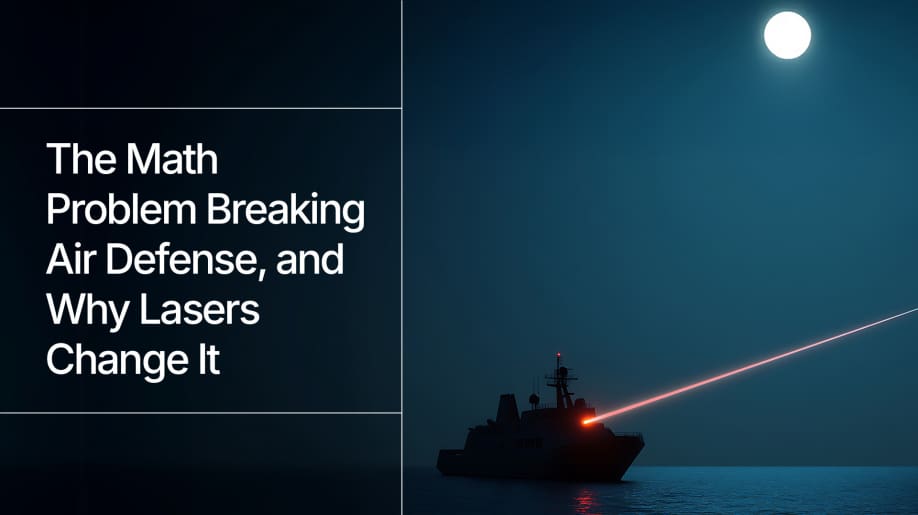
The Math Problem Breaking Air Defense, And Why Lasers Change It

03/04/2026

The Math Problem Breaking Air Defense, And Why Lasers Change It

By Aaron Westman, Senior Director of Business Development at AV  

A $50,000 drone can destroy a $30 million aircraft.

A $2 million missile can destroy a $50,000 drone.

If that sounds like a losing proposition, it’s because it is.

Unmanned Aircraft Systems (UAS) have fundamentally altered the economics of conflict. We have all seen the videos — small, inexpensive aircraft delivering outsized battlefield effects. Nowhere has this been more visible than in Ukraine, where production numbers and lethality statistics are staggering.

While much attention is focused on drone technology, the equally critical and often overlooked counterpart is counter-unmanned aerial systems (C-UAS), systems that allow us to defend against aerial threats. The ongoing cat-and-mouse game between drones and the defense systems designed to defeat them is evolving at an unprecedented pace. Dedicated C-UAS formations are being developed and adopted around the world. Advanced sensors and effectors are being deployed not just by militaries, but by law enforcement agencies, critical infrastructure operators, and even professional sports venues.

The importance of C-UAS is understood. Its implications are not.

At its core, the C-UAS challenge is not just technological. It is also economic.

Drones live in the world of software—iterative, mass-produced, and scaled across global supply chains capable of producing hundreds of thousands, even millions, of units per year. Air defense lives in the world of atoms. Every interceptor must be built, shipped, stored, and sustained. Each one is a discrete, exhaustible object. Once fired, it disappears from inventory, and replacing it takes time, money, and industrial capacity that cannot surge at the speed of software.

This creates a structural imbalance in cost and scale. A single defended site facing sustained drone pressure can consume thousands of interceptors in a matter of months, turning defense into a contest of industrial endurance rather than tactical skill. When each engagement carries a five or six-figure price tag, the defender risks spending more to defeat the threat than the attacker spends to create it.

In this environment, the defining metric of effectiveness is no longer whether a system can intercept a drone, but whether it can do so affordably, repeatedly, and at the scale the threat demands.

In essence, C-UAS is no longer defined by whether you can stop a drone, but whether you can afford to stop them all.

Why Cost Parity Is Not Enough

Conventional wisdom holds that if we can simply make interceptors cheaper, the problem goes away. It does not.

Even if an interceptor achieves nominal cost parity with a one-way attack drone, the defender still faces the burden of manufacturing, storing, and distributing large quantities of physical munitions. The attacker retains initiative. The defender retains logistical burden.

What the C-UAS fight demands is not just cost reduction. It demands a fundamentally different scaling model — one that can keep pace with, or outpace, the industrial production of drones.

That is where directed energy enters the conversation.

A Different Model: Electricity Instead of Inventory

Laser Directed Energy Weapons (LDEWs) invert the economics of C-UAS.

A missile is consumed when fired. A laser recharges.

Instead of throwing hardware at hardware, a laser delivers concentrated energy onto the target.  The marginal cost per engagement is measured in electricity — typically about a kilowatt-hour or $0.18 worth of electricity per shot, roughly comparable to the amount required to operate a household refrigerator for a day.

A laser system does not need a warehouse of interceptors. It does not require constant munitions resupply convoys. It is limited primarily by power availability and thermal management, not by missile inventory.

In practical terms, this means that a C-UAS unit equipped with an effective LDEW can defend against large volumes of small UAS threats without the exponential logistics burden associated with kinetic interceptors.

This is not science fiction. It is not a cinematic “death ray.” A modern LDEW functions more like a long-range precision welder, applying concentrated energy to structurally or functionally disable a drone. The physics are straightforward. The engineering challenge has been shrinking the system, lowering the cost, and making it rugged enough for real-world use.

Thanks to advances in commercial fiber lasers, optics, and power electronics, that tipping point has arrived.

Demonstrated Scale

Over the past four years, our team at AV has conducted more than 66 test, demonstration, live-fire, and operational exercises with our LOCUST family of C-UAS laser systems. Across those events — including preparations and supporting trials — we estimate that our systems have safely defeated over 1,000 small UAS targets.

These were not simulations. They were real unmanned aircraft, real sensors, real power systems, and real environmental conditions.

What is noteworthy is not simply that lasers work. It is that they can operate repeatedly without the inventory constraints that define kinetic systems. Even with only a limited number of prototypes built to date, the cumulative number of engagements would have required substantial missile expenditure had traditional interceptors been used.

That difference scales.

Not a Silver Bullet — But a Necessary One

No single system will solve every aspect of the C-UAS problem. RF-based systems will continue to play an important role against nuisance or commercially derived drones. Gun-based systems will retain utility at very close ranges or in specific environments. Kinetic interceptors remain essential against certain classes of threats.

But when confronting high-volume, low-cost robotic systems, it is difficult to envision a more suitable hard-kill effector than an affordable, producible LDEW.

The question is not whether lasers can defeat drones. They can, they do.

The real question is whether we are willing to align our defensive strategy with the economics of the threat.

In the C-UAS fight, cost structure is destiny. 


Yesterday, AV Announced a $30 million investment in its New Mexico campus, which is where the LOCUST system is manufactured.

ABOUT THE AUTHOR 

Aaron Westman is an engineer and leader specializing in counter-UAS and directed energy systems. He has played a key role advancing mobile laser weapon integration and operational deployment, supporting a variety of cross-domain capabilities that improve precision engagement and layered air defense.

JOIN THE AV MISSION 

AV isn’t for everyone. We hire the curious, the relentless, the mission-obsessed. The best of the best.

We don’t just build defense technology—we redefine what’s possible. As the premier autonomous systems company in the U.S., AV delivers breakthrough capabilities across air, land, sea, space, and cyber. From AI-powered drones and loitering munitions to integrated autonomy and space resilience, our technologies shape the future of warfare and protect those who serve.

Founded by legendary innovator Dr. Paul B. MacCready, Jr., AV has spent over 50 years pushing the boundaries of what unmanned systems can do. Our heritage includes seven platforms in the Smithsonian—but we’re not building history, we’re building what’s next.

If you’re ready to build technology that matters—with speed, scale, and purpose—there’s no better place to do it than AV.


Let’s Advance Your Mission

Product Catalog

View the full catalog to explore our solutions in detail.

Press Release

AV Delivers JLTV-Mounted LOCUST Laser Weapon Systems to U.S. Army

12/18/2025

AV Delivers JLTV-Mounted LOCUST Laser Weapon Systems to U.S. Army

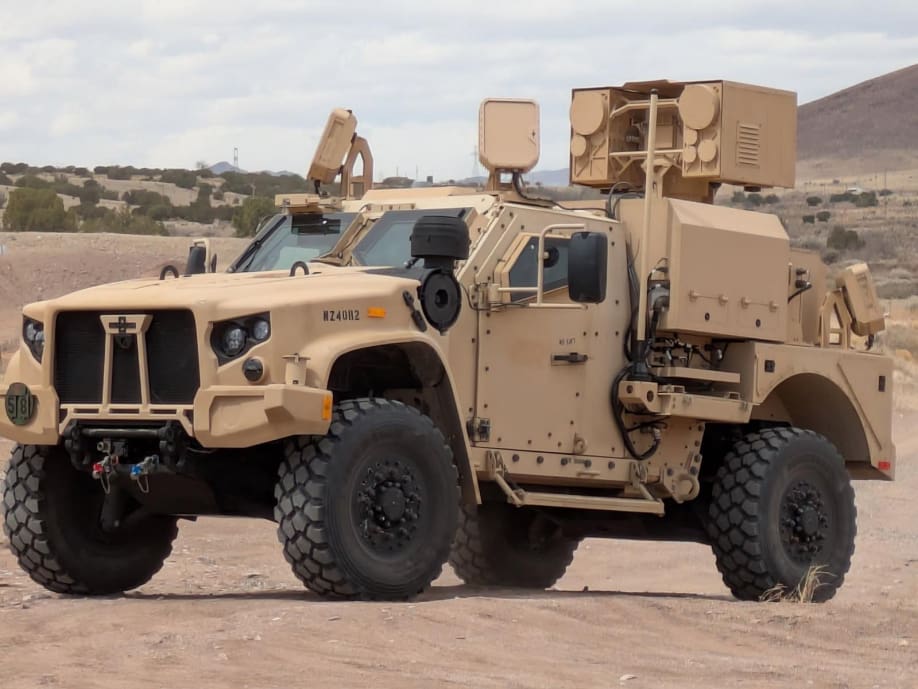
ARLINGTON, Va., December 18, 2025 – AeroVironment, Inc. (“AV”) (NASDAQ: AVAV), a leading provider of counter-unmanned aircraft system (C-UAS) technologies, today announced the successful delivery of two Joint Light Tactical Vehicle (JLTV)-mounted mobile C-UAS Laser Weapon Systems (LWS) to the U.S. Army as part of the second increment of the Army Multi-Purpose High Energy Laser (AMP-HEL) prototyping effort. These systems were delivered to the Army’s Rapid Capabilities and Critical Technologies Office (RCCTO), now integrated into the Portfolio Acquisition Executive Fires, reflecting the Army’s ongoing transformation and acquisition reform efforts.

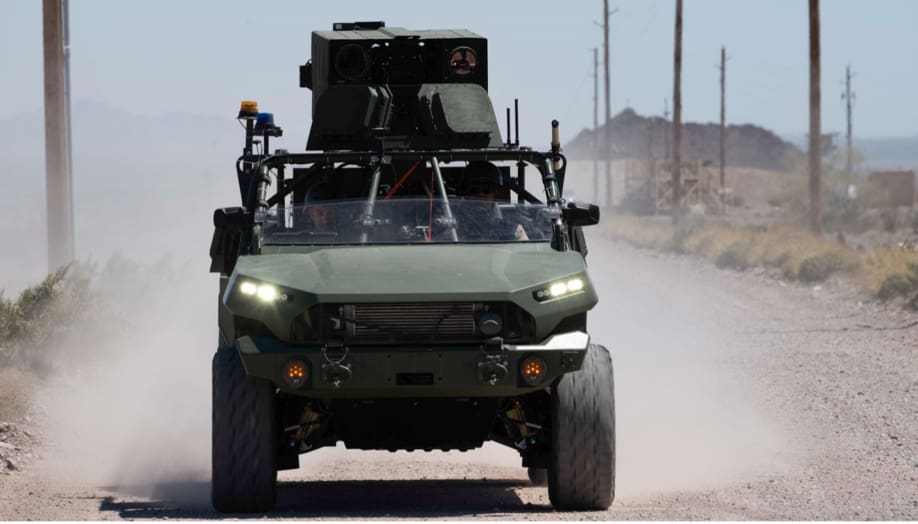
In September, AV announced delivery of the first increment of AMP-HEL prototype systems–two LOCUST LWS integrated on the General Motors Defense Infantry Squad Vehicle (ISV) platform. This second-increment system on the Oshkosh JLTV platform features the same 20kW-class LOCUST LWS with a larger aperture beam director, improving lethality performance.

“AV continues to deliver proven, efficient, modular laser weapon systems that perform and protect in real-world threat environments,” said Mary Clum, President, Space, Cyber & Directed Energy for AV. “Integrated as part of these AMP-HEL systems, LOCUST is a cost-effective, rugged, precise, and scalable solution that is addressing the ever-evolving UAS threats our warfighters are facing on frontlines today. With the technology proven, we remain focused on advancing capabilities while scaling manufacturing to meet the growing demand.”

AV delivered its first LOCUST LWS to RCCTO as part of the Palletized-High Energy Laser (P-HEL) program in 2022. With more than three years of operational deployment outside the United States, these state-of-the-art LWS have demonstrated exceedingly high operational availability rates for prototype systems after first generation lessons learned informed necessary improvements now supporting current technology development efforts. During these deployments, the LOCUST-equipped P-HEL systems, now integrated on AMP-HEL, have performed their designed mission against UAS threats in real world combat.

“Directed energy is no longer a future concept—it is a proven force-protection capability,” said John Garrity, Vice President of AV’S Directed Energy business unit. “Since deployed, LOCUST-equipped P-HEL systems have actively protected warfighters, allies, and critical infrastructure against aerial threats. With LOCUST’s target acquisition, tracking and precision beam control, warfighters have an easy-to-use, reliable, trusted, and proven solution against the very real and evolving threats of modern warfare.”

Designed to be platform-agnostic and rapidly deployable, AV’s directed-energy systems integrate seamlessly with Army command-and-control architectures, providing a critical C-UAS capability that protects Soldiers and assets across a wide range of missions and environments. These systems have been successfully integrated in fixed-site base defense systems and on maneuverable platforms, including the ISV and JLTV, and mounted on the Light Medium Tactical Vehicle for increased mobility.


About AeroVironment, Inc.

AeroVironment (“AV”) (NASDAQ: AVAV) is a defense technology leader delivering integrated capabilities across air, land, sea, space, and cyber. The Company develops and deploys autonomous systems, loitering munitions, counter-UAS technologies, space-based platforms, directed energy systems, and cyber and electronic warfare capabilities—built to meet the mission needs of today’s warfighter and tomorrow’s conflicts. At the core of these technologies lies AV_Halo, a modular, mission-ready suite of AI-powered software tools that empowers warfighters and enables full-battlefield dominance: detect, decide, deliver. With a national manufacturing footprint and a deep innovation pipeline, AV delivers proven systems and future-defining capabilities at speed, scale, and operational relevance. For more information, visit www.avinc.com.


Safe Harbor Statement

Certain statements in this press release may constitute “forward-looking statements” as that term is defined in the Private Securities Litigation Reform Act of 1995. These statements are made on the basis of current expectations, forecasts and assumptions that involve risks and uncertainties, including, but not limited to, economic, competitive, governmental and technological factors outside of our control, that may cause our business, strategy or actual results to differ materially from those expressed or implied. Factors that could cause actual results to differ materially from the forward-looking statements include, but are not limited to, our ability to perform under existing contracts and obtain additional contracts; changes in the regulatory environment; the activities of competitors; failure of the markets in which we operate to grow; failure to expand into new markets; failure to develop new products or integrate new technology with current products; and general economic and business conditions in the United States and elsewhere in the world. For a further list and description of such risks and uncertainties, see the reports we file with the Securities and Exchange Commission. We do not intend, and undertake no obligation, to update any forward-looking statements, whether as a result of new information, future events or otherwise.


CONTACT:

AeroVironment
+1.703.418.2828
pr@avinc.com

Domains

Solutions

Let’s Advance Your Mission

Product Catalog

View the full catalog to explore our solutions in detail.

Press Release

AV Delivers First Two Multi-Purpose High Energy Laser Systems to U.S. Army

09/03/2025

AV Delivers First Two Multi-Purpose High Energy Laser Systems to U.S. Army

ARLINGTON, Va., August 31, 2025 – AeroVironment, Inc. (“AV”) (NASDAQ: AVAV) today announced the successful delivery of the first two mobile counter-unmanned aircraft system (C-UAS) prototype Laser Weapon Systems (LWS) to the U.S. Army Rapid Capabilities and Critical Technologies Office (RCCTO) as part of the first increment of the Army Multi-Purpose High Energy Laser (AMP-HEL) prototyping effort. The AMP-HEL prototype systems feature AV’s 20kW-class LOCUST™ LWS integrated on the General Motors Defense Infantry Squad Vehicle (ISV) platform–a significant advancement in mobile, frontline C-UAS capabilities.

“This milestone marks a major step forward in the Army’s pursuit of fieldable directed energy capabilities,” said Mary Clum, Senior Vice President for AV’s Space & Directed Energy Group. “Through the AMP-HEL program, AV is delivering our extensively validated LOCUST laser system–a technically sophisticated solution that has demonstrated reliability and operational readiness for the C-UAS fight. We are honored to support the U.S. Army RCCTO and, together, accelerate warfighter access to these critical capabilities.”

Following integration at AV’s Directed Energy (DE) manufacturing facility in Albuquerque, New Mexico, the AMP-HEL prototypes underwent rigorous government acceptance testing at Yuma Proving Ground in Arizona to validate performance, mobility, safety, and lethality. Subsequently, Army units performed new equipment training at Fort Sill, Oklahoma to prepare for potential employment of DE capabilities. Soldier feedback from the event is shaping ongoing enhancements to ensure warfighter readiness and operational relevance in dynamic threat environments.

The AMP-HEL prototyping effort is part of the Army’s broader modernization initiative to rapidly develop and field DE solutions to defeat a range of threats, including drones and other airborne systems. The integration of laser systems on the lightweight, highly mobile ISV platform reflects a commitment to scalable, adaptable, and expeditionary force protection solutions. Next month, AV is set to deliver the second increment of AMP-HEL–two Joint Light Tactical Vehicles with a 20kW class LOCUST LWS, radar, and command-and-control systems.

“The need for these systems from real world events is clear: the time is now for directed energy to get into the hands of warfighters everywhere and we are confident that LOCUST meets that need,” said John Garrity, Vice President of Directed Energy Systems for AV. “AV is committed to supporting the Army’s modernization and modularity priorities. We stand ready to meet the mission need through full-scale manufacturing of our LOCUST laser systems, including AMP-HEL and other mobile and fixed-site platforms, to increase lethality and continue to build on our extensively validated reliability and precision tracking and targeting technology to address the evolving threats.”


About AeroVironment, Inc.

AeroVironment (“AV”) (NASDAQ: AVAV) is a defense technology leader delivering integrated capabilities across air, land, sea, space, and cyber. The Company develops and deploys autonomous systems, loitering munitions, counter-UAS technologies, space-based platforms, directed energy systems, and cyber and electronic warfare capabilities—built to meet the mission needs of today’s warfighter and tomorrow’s conflicts. At the core of these technologies lies AV_Halo, a modular, mission-ready suite of AI-powered software tools that empowers warfighters and enables full-battlefield dominance: detect, decide, deliver. With a national manufacturing footprint and a deep innovation pipeline, AV delivers proven systems and future-defining capabilities at speed, scale, and operational relevance. For more information, visit www.avinc.com.


Safe Harbor Statement

Certain statements in this press release may constitute “forward-looking statements” as that term is defined in the Private Securities Litigation Reform Act of 1995. These statements are made on the basis of current expectations, forecasts and assumptions that involve risks and uncertainties, including, but not limited to, economic, competitive, governmental and technological factors outside of our control, that may cause our business, strategy or actual results to differ materially from those expressed or implied. Factors that could cause actual results to differ materially from the forward-looking statements include, but are not limited to, our ability to perform under existing contracts and obtain additional contracts; changes in the regulatory environment; the activities of competitors; failure of the markets in which we operate to grow; failure to expand into new markets; failure to develop new products or integrate new technology with current products; and general economic and business conditions in the United States and elsewhere in the world. For a further list and description of such risks and uncertainties, see the reports we file with the Securities and Exchange Commission. We do not intend, and undertake no obligation, to update any forward-looking statements, whether as a result of new information, future events or otherwise.


Contact

AeroVironment
+1.703.418.2828
pr@avinc.com

Domains

Solutions

Let’s Advance Your Mission

Product Catalog

View the full catalog to explore our solutions in detail.

News

Leonardo DRS and BlueHalo Successfully Demonstrate New Counter-UAS Directed Energy Stryker, Shooting Down Drones in Live-Fire Engagement

10/14/2024

ARLINGTON, VA — Leonardo DRS, Inc. (NASDAQ: DRS) and BlueHalo announced today the successful live-fire demonstration of a new Counter Unmanned Aircraft System (C-UAS) Directed Energy (DE) Stryker designed to defeat Group 1-3 UAS with multiple kinetic and non-kinetic defeat technologies.

During last month’s demonstration for U.S. Army officials in Socorro, N.M., the mobile C-UAS capability successfully destroyed numerous drones using BlueHalo’s 26kW LOCUST Laser Weapon System.  Additionally, the demonstration included near-simultaneous C-UAS and ground engagements with the laser and a 30mm remote weapon station (RWS).  The C-UAS DE Stryker successfully destroyed every drone over the two-day demonstration.

Leonardo DRS has deep experience in developing, integrating, and fielding mobile air defense and C-UAS solutions for the U.S. Army. The demonstration is the latest step in a process that started with the company identifying the need for a directed energy multi-layered mobile C-UAS system built around best-of-breed technologies from strong partners.

“In just eight months, Leonardo DRS and our outstanding industry partners designed, built, and tested this Stryker-based Directed Energy Counter-UAS prototype.  We were able to move quickly by leveraging DRS’s proven experience building a cohesive team of partners to rapidly deliver air defense capabilities to the Army,” said Aaron Hankins, Senior Vice President and General Manager of Leonardo DRS Land Systems.  “Our C-UAS Directed Energy Stryker is a future capability available to warfighters today, and we’re excited to display it during the 2024 AUSA Annual meeting.”

The Stryker includes two primary kinetic effectors – EOS Defense Systems’ USA R400 30mm RWS with Northrop Grumman’s XM914 cannon and BAE Systems’ 2.75” Advanced Precision Kill Weapon System fired from an Arnold Defense launcher.  The on-board radar is DRS’ RPS-92 nMHR which provides long-range detection, continuous tracking, and weapon system cueing.   As the lead vehicle integrator, DRS Land Systems worked across the coalition to integrate their “best-of-breed” technologies.

Non-kinetic effectors include BlueHalo’s LOCUST LWS, which is stored inside the Stryker and deployed when a threat is detected. The 26-kilowatt LWS combines precision optical and laser hardware with advanced software and processing to enable and enhance the directed energy “kill chain”.  It tracks, identifies, and defeats Group 1-3 UAS and other threats.  In addition to the LOCUST LWS, the Stryker employs BlueHalo’s Titan C-UAS™ and Titan-SV non-kinetic technologies, delivering comprehensive 360° surveillance and threat detection and mitigation of Group 1 and 2 drone threats.

“BlueHalo’s LOCUST Laser Weapon System is operationally deployed, proven, and trusted. Its modularity and ease of integration across platforms makes it a great fit for the Stryker armored vehicle,” said Mary Clum, BlueHalo Portfolio President and Corporate Executive Vice President. “BlueHalo is thrilled to lean forward with our partners at Leonardo DRS and the incredible coalition of industry leaders that has come together. Our unique combination of operational know-how and innovation has enabled us to rapidly develop a critical capability that directly addresses the challenges our warfighters are facing daily in contested environments. We are excited to share this progress with customers and roll these systems out to the frontlines in support of our nation’s most critical missions.”

The C-UAS DE Stryker provides soldiers with the mobility, firepower, and protection required to maneuver, fight, and survive at the tactical level in contested environments. The Stryker has enhanced lethality to defeat ground and air threats, and it is fully integrated with the US Army’s Forward Area Air Defense Command and Control (FAAD C2) network, ensuring it is interoperable with other Air Defense systems.

The new C-UAS DE Stryker brings together best-of-breed technologies from a coalition of industry partners. In addition to Leonardo DRS and BlueHalo, the coalition includes EOS Defense Systems USA, Northrop Grumman, BAE Systems, Digital Systems Engineering, Arnold Defense, and AMPEX.

###

About Leonardo DRS

Headquartered in Arlington, VA, Leonardo DRS, Inc. is an innovative and agile provider of advanced defense technology to U.S. national security customers and allies around the world. We specialize in the design, development and manufacture of advanced sensing, network computing, force protection, and electric power and propulsion, and other leading mission-critical technologies. Our innovative people are leading the way in developing disruptive technologies for autonomous, dynamic, interconnected, and multi-domain capabilities to defend against new and emerging threats. For more information and to learn more about our full range of capabilities, visit www.LeonardoDRS.com.

About BlueHalo

BlueHalo is purpose-built to provide industry-leading capabilities in the areas of Space, C-UAS and Autonomous Systems, Electronic Warfare & Cyber, and AI/ML. The company develops and brings to market next-generation capabilities to support customers’ critical missions and national security. Learn more at http://www.bluehalo.com and follow BlueHalo on LinkedIn.

Domains

Solutions

Let’s Advance Your Mission

Product Catalog

View the full catalog to explore our solutions in detail.