Blog

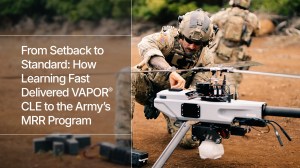
From Setback to Standard: How Learning Fast Delivered VAPOR® CLE to the Army’s MRR Program

04/21/2026

Jason Wright, Senior Product Line Manager

The Moment That Matters Isn’t the Win—It’s the Reset

In defense technology, the defining moment isn’t when you win—it’s how quickly you learn, improve and deliver after a failure.

When AV’s VAPOR® unmanned aircraft system (UAS), an all-electric vertical takeoff and landing (VTOL) platform, was not selected in the initial tranche of the Army’s Medium Range Reconnaissance (MRR) effort, the feedback was clear—and candid.

Our system wasn’t ready.

It was more prototype than deployable solution. It did not yet meet requirements for compact packout. It wasn’t fully operational on Kinesis, the open-standard one-to-many robotic command-and-control system AV is iterating for the Army. It didn’t meet the Army’s expectation for system maturity.

We had a choice: walk away—or rebuild with purpose.

Listening Hard: Turning Gaps into a Roadmap

We didn’t interpret the Army’s feedback as a rejection. We treated it as a roadmap.

The requirements weren’t abstract—they were operational. The system needed to deploy faster, integrate seamlessly, carry more, fly longer, and perform in real-world conditions from day one.

The AV team re-architected the platform with a focus on usability and speed of tactical employment. We replaced tool-assembly with quick-connect rotor blades, landing gear, and tail assembly. We shrunk the tactical footprint nearly 50-percent, reducing a 28-cubic foot, 110-pound packout to seven cubic feet and 58 pounds for a full packout.

Engineers upgraded the power system from a legacy battery lasting 75 minutes to an upgraded Amprius SA08 battery pack, extending endurance to 120 minutes, unlocking the persistent loitering demanded by operators.

The team embedded NVIDIA’s Jetson Orin processor, adding onboard compute to enhance VAPOR’s performance, autonomy, and capacity for future AI capabilities, and fully integrated the platform with Tomahawk Grip’s TA5 control hardware and Kinesis software.

It wasn’t a patch. It was a full reset, executed in 10 months, to deliver the next-generation VAPOR® Compact Long Endurance (CLE).

Engineering for the Mission, Not the Demo

VAPOR CLE wasn’t built to impress in a lab. It was built to perform in the field.

Payload integration became central to that mission.

We incorporated Trillium’s HD-40LVV gimbal, for high-definition intelligence, surveillance, and reconnaissance. And HD-40LVV-LP for laser target designation. We integrated SPOTR-Edge ATR (Automatic Target Recognition) to allow operators to move faster from detection to decision. We added a communications relay for MANET mesh networks, allowing operators remote viewing, camera control, and vehicle control.

We brought in the CACI Pit Viper-Air electronic warfare payload, expanding the system’s mission profile into contested environments and giving operators a tool to mitigate radio frequency and WIFI threats.

And we aligned with DEVCOM Armament’s Center’s CLIK (Common Lethality Interface Kit) standards, enabling lethality integration and ensuring the platform supports evolving Army strike requirements.

The Road Back: Proving, Not Promising

Re-entering the Army’s evaluation process meant one thing: proof.

Our venue was second tranche of the Medium Range Reconnaissance, a program pathway designed for acquisition speed without lowering the standards for reliability, usability, and immediate operational value.

The Army gave us a flyoff opportunity.

Independent evaluators assessed the system’s performance on more than 35 key system requirements: flight endurance, sensor and targeting quality, operational readiness, operation day/night and in GPS denied environments.

Targeting was an early test. In forward flight, hundreds of feet above ground, VAPOR put a 60-millimeter mortar within five inches of target center. A first proof point of many to come; and validation of our payload drop software.

Mission testing continued, defined by performance not potential.

Testers deployed the system in minutes and demonstrated adaptability and effectiveness for ISR, EW, and strike missions, in dynamic conditions. The flight test card was lengthy and rigorous. And the results vindicating; the Army selected VAPOR for production award on the second tranche of the MRR program.  We showed that we had listened and learned.

What It Means Going Forward

Bottom line, AV learned from failure, redoubled our effort and investment, and performed. The VAPOR experience represents our values: Results, Ownership, Innovation, Dedication to Customers. These things matter, learning fast and delivering successfully matters. We’re proud to provide VAPOR CLE to American soldiers.


ABOUT THE AUTHOR

Jason Wright is a senior product line manager at AV with over 20 years of defense aerospace experience. He is experienced in leading complex projects and driving operational execution. Leading from the front, with the VAPOR engineering team has been the focus for the last 18 months. He emphasizes continuous learning and professional development, with a background in structured project delivery, cross-functional coordination, and supporting mission-focused aerospace and defense initiatives.


JOIN THE AV MISSION

AV isn’t for everyone. We hire the curious, the relentless, the mission-obsessed. The best of the best.

We don’t just build defense technology—we redefine what’s possible. As the premier autonomous systems company in the U.S., AV delivers breakthrough capabilities across air, land, sea, space, and cyber. From AI-powered drones and loitering munitions to integrated autonomy and space resilience, our technologies shape the future of warfare and protect those who serve.

Founded by legendary innovator Dr. Paul B. MacCready, Jr., AV has spent over 50 years pushing the boundaries of what unmanned systems can do. Our heritage includes seven platforms in the Smithsonian—but we’re not building history, we’re building what’s next.

If you’re ready to build technology that matters—with speed, scale, and purpose—there’s no better place to do it than AV.

Let’s Advance Your Mission

Product Catalog

Download the full catalog to explore our solutions in detail.

Blog

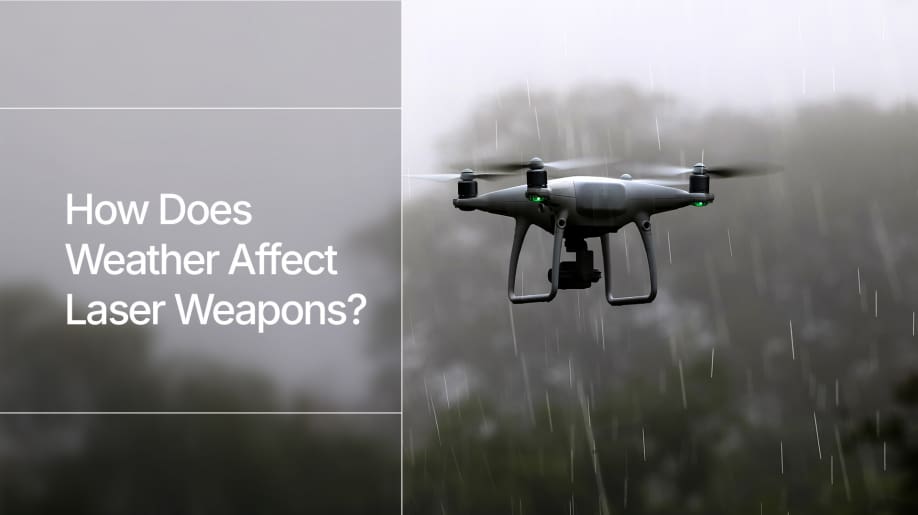
How Does Weather Affect Laser Weapons? A More Important Question Than It Seems

04/08/2026

How Does Weather Affect Laser Weapons? A More Important Question Than It Seems

By Aaron Westman, Senior Director of Business Development at AV 

One of the most common questions I’m asked about laser weapon systems is simple:

How do they perform in bad weather? 

At first glance, this appears to be a straightforward technical question. In reality, it’s not. Because laser weapons don’t operate in isolation—they operate within a broader contest between offensive and defensive systems, where environmental factors shape outcomes on both sides.

Weather is one of the most important of those factors. And historically, it has tended to favor the defender.

From Napoleon’s invasion of Russia to the D-Day landings, adverse weather has repeatedly slowed maneuver, disrupted coordination, and degraded the timing and precision required for offensive operations. Attacking forces depend on synchronization, visibility, and reliable sensing—all of which are vulnerable to environmental conditions.

Defensive systems, by contrast, are designed to absorb uncertainty.

This distinction is critical. Weather does not uniquely disadvantage laser weapons—it affects all systems. But in many cases, it degrades the attacker more than the defender. And because laser weapons are inherently defensive tools—providing speed-of-light engagement, precision, and persistent coverage—they often benefit from this dynamic on balance.

This is not just theoretical. It is consistently observed in testing and operations.

In ongoing evaluations of the LOCUST laser weapon system, high wind conditions degrade small UAS performance—impacting stability, navigation, and sensor effectiveness—well before degrading the laser system’s ability to to track and engage them. Similarly, reduced visibility conditions like haze, fog, or cloud cover undermine onboard sensors of small drones long before the more capable sensing and tracking systems of modern laser weapon platforms.

This is not to suggest laser performance is unaffected by weather. All systems are affected by environmental conditions. The key point is comparative: in operationally relevant scenarios, the threat system is degraded more than the defensive weapon engaging it.

This conclusion may seem counterintuitive, but it reflects a broader reality across modern warfare.

Over the course of two decades working with drones, radars, and directed energy platforms, I have yet to encounter a system that is immune to weather. Which raises an important question: why are laser weapons often characterized as “fair weather” systems?

One possible explanation is laser weapons rely on optical systems to complete their kill chain. But this is not unique.

Most modern targeting and guidance systems depend on optical sensing in some form. From the human eye to widely deployed munitions such as Hellfire, AIM-9 Sidewinder, and Stinger, optical and infrared sensors are fundamental to detection, tracking, and engagement across the battlefield.

Even systems that rely primarily on radio frequency (RF) sensing are not immune to environmental effects. Operators of advanced radar systems understand well that atmospheric conditions including precipitation, humidity, and turbulence can impact performance, detection range, and track quality. No sensing modality operates outside the influence of weather.

A related concern exploitation of weather by an attacker to achieve surprise or concealment.

In such scenarios, passive systems become particularly valuable. Laser weapons rely on passive sensing for detection and tracking, meaning they don’t emit signals detectable by an adversary. They can continuously observe the environment without revealing their position, even when operating in degraded conditions.

By contrast, active sensing systems such as radars inherently emit energy, making them detectable and targetable. As a result, these systems are often employed with emission control considerations, which can limit their availability at critical moments.

Looking ahead, the more important question is not how any single system performs in ideal conditions, but how systems perform in the environments where future conflicts are most likely to occur.

Will those conflicts be fought in good conditions—or in contested, uncertain, and degraded environments?

What attributes will matter most: magazine depth, persistence, survivability, and precision under imperfect conditions?

When viewed through that lens, laser weapon systems offer a compelling set of advantages. Their deep magazine, passive sensing approach, and speed-of-light engagement enable persistent defensive coverage without the logistical and operational constraints associated with traditional interceptors.

Integrated in a layered air defense architecture, these attributes enhance resilience and reduce overall system vulnerability, particularly in the face of increasingly numerous and low-cost aerial threats.

Ultimately, the value of any defensive system lies not only in its ability to perform, but in its ability to deter.

By improving the reliability, persistence, and cost-effectiveness of air defense in real-world conditions, including adverse weather, laser weapons can contribute meaningfully to that objective.

And effective deterrence remains the most important outcome of all.

About the Author

Aaron Westman is an engineer and leader specializing in counter-UAS and directed energy systems. He has played a key role advancing mobile laser weapon integration and operational deployment, supporting a variety of cross-domain capabilities that improve precision engagement and layered air defense.

Join the AV Mission

AV isn’t for everyone. We hire the curious, the relentless, the mission-obsessed. The best of the best.

We don’t just build defense technology—we redefine what’s possible. As the premier autonomous systems company in the U.S., AV delivers breakthrough capabilities across air, land, sea, space, and cyber. From AI-powered drones and loitering munitions to integrated autonomy and space resilience, our technologies shape the future of warfare and protect those who serve.

Founded by legendary innovator Dr. Paul B. MacCready, Jr., AV has spent over 50 years pushing the boundaries of what unmanned systems can do. Our heritage includes seven platforms in the Smithsonian—but we’re not building history, we’re building what’s next.

If you’re ready to build technology that matters—with speed, scale, and purpose—there’s no better place to do it than AV.
Explore Opportunities

Domains

Let’s Advance Your Mission

Product Catalog

Download the full catalog to explore our solutions in detail.

Blog

Can a Laser Weapon Operate Safely in Civilian Airspace?

03/23/2026

Aaron Westman, Senior Director of Business Development at AV 
Can a Laser Weapon Operate Safely in Civilian Airspace?

When most people hear the phrase laser weapon, they picture something out of science fiction — a glowing beam shooting across the sky toward a target and then carving through that target with ease, like a knife through butter.

The reality of lasers is very different.

Recently, the Joint Interagency Task Force 401 (JIATF 401) — the U.S. Department of War’s lead agency on C-UAS – worked alongside the Federal Aviation Administration (FAA) and completed a series of safety demonstrations at White Sands Missile Range in New Mexico using the Army’s Multipurpose High Energy Laser (AMP-HEL) system. These tests were designed specifically to answer the question many people are asking:

Can counter-drone lasers operate safely in mixed civilian airspace?

The short answer is yes — and the reason why comes down to how these systems are built and operated.

Over the past two decades as an engineer working in counter-UAS systems — including extensive testing of directed energy platforms — I’ve worked on systems designed with layered safety at their core. In the last four years alone, our LOCUST® team has conducted more than 66 test events and safely engaged over a thousand drone targets without incident.

That body of testing helps illustrate how these systems are engineered to operate safely in complex environments.

But how do they actually work?

LAYERS OF SAFETY

Most people imagine a laser weapon working like a laser gun in a science fiction movie: an operator points it, pulls the trigger, and a beam shoots toward the target.

In reality, modern laser systems operate much more like commercial aviation systems — with multiple independent safety layers designed to prevent a single mistake from creating a hazardous situation.

Every time an operator presses the “fire” button, the system runs through a series of automated checks. Some examples include:

  • Is the laser pointing away from protected “keep-out” zones?
  • Are all internal subsystems operating within safe parameters?
  • Is the system properly locked onto a target?
  • Are safety interlock switches engaged?
  • Are all software safety checks satisfied?

Each of these checks acts as a safety “vote.”

If any subsystem registers a “no vote,” the laser simply will not fire. An operator can press the trigger — and nothing happens. The system refuses to engage until all conditions are verified as safe.

These automated safeguards are built into both the hardware and the software of the system.

A WIDER VIEW OF THE AIRSPACE

Laser systems also don’t operate alone.

They are connected to higher-level command and control (C2) systems that maintain awareness of everything flying in the surrounding airspace. These systems combine data from radar, aircraft transponders, and other sensors to create what is known as an Integrated Air Picture.

By fusing information from multiple sources, operators can see civilian aircraft, military aircraft, and other objects operating nearby in real time.

This broader view provides another layer of safety. The command system can also issue its own “votes” that prevent the laser from firing if protected aircraft or restricted airspace are nearby.

In practical terms, this means that if an operator accidentally points the system toward an area where protected aircraft are operating, the laser will not fire. The system automatically blocks the engagement.

It’s another example of the principle used widely in aviation: multiple independent safeguards working together to prevent unsafe conditions.

WHAT ACTUALLY HAPPENS WHEN A LASER FIRES?

Another common misconception is how the laser beam behaves once it leaves the system.

In movies, laser beams look like glowing bolts of light traveling across the sky. Real directed-energy systems don’t work that way.

The beam itself is invisible and travels at the speed of light. The system can turn the laser on and off extremely quickly — engaging or disengaging in fractions of a second as safety systems continuously monitor conditions.

People also often imagine that the beam continues indefinitely into space like a perfectly straight pencil.

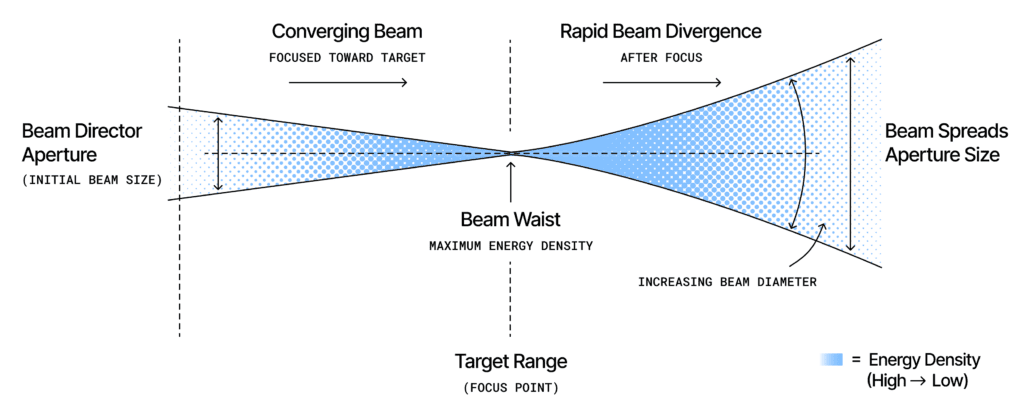
In reality, the beam is shaped like an hourglass. The center of the hourglass is called the focus point. The focus point is set to a specific, controlled distance to concentrate energy on a target. Beyond that focus point, the beam naturally spreads, reducing in intensity by an order of magnitude a few hundred meters beyond the focus point.

This means that after the target area, the beam quickly loses the intensity needed to cause damage. The natural physics of the beam significantly limits the risk to aircraft far beyond the engagement area.

FAMILIAR TECHNOLOGY


It’s also important to remember that the core laser technology used in these systems is not exotic.

The same class of near-infrared fiber lasers used in directed-energy systems is widely deployed across industry. Variants of these lasers are used every day in manufacturing to cut and weld metals, in medicine to perform precise surgical procedures, and even in agriculture as an herbicide-free way to remove weeds.

What makes counter-drone systems different is not the laser itself, but the sophisticated sensors, targeting systems, and safety controls built around it.

A SAFER WAY TO COUNTER DRONE THREATS

The rapid growth of small drone threats has created a difficult challenge: how to stop dangerous aircraft without introducing new risks into already busy airspace. That challenge now affects airports, critical infrastructure, public events, and military installations alike.

Properly designed laser systems help solve that problem.

Taken together — automated safety checks, integrated airspace awareness, and the natural physics of the beam itself — these systems are designed to operate safely even in mixed civilian airspace.

In a crowded airspace, the safest way to stop a dangerous drone may ultimately be a precisely controlled beam of light.

ABOUT THE AUTHOR

Aaron Westman is an engineer and leader specializing in counter-UAS and directed energy systems. He has played a key role advancing mobile laser weapon integration and operational deployment, supporting a variety of cross-domain capabilities that improve precision engagement and layered air defense.

JOIN THE AV MISSION

AV isn’t for everyone. We hire the curious, the relentless, the mission-obsessed. The best of the best.

We don’t just build defense technology—we redefine what’s possible. As the premier autonomous systems company in the U.S., AV delivers breakthrough capabilities across air, land, sea, space, and cyber. From AI-powered drones and loitering munitions to integrated autonomy and space resilience, our technologies shape the future of warfare and protect those who serve.

Founded by legendary innovator Dr. Paul B. MacCready, Jr., AV has spent over 50 years pushing the boundaries of what unmanned systems can do. Our heritage includes seven platforms in the Smithsonian—but we’re not building history, we’re building what’s next.

If you’re ready to build technology that matters—with speed, scale, and purpose—there’s no better place to do it than AV.
Let’s Advance Your Mission

Product Catalog

Download the full catalog to explore our solutions in detail.

Blog

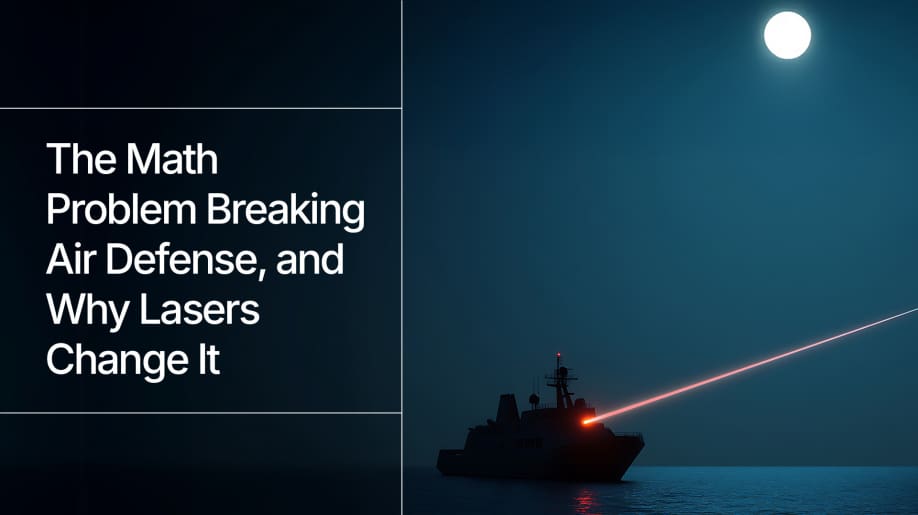
The Math Problem Breaking Air Defense, And Why Lasers Change It

03/04/2026

The Math Problem Breaking Air Defense, And Why Lasers Change It

By Aaron Westman, Senior Director of Business Development at AV  

A $50,000 drone can destroy a $30 million aircraft.

A $2 million missile can destroy a $50,000 drone.

If that sounds like a losing proposition, it’s because it is.

Unmanned Aircraft Systems (UAS) have fundamentally altered the economics of conflict. We have all seen the videos — small, inexpensive aircraft delivering outsized battlefield effects. Nowhere has this been more visible than in Ukraine, where production numbers and lethality statistics are staggering.

While much attention is focused on drone technology, the equally critical and often overlooked counterpart is counter-unmanned aerial systems (C-UAS), systems that allow us to defend against aerial threats. The ongoing cat-and-mouse game between drones and the defense systems designed to defeat them is evolving at an unprecedented pace. Dedicated C-UAS formations are being developed and adopted around the world. Advanced sensors and effectors are being deployed not just by militaries, but by law enforcement agencies, critical infrastructure operators, and even professional sports venues.

The importance of C-UAS is understood. Its implications are not.

At its core, the C-UAS challenge is not just technological. It is also economic.

Drones live in the world of software—iterative, mass-produced, and scaled across global supply chains capable of producing hundreds of thousands, even millions, of units per year. Air defense lives in the world of atoms. Every interceptor must be built, shipped, stored, and sustained. Each one is a discrete, exhaustible object. Once fired, it disappears from inventory, and replacing it takes time, money, and industrial capacity that cannot surge at the speed of software.

This creates a structural imbalance in cost and scale. A single defended site facing sustained drone pressure can consume thousands of interceptors in a matter of months, turning defense into a contest of industrial endurance rather than tactical skill. When each engagement carries a five or six-figure price tag, the defender risks spending more to defeat the threat than the attacker spends to create it.

In this environment, the defining metric of effectiveness is no longer whether a system can intercept a drone, but whether it can do so affordably, repeatedly, and at the scale the threat demands.

In essence, C-UAS is no longer defined by whether you can stop a drone, but whether you can afford to stop them all.

Why Cost Parity Is Not Enough

Conventional wisdom holds that if we can simply make interceptors cheaper, the problem goes away. It does not.

Even if an interceptor achieves nominal cost parity with a one-way attack drone, the defender still faces the burden of manufacturing, storing, and distributing large quantities of physical munitions. The attacker retains initiative. The defender retains logistical burden.

What the C-UAS fight demands is not just cost reduction. It demands a fundamentally different scaling model — one that can keep pace with, or outpace, the industrial production of drones.

That is where directed energy enters the conversation.

A Different Model: Electricity Instead of Inventory

Laser Directed Energy Weapons (LDEWs) invert the economics of C-UAS.

A missile is consumed when fired. A laser recharges.

Instead of throwing hardware at hardware, a laser delivers concentrated energy onto the target.  The marginal cost per engagement is measured in electricity — typically about a kilowatt-hour or $0.18 worth of electricity per shot, roughly comparable to the amount required to operate a household refrigerator for a day.

A laser system does not need a warehouse of interceptors. It does not require constant munitions resupply convoys. It is limited primarily by power availability and thermal management, not by missile inventory.

In practical terms, this means that a C-UAS unit equipped with an effective LDEW can defend against large volumes of small UAS threats without the exponential logistics burden associated with kinetic interceptors.

This is not science fiction. It is not a cinematic “death ray.” A modern LDEW functions more like a long-range precision welder, applying concentrated energy to structurally or functionally disable a drone. The physics are straightforward. The engineering challenge has been shrinking the system, lowering the cost, and making it rugged enough for real-world use.

Thanks to advances in commercial fiber lasers, optics, and power electronics, that tipping point has arrived.

Demonstrated Scale

Over the past four years, our team at AV has conducted more than 66 test, demonstration, live-fire, and operational exercises with our LOCUST family of C-UAS laser systems. Across those events — including preparations and supporting trials — we estimate that our systems have safely defeated over 1,000 small UAS targets.

These were not simulations. They were real unmanned aircraft, real sensors, real power systems, and real environmental conditions.

What is noteworthy is not simply that lasers work. It is that they can operate repeatedly without the inventory constraints that define kinetic systems. Even with only a limited number of prototypes built to date, the cumulative number of engagements would have required substantial missile expenditure had traditional interceptors been used.

That difference scales.

Not a Silver Bullet — But a Necessary One

No single system will solve every aspect of the C-UAS problem. RF-based systems will continue to play an important role against nuisance or commercially derived drones. Gun-based systems will retain utility at very close ranges or in specific environments. Kinetic interceptors remain essential against certain classes of threats.

But when confronting high-volume, low-cost robotic systems, it is difficult to envision a more suitable hard-kill effector than an affordable, producible LDEW.

The question is not whether lasers can defeat drones. They can, they do.

The real question is whether we are willing to align our defensive strategy with the economics of the threat.

In the C-UAS fight, cost structure is destiny. 


Yesterday, AV Announced a $30 million investment in its New Mexico campus, which is where the LOCUST system is manufactured.

ABOUT THE AUTHOR 

Aaron Westman is an engineer and leader specializing in counter-UAS and directed energy systems. He has played a key role advancing mobile laser weapon integration and operational deployment, supporting a variety of cross-domain capabilities that improve precision engagement and layered air defense.

JOIN THE AV MISSION 

AV isn’t for everyone. We hire the curious, the relentless, the mission-obsessed. The best of the best.

We don’t just build defense technology—we redefine what’s possible. As the premier autonomous systems company in the U.S., AV delivers breakthrough capabilities across air, land, sea, space, and cyber. From AI-powered drones and loitering munitions to integrated autonomy and space resilience, our technologies shape the future of warfare and protect those who serve.

Founded by legendary innovator Dr. Paul B. MacCready, Jr., AV has spent over 50 years pushing the boundaries of what unmanned systems can do. Our heritage includes seven platforms in the Smithsonian—but we’re not building history, we’re building what’s next.

If you’re ready to build technology that matters—with speed, scale, and purpose—there’s no better place to do it than AV.

 

Let’s Advance Your Mission

Product Catalog

Download the full catalog to explore our solutions in detail.

Blog

Three Questions About the Future of AI in Defense, Thoughts from the AI lead at AV’s Innovation Center

10/28/2025

Three Questions About the Future of AI in Defense, Thoughts from the AI lead at AV's Innovation Center

By Zarinah Casanova, AI Lead for AV’s Innovation Center 

Artificial intelligence has entered our daily lives—but on the battlefield, its role carries life-and-death consequences. That shift from everyday convenience to mission-critical responsibility is where my work begins.

For the past two decades, I’ve worked across cloud analytics, data science, and machine learning operations. Today, I lead AV’s Innovation Center in Annapolis Junction, Maryland, where we’re developing next-generation AI to keep our country safe. My own journey—from a high school work-study student to helping grow our lab from a single computer into a full data center—has reinforced a simple truth: in defense, AI is about responsibility. Systems must be reliable, explainable, and resilient because lives and missions depend on them.

The future of defense AI won’t be built by one person or one lab. It will come from collaboration across disciplines, communities, and nations. And as the technology races ahead, we have to stop and ask the toughest questions—the ones that will define whether AI strengthens our defenses or puts them at risk. AV’s Innovation Center was built for answers and there are three high-priority questions we’re working to address every day:

1. As national security missions grapple with the challenge of processing massive amounts of data, how can cutting-edge AI innovations be harnessed to make timely and impactful decisions?

Our missions are becoming more data-hungry, making breakthroughs in data collection, cleaning, and processing for AI an operational imperative. The traditional, time-consuming method of collecting all data and returning it to a central source for processing is no longer viable. By the time the data is ingested, the window for actionable intelligence has often passed. This inefficiency highlights the critical importance of decentralized, real-time data processing.

We are shifting towards architectures where processing and intelligence occur at the edge. This evolution involves deploying AI on low-resource or non-specialized hardware and utilizing it to process diverse raw data streams, such as those from sensors and network traffic, directly on site. The AV Innovation Center is on the cutting edge of this transformation, actively developing and testing these edge AI solutions to ensure timely and potentially autonomous actions in reaction to observations.

Additionally, innovative methods for data processing are essential. In our lab, we have prototyped an AI-driven data normalization process that automates the handling of rapidly changing data. This innovation addresses the ongoing struggle to keep pace with the ever-changing data landscape. The future of AI in defense hinges on these advancements, driving towards a paradigm of scalable, efficient, and real-time data processing that meets mission-critical needs with precision and speed.

 2. In the next five years, how far can we push AI at the edge—running on drones, satellites, or sensors in contested environments?

We’re actively working to translate the remarkable advances in artificial intelligence, particularly the reasoning and analytical capabilities demonstrated by large language models, into practical applications at the edge. While these publicly available Large Language Models (LLMs) are impressive, their size and general-purpose training present two key hurdles for deployment at the edge. First, their resource demands are often prohibitive for edge devices, and reliable network connectivity can’t be guaranteed. Second, they lack the specialized domain expertise necessary to interpret raw sensor data or contribute to real-time tactical decision-making.

The AV Innovation Center is focused on addressing these challenges by dramatically reducing model size while simultaneously ‘teaching’ those models to natively understand raw sensor data, recognize critical patterns, and enable proactive decision-making. In the next five years, this will lead to a significant leap in autonomous edge capabilities, enabling platforms to make complex, context-aware decisions in the most challenging environments.

3. How do we ensure that Autonomous AI systems behave as expected and remain responsible in critical scenarios?

Building autonomous AI for defense carries a significant responsibility, one we don’t take lightly. We proactively design for safety through monitoring and traceability right from the start. We also build in layers of oversight to keep the AI in check, ensuring it operates as intended. These factors are integral to our development process, ensuring our systems are transparent and accountable.

We establish evaluation frameworks early in the development process to rigorously assess safe operation of our AI systems. To support this, we engage with an AI review board composed of technical, legal, and compliance experts. This diverse oversight provides critical perspectives and helps us navigate complex challenges related to safe and responsible deployment.

These questions are not easy to solve – nor should they be. AV’s Innovation Center works to answer these questions by fostering a culture that welcomes critical thinking, especially when it comes to responsible innovation. We’re looking for people who are not only brilliant engineers but also deeply committed to building AI systems that operate reliably and as intended. By integrating these principles into our innovation process, we aim to develop AI systems that are both cutting-edge and responsible. If this sounds like you, explore opportunities and join me at AV as we ask – and answer – the questions most critical to protecting our nation.


ABOUT AV — JOINING THE MISSION

AV isn’t for everyone. We hire the curious, the relentless, the mission-obsessed. The best of the best.

We don’t just build defense technology—we redefine what’s possible. As the premier autonomous systems company in the U.S., AV delivers breakthrough capabilities across air, land, sea, space, and cyber. From AI-powered drones and loitering munitions to integrated autonomy and space resilience, our technologies shape the future of warfare and protect those who serve.

Founded by legendary innovator Dr. Paul MacCready, AV has spent over 50 years pushing the boundaries of what unmanned systems can do. Our heritage includes seven platforms in the Smithsonian—but we’re not building history, we’re building what’s next.

If you’re ready to build technology that matters—with speed, scale, and purpose—there’s no better place to do it than AV.

Let’s Advance Your Mission

Product Catalog

Download the full catalog to explore our solutions in detail.

Blog

Opening Statement: Industry Perspectives on How Drone Warfare Abroad Is Transforming Threats at Home

07/16/2025

Opening Statement: Industry Perspectives on How Drone Warfare Abroad Is Transforming Threats at Home Church Hutt

Chairman Gimenez, Ranking Member McIver, and Distinguished Members of the Subcommittee: 

Thank you for the opportunity to testify on how drone warfare abroad is informing domestic investments to prepare for threats here in the United States. I commend the committee’s focus on these challenges and your efforts to enhance the safety of the American people and the U.S. transportation systems. My name is Church Hutton, and I serve as the Chief Growth Officer for AV, formerly AeroVironment. It is my pleasure to testify alongside industry partners as we highlight associated challenges, opportunities, and the importance of providing effective capabilities to our servicemembers and first line responders. 


Let’s Advance Your Mission

Product Catalog

Download the full catalog to explore our solutions in detail.