
By Florian Gruener, Managing Director of Telerob, an AV Company
A recent incident at Leipzig/Halle Airport is a good example of how the threat from unmanned systems is changing.
Authorities discovered an unmanned drone carrying an improvised explosive device on airport grounds near Ukrainian cargo aircraft. Leipzig/Halle is one of Europe’s largest freight hubs and a critical logistics gateway supporting global commerce and the movement of military supplies into Eastern Europe.
In a matter of moments, a transportation hub became the scene of an active security incident.
Flights were disrupted. Security perimeters expanded. Explosive ordnance disposal specialists responded.
For investigators, the danger was not simply the drone itself. It was everything they did not know.
Was the explosive stable? Could it be remotely triggered? Would moving the drone initiate the device? Was there a chemical, biological or radiological threat? Was this the only device?
These are the kinds of questions EOD operators must answer before they can safely deal with an unknown explosive.
And the basic principle is quite simple: the more distance you can put between the operator and an unknown explosive, the better.
That is why another unmanned system became an important part of the response that day at Leipzig.
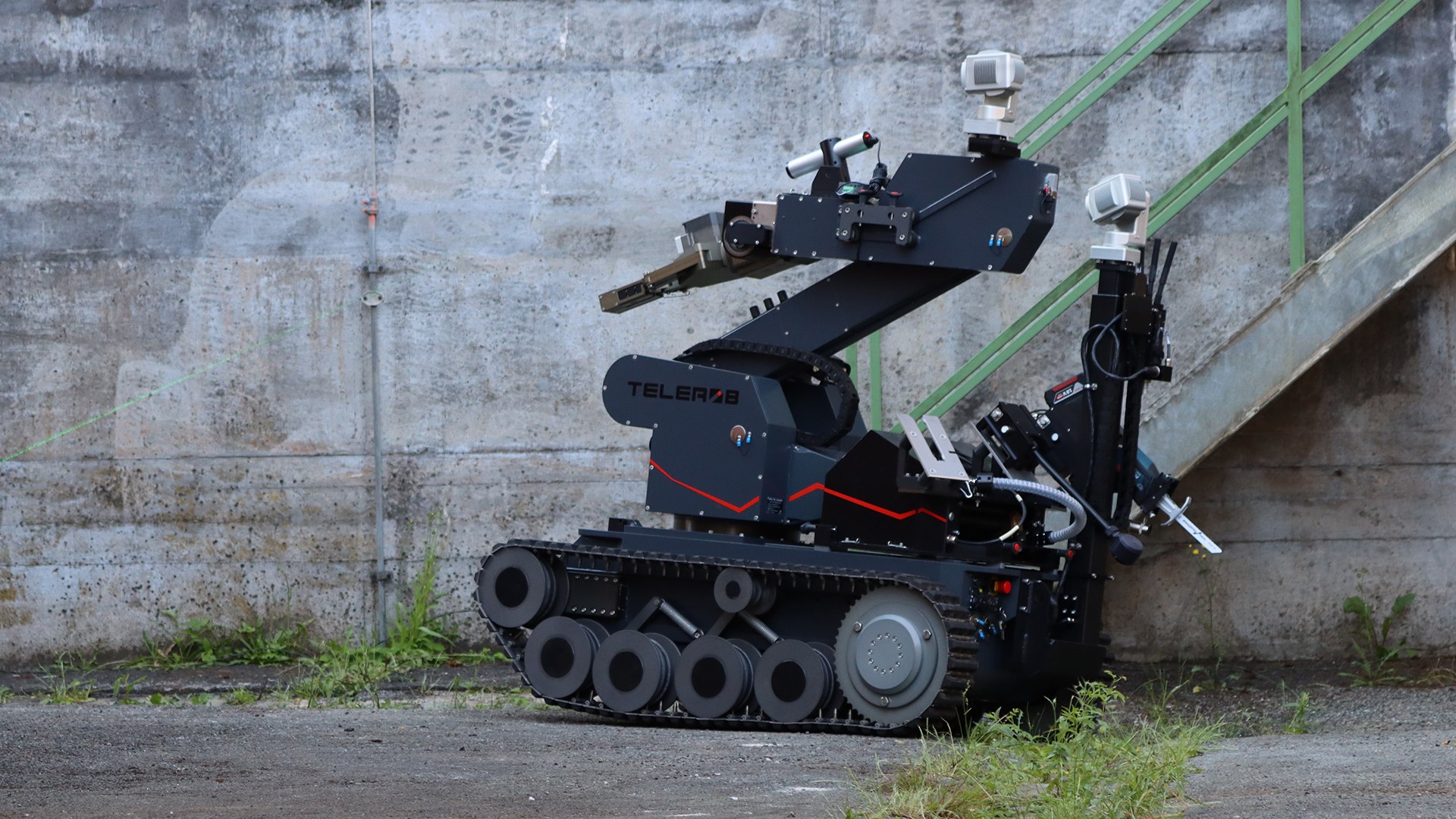
AV’s tEODor™ EVO, a remotely operated unmanned ground vehicle, moved toward the threat, allowing bomb technicians to remain at a safer distance while they investigated and manipulated the device and supported the safe removal of the detonator.
The headlines were about a drone.
But for me, Leipzig demonstrated something that deserves much more attention as governments and critical infrastructure operators invest in counter-UAS:
Stopping the drone is not necessarily the end of the mission.
When Counter-UAS Becomes EOD
A great deal of investment is currently going into counter-UAS capabilities, and as the modern UAS threat continues to evolve quickly, we are constantly asking questions like:
Can we detect the drone? Can we identify it? Can we track it? Can we jam it, intercept it or otherwise defeat it?
All of these are important questions.
But if that drone is carrying an explosive payload, bringing it to the ground does not necessarily solve the problem.
It changes the problem. We need to start asking new questions.
The threat that was moving through the air is now sitting on the ground. Someone still needs to determine what it is carrying. Someone needs to inspect it. Someone needs to understand whether it can be moved. And eventually, someone needs to render it safe.
The mission has transitioned from counter-UAS to EOD.
This is an important connection because counter-UAS and EOD are often treated as separate capabilities. Operationally, however, the transition between them can happen in seconds.
First, you have a drone in the air.
Then, you have a drone on the ground.
If that drone is carrying an explosive payload, you now have an EOD problem.
That means protecting airports, military installations, ports, logistics hubs and other critical infrastructure requires us to think beyond how we defeat the aircraft. We also have to plan for what happens after the aircraft is defeated.
A Cheap System Can Create an Expensive Problem
Leipzig also demonstrates why this problem is becoming more urgent.
The economics of the drone threat are highly asymmetric.
Commercial drones can fly significant distances, navigate accurately and carry meaningful payloads. At the same time, they are widely available and comparatively inexpensive.
A system costing hundreds or thousands of dollars can potentially create effects costing millions.
It can interrupt airport operations. It can disrupt logistics. It can threaten military movements. It can force the closure of infrastructure and require a significant security response.
We have seen this development very clearly in active conflicts over the last several years. The same technologies and tactics can create serious problems far beyond a traditional front line.
For me, the important question is not simply what the drone costs.
It is what effect the drone can create and whether we are prepared for the complete response that follows.
Why Distance Matters
EOD robots are not new. We have been building these systems at Telerob and AV for decades, and the basic principle behind them has remained remarkably consistent.
If a dangerous task can be performed remotely, there is no reason to put a person directly next to the danger when that can be avoided.
That does not mean the robot replaces the EOD operator. I think this is an important distinction.
The operator understands the situation. The operator evaluates the threat. The operator makes the decisions.
The robot gives that person the ability to act on those decisions from a safer distance.
At Leipzig, bomb technicians could maneuver tEODor toward the drone, inspect the device through its cameras and use its manipulator to interact with the payload while remaining at a protected distance.
There is no single technical feature that makes an EOD robot effective. It is the combination of mobility, cameras, manipulation, communications and mission-specific tools working together to give the operator the capabilities needed for a particular situation.
Technology does not resolve an EOD incident.
Trained people do.
Planning for the Complete Response
We should not think about counter-UAS simply as a sequence that ends when a drone is detected, tracked and defeated.
We should think about the complete response.
Can we detect the drone?
Can we identify what it is doing?
Can we stop it?
And then, can we safely deal with what remains?
That last question will become increasingly important as drones become more capable, accessible and adaptable.
Different missions will require different robotic systems. Some situations will require larger platforms with significant manipulation capabilities. Others may require smaller, rapidly deployable systems. There will not be one robot that fits every mission.
But the objective remains the same: give operators the information and physical capability they need while keeping them as far away from the danger as reasonably possible.
Leipzig demonstrated why that matters.
Leipzig is a reminder that defeating an unmanned threat doesn’t necessarily eliminate it. Sometimes, it simply moves the threat from one domain to another.
The organizations responsible for protecting critical infrastructure need to plan for that transition before it happens.
Because the C-UAS mission may end when the drone reaches the ground, but the EOD mission may only be beginning.
ABOUT THE AUTHOR
Florian Gruener is Managing Director of Telerob GmbH and leads AV’s Unmanned Ground Vehicle product line. He has worked in the unmanned ground systems industry for many years, supporting military, law enforcement and public safety customers worldwide.
JOIN THE AV MISSION
AV isn’t for everyone. We hire the curious, the relentless, the mission-obsessed. The best of the best.
We don’t just build defense technology—we redefine what’s possible. As the premier autonomous systems company in the U.S., AV delivers breakthrough capabilities across air, land, sea, space, and cyber. From AI-powered drones and loitering munitions to integrated autonomy and space resilience, our technologies shape the future of warfare and protect those who serve.
Founded by legendary innovator Dr. Paul B. MacCready, Jr., AV has spent over 50 years pushing the boundaries of what unmanned systems can do. Our heritage includes seven platforms in the Smithsonian—but we’re not building history, we’re building what’s next.
If you’re ready to build technology that matters—with speed, scale, and purpose—there’s no better place to do it than AV.