
By Paul Webber, Director, Strategic Initiatives, Advanced Defense Solutions, AV
There is a moment that is becoming increasingly common for operators.
The sky gets busy. Alerts stack up. Tracks multiply. Radios get louder. Somebody says, “Just keep it moving,” which is not a strategy. It is a reaction to a symptom.
In that moment, nobody is really asking, “Can we intercept a drone?”
The real question is, “Can we get ahead?”
That is what modern unmanned aircraft system, or UAS, threats do best. They do not need to be perfect. They just need to be numerous, fast, persistent, and cheap enough to push a defense past its carrying capacity.
Once that happens, the attacker is no longer trying to beat your interceptor. They are trying to beat your decision loop.
I’ve spent most of my career working with people whose job is to keep bad things from happening to Americans. For the past several years, I’ve architected counter-drone (C-UAS) solutions at AV and I’m watching the threat continue to move faster and scale wider while putting unprecedented strain on defenses both domestic and worldwide.
In Part one of this series I’m authoring, I framed the problem as an S-curve mismatch: legacy air defense architectures built for a different threat regime, now stressed by UAS operating at scale, tempo, and decision-compressing speed.
Part two is about the path to a solution: not a single sensor, not another screen, and not a big-bang leap to autonomy. The answer, I believe, is a phased, distributed architecture that increases defensive carrying capacity without overwhelming operators.
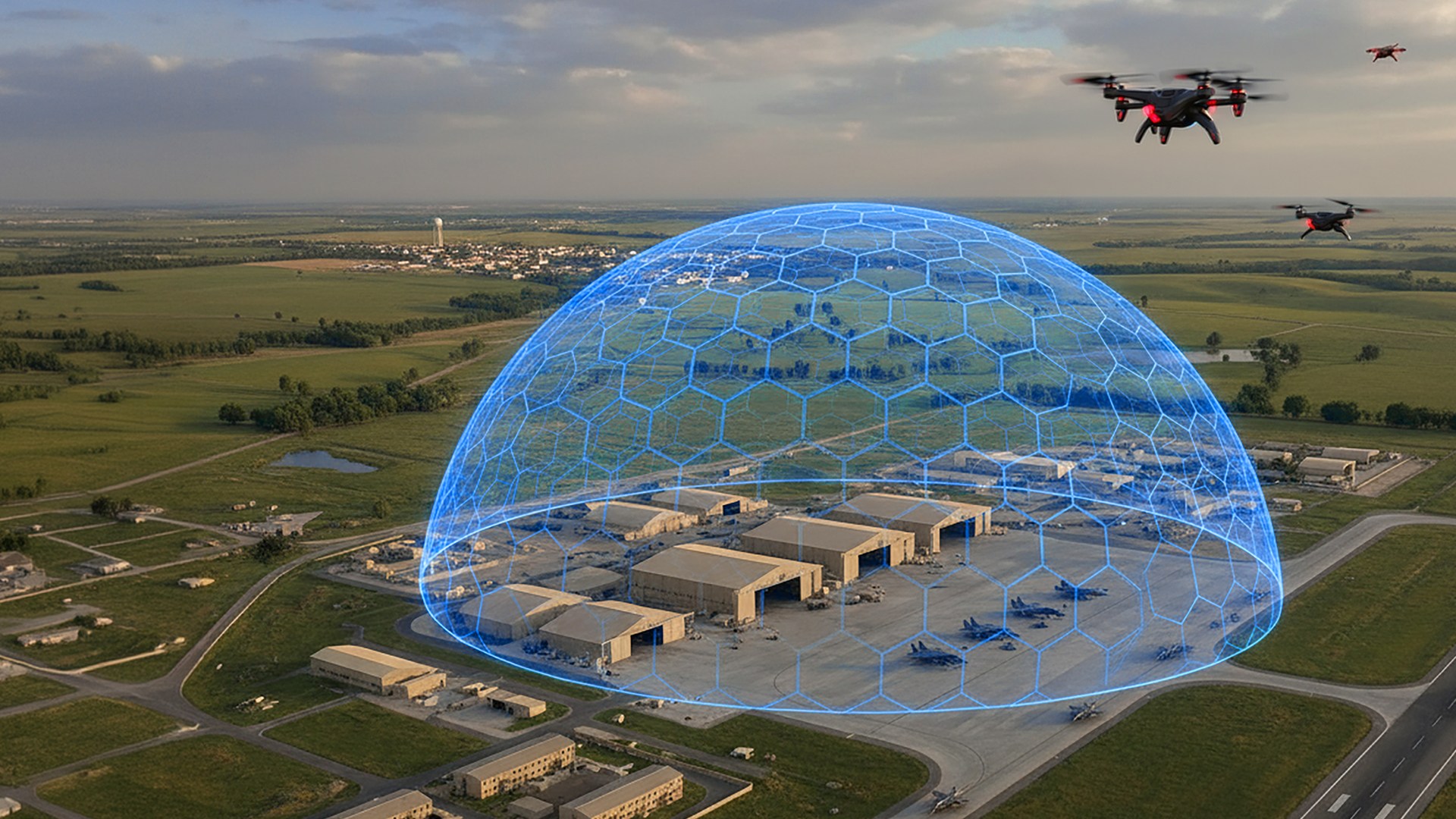
At AV, I’m part of a team that is making that path real through testing with an important milestone upcoming as we deploy our layered defense product known as Halo_Shield™ at GrandSKY in Grand Forks, North Dakota, one of the nation’s premier unmanned aircraft systems research and testing hubs.
GrandSKY is the right kind of environment for this work: operationally relevant, adjacent to Grand Forks Air Force Base, deeply tied to unmanned aircraft system research and testing, and complex enough to expose whether a layered counter-UAS architecture can move from concept to implementation.
GrandSKY is not just a demonstration site. It is a proving ground for how Halo_Shield can grow from an initial tile into a scalable, distributed shield over time.
The goal is not just to defend GrandSKY. The goal is to show how a critical asset location can evolve from an initial protective footprint into a distributed, layered shield that can be adapted for military installations, research facilities, airports, seaports, borders, power grids, energy sites, data centers, and other critical infrastructure.
MAYA Applied to Counter-UAS
MAYA, Most Advanced Yet Acceptable, is not a branding exercise.
Applied to C-UAS, MAYA means being advanced enough to compress the OODA loop (Observe, Orient, Decide, Act) against scale and speed, while still acceptable enough to fit real operator workflows, rules of engagement constraints, and integration realities.
In counter-UAS, it is the difference between a capability that looks impressive in a briefing and one an operator will actually use when the sky gets busy.
It’s more than “Just keep it moving.”
MAYA keeps the solution path honest by forcing three questions:
- Can we field a solution now without breaking existing workflows?
- Can we grow the solution without rewriting the system every time we add a sensor or effector?
- Can we trust the solution under load, when timelines collapse and operators are attention-limited?
That is why the path has to be fielding a solution that is incremental.
You do not jump from manual control to full autonomy in one leap. You earn trust in phases. Each phase should be measurable, explainable, and operationally useful on its own.
Phase One of deploying Halo_Shield at GrandSKY allows for that trust to grow, beginning with a Terrestrial Tile-driven configuration focused on detection, tracking, identification, and defeat of small UAS threats, while also establishing initial Left-of-Launch detection and a focused ARGUS™ perimeter defense footprint.
This phase is advanced but not abstract. It is designed to show what can be fielded, measured, improved, and expanded.
What Distributed Defense Looks Like in Practice
Traditional point defense concentrates sensors and effectors in one location and runs the mitigation cycle from that single position. It is a valid construct, but it comes with hard ceilings: finite magazine depth, finite operator bandwidth, limited coverage geometry, and a natural pull toward centralized decisions that can make the system itself the bottleneck.
Distributed defense does not concentrate capacity. It multiplies it.
Halo_Shield is built around mission-specific, purpose-built Tiles: Sentinel, Terrestrial, Nautical, Aerial, and Celestial. Each Tile is a defined operational area where sensors, effectors, software, and command-and-control workflows are configured around a mission, terrain, asset, and threat profile.
In Phase One of deployment at GrandSKY, the first step is the Terrestrial Tile. That configuration integrates AV_Halo™ COMMAND for layered battle management and command and control (C2), while remaining compatible with peer and higher-echelon battle management command and control (BMC2) platforms. It brings together:
- TITAN®-SV MPV3 — C-UAS RF detection
- ARGUS™ — perimeter security and ground-domain awareness
- Passive radar — non-emitting detection and tracking of airborne targets
- Acoustic sensors — passive detection and cueing based on aircraft signatures
- EO/IR — visual confirmation, classification, identification, and precision tracking
- TITAN® — C-UAS RF detection and defeat
- AV_Halo™ COMMAND — battle management C2 that fuses these sensor inputs into a common operating picture and enables automated edge responses
- — along with additional AV and OEM partner capabilities.
The practical effect is straightforward: distributed, multi-modal sensing extends detection and tracking, improves identification and situational awareness, and creates multiple opportunities to detect the same threat before it reaches the defended asset. RF, passive radar, acoustic, and EO/IR sensors provide complementary views of the battlespace, while AV_Halo COMMAND correlates those inputs into a common track picture. A predominantly passive sensor posture also allows the system to maintain persistent awareness while minimizing emissions and reducing the likelihood that the defensive architecture becomes an obvious target itself.
Point defense is a single strong door.
AV’s Halo_Shield is the perimeter, the hallway, the cameras, the listening posts, the lighting, the locks, and the guards moving through the building. You still want the strong door. You just do not want your first indication of a threat to be the sound of the doorframe cracking.
At GrandSKY, the objective is not simply to defend the front door. It is to create multiple layers of awareness and response throughout the entire building.
A New Mitigation Cycle for a New Threat Curve
Distributed defense also requires updating the targeting methodology. The legacy cycle — Detect, Track, Identify, Process, Engage — was built around individual engagements.
The distributed cycle is built for throughput:
Place → Sense → Find → Fix → Pair → Engage → Assess
This shift is not cosmetic. It changes how you scale.
Place creates capacity. Coverage is designed, not assumed.
Sense, Find, and Fix build confidence early and reduce downstream uncertainty.
Pair preserves resources by matching the right effector to the right threat at the right time.
Engage and Assess close the loop fast enough to handle the next track, the next axis, and the next wave.
This is where GrandSKY becomes more than an installation. It becomes an operational test of whether a modular architecture can reduce operator workload, validate advanced planning and engagement tools, and support coordinated response in a realistic environment.
The legacy cycle optimizes for the single shot. The distributed cycle optimizes for sustained throughput under pressure.
The Phased Maturity Model, Building Trust
The solution path for counter-UAS leaders is not “autonomy now.”
It is staged maturity that builds confidence, capability, and trust over time.
Phase 1: Auto-cue
Auto-cue speeds Observe and Orient without changing the fundamentals of control. The solution architecture cues higher-fidelity sensors based on initial detections. Operators retain ownership of identification and engagement decisions.
This is a natural fit for GrandSKY Phase One. The Terrestrial Tile establishes the foundation for early detection, sensor cueing, track development, and operator confidence without forcing a leap into unfamiliar workflows.
Phase 2: Auto-task
Auto-task makes the network behave like a network. Sensors and workflows are coordinated across the Tile automatically. Operators stay in control of decisions, but the system reduces the manual choreography that burns time and attention.
This is where defensive carrying capacity starts to increase without simply adding more people. The goal is not to make the operator work faster. The goal is to remove work the operator should not have to do in the first place.
Phase 3: Recommendations
This is where scale becomes real. The solution architecture recommends actions, particularly weapons pairing and scheduling, based on track confidence, resource availability, constraints, timing, and rules of engagement. Humans remain in charge.
Two rules apply here: recommendations must be explainable, and they must perform under load. If the system cannot explain why it recommends a course of action, operators will not trust it. If it only performs on a quiet day, it is not ready.
At GrandSKY, this is one of the key values of a phased approach. Initial deployment can validate sensing, tracking, and workflow performance. Later phases can add more complex effectors, additional sensors, and more advanced pairing logic once the foundation is stable.
Phase 4: Conditional autonomy with human oversight
When threat volume or time-of-arrival compresses beyond human-compatible tempo, the system can execute within pre-approved policy, constraints, and commander’s intent, with humans supervising and able to intervene.
This is not humans out of the loop. It is humans above the loop.
Autonomy should function as a relief valve, not a default setting. The goal is not to replace human judgment. It is to preserve it when the sky gets crowded.
Phasing to the Solution
The solution path is not a big-bang leap to autonomy. It is phased adoption that builds trust, increases throughput, and expands defensive carrying capacity over time.
GrandSKY gives that path a real implementation environment.
Distributed Tiles expand situational awareness and multiply capacity. The updated mitigation cycle creates room for pairing, scheduling, and rapid assessment at scale. MAYA keeps the approach grounded in what operators will actually use, leaders can actually field, and integrators can actually sustain.
The question to carry into Part 3 is simple:
Are you buying point solutions, or are you building a path to scale that holds up when the sky gets busy?
ABOUT THE AUTHOR
Paul Webber is a retired Marine Raider and strategic advisor with over two decades of leadership, special operations, and systems analysis experience. He blends operational insight with design thinking to tackle complex defense challenges, particularly in emerging domains like C-UAS. Paul holds an MBA from the University of Georgia, an MS from the Naval Postgraduate School, maintains a Top Secret-SCI clearance, and applies a human-centered lens to technology adoption and workflow design in defense environments.
——
ABOUT AV — JOINING THE MISSION
AeroVironment (AV) is a defense technology company with a mission to invent and deliver advantage to U.S. and allied militaries. AV isn’t for everyone. We hire the curious, the relentless, the mission-obsessed.
AV doesn’t just build defense technology; we redefine what’s possible. As the premier autonomous systems company in the U.S., we deliver breakthrough capabilities across air, land, sea, space, and cyber. From autonomy-enabled drones and loitering munitions to integrated autonomy and space resilience, our technologies shape the future of warfare and protect those who serve.
Founded by legendary innovator Dr. Paul MacCready, AV has spent over 50 years pushing the boundaries of what unmanned systems can do. Our heritage includes seven platforms in the Smithsonian—but we’re not building history, we’re building what’s next.
If you’re ready to build technology that matters – with speed, scale, and purpose – come find your people.