
What the DOT, DHS, and DoW agreement means for the southern border’s unwelcome drones.
The federal government recently announced some changes to the airspace along our southern border, and it is fair to say that cartel drone operators were not the intended beneficiaries.
On October 16, the Departments of Transportation, War, and Homeland Security announced a coordinated effort to prohibit unauthorized drone operations within one nautical mile north of the U.S.-Mexico border, from the ground up to 400 feet.
For those of us who have spent years working on defenses against small drones, this was encouraging news, not because of policy but because we see an effective method for deterring bad actors. Flight restrictions are useful, but their effectiveness against criminal organizations has always suffered from the awkward fact that compliance is not generally their strongest suit.
Having the means to enforce those restrictions makes the conversation considerably more interesting. The harder question is whether enforcement changes what the operators do next.
The scale is not hypothetical. U.S. Customs and Border Protection reported detecting more than 42,000 near-border drone flights in fiscal year 2025, while cautioning that not all were necessarily malicious. Military officials have also described drones being used for reconnaissance in support of smuggling and human trafficking. The aircraft do not need to carry anything to be useful to a cartel. Sometimes knowing where the people trying to stop you are standing is useful enough.
Small drones have created a peculiar problem for the people responsible for protecting us. Technology that is affordable, widely available, and useful for any number of legitimate purposes can also be put to work by people with considerably less public-spirited intentions. Defenders then have to work out how to stop it without spending a fortune or creating a bigger problem for everyone nearby.
It is a surprisingly demanding set of requirements, considering how little is required of the person causing the problem.
This is where laser weapon systems have something useful to offer. By concentrating light on a drone, a high-energy laser can physically damage or disable it without sending a bullet or missile through the air. The precision of that approach, together with the potential for a very low cost per engagement, makes lasers particularly attractive for missions that may require repeated responses to inexpensive threats, provided the system can find, track and safely engage them under real operating conditions.
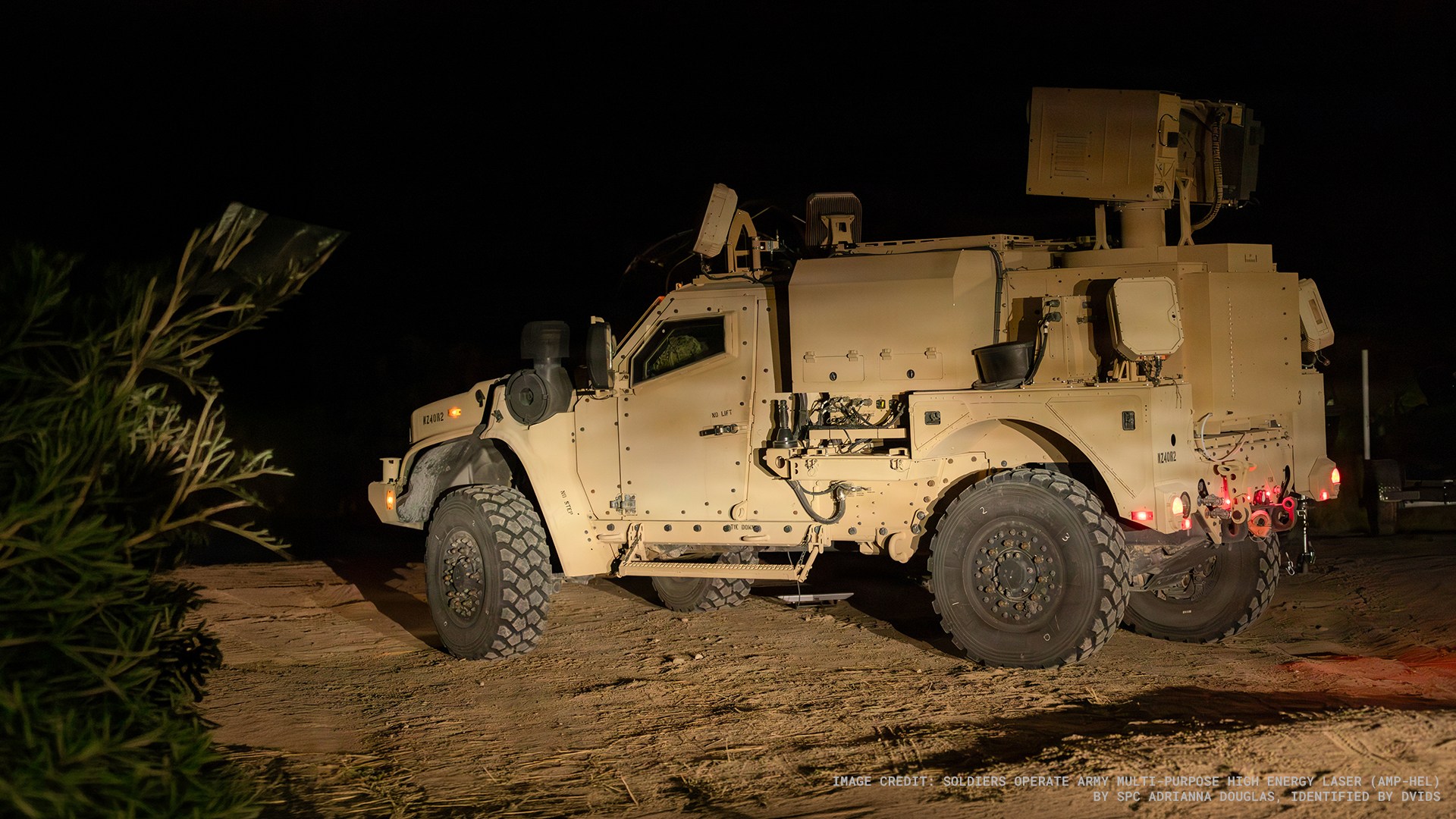
The Army’s Multi-Purpose High Energy Laser program, or AMP-HEL, provides a practical example. These vehicle-mounted systems use AV’s LOCUST® laser technology, combining precision tracking and drone defeat capability on platforms that can move where they are needed. AV has already delivered these systems to the Army on light tactical vehicles—a somewhat less theatrical introduction to the laser age than science fiction had prepared us for, but a useful one.
There is an important distinction here, particularly for customers who have to live with these systems after the demonstration is over. Defeating one drone shows that the weapon can do its job. Defending a location means doing it reliably, with the operators, sensors, power, maintenance, and engagement decisions that the mission actually requires. The drone does not schedule its arrival around the test plan.
For those protecting a border or a critical facility, the practical question is whether they can keep responding to the next drone, and the one after that. An effective defense needs to remain affordable and resilient long after the first successful engagement, and available when the next aircraft shows up.
The cost curve is a critical factor for defenders. For someone accustomed to using cheap aircraft with relatively little concern about losing them, a capable and persistent defense introduces an unwelcome complication. The aircraft may still be inexpensive, but the specter of needing to replace it creates doubt in the mind of the operator charged with completing the task.
The electrical energy used in an engagement can cost far less than an expendable interceptor, and the next shot does not require another round of ammunition. That makes repeated attempts to breach protected airspace a more manageable proposition for the defender, though the comparison only holds if the whole system can be sustained at a sensible cost.
That does not make the electricity bill the cost of the defense. Lasers still need power, cooling, maintenance, trained operators, and conditions in which they can engage effectively. The comparison that matters is the cost of sustaining the defense over time, not the price of one impressive shot.
This also suggests a better question for the customer than how many drones were destroyed. Are incursions becoming less frequent in the area being defended? Are operators changing routes or tactics? Are those changes making surveillance and smuggling harder, or merely moving the problem down the border? A successful engagement measures the weapon. Those answers begin to measure the mission. We should be careful not to mistake displacement for deterrence.
That is why the border announcement is an encouraging step toward making protected airspace mean something in practice. Scaling this up will require more systems, trained operators, and sustained cooperation among the agencies responsible for security and aviation safety. Industry will need to expand production, and government will need to provide the consistent demand that makes that investment possible. Customers should also ask whether deployments are reducing incursions in the defended area without simply pushing them to the next one.
There is more work to do in protecting ports, energy facilities, transportation hubs, and other places where an unwelcome drone could cause trouble well beyond its purchase price. Still, we should take some satisfaction in the progress. Small drones have given criminal organizations and other hostile actors a useful new tool; it is encouraging to see the people charged with stopping them getting useful tools of their own.
With continued investment and care, we can make more of our airspace reliably inhospitable to those who intend to misuse it. The legitimate flying public should scarcely notice. Ideally, our adversaries will.
Editorial working draft. Verify CBP figure and customer-facing operational statements with Aaron before publication.
ABOUT THE AUTHOR
Aaron Westman is an engineer and leader specializing in counter-UAS and directed energy systems. He has played a key role advancing mobile laser weapon integration and operational deployment, supporting a variety of cross-domain capabilities that improve precision engagement and layered air defense.
JOIN THE AV MISSION
AV isn’t for everyone. We hire the curious, the relentless, the mission-obsessed. The best of the best.
We don’t just build defense technology—we redefine what’s possible. As the premier autonomous systems company in the U.S., AV delivers breakthrough capabilities across air, land, sea, space, and cyber. From AI-powered drones and loitering munitions to integrated autonomy and space resilience, our technologies shape the future of warfare and protect those who serve.
Founded by legendary innovator Dr. Paul B. MacCready, Jr., AV has spent over 50 years pushing the boundaries of what unmanned systems can do. Our heritage includes seven platforms in the Smithsonian—but we’re not building history, we’re building what’s next.
If you’re ready to build technology that matters—with speed, scale, and purpose—there’s no better place to do it than AV.