
By Mary Clum, President of Space, Cyber and Directed Energy, AV
My grandfather helped change the way we think about air combat.
Harry J. Hillaker, the “Father of the F-16,” was part of the small group of engineers, pilots and strategists known as the Fighter Mafia. Alongside John Boyd and others, he challenged a powerful assumption of his time: that the answer to every new threat had to be a larger, more complex and more expensive system.
The result was the F-16 fighter aircraft.
Its significance went far beyond a new airplane. The F-16 helped redefine fighter design around agility, responsiveness, affordability and scale. It demonstrated that operational advantage could come not from adding complexity, but from making disciplined engineering choices around what the mission actually required.
Boyd would eventually formalize another idea that has endured for generations:
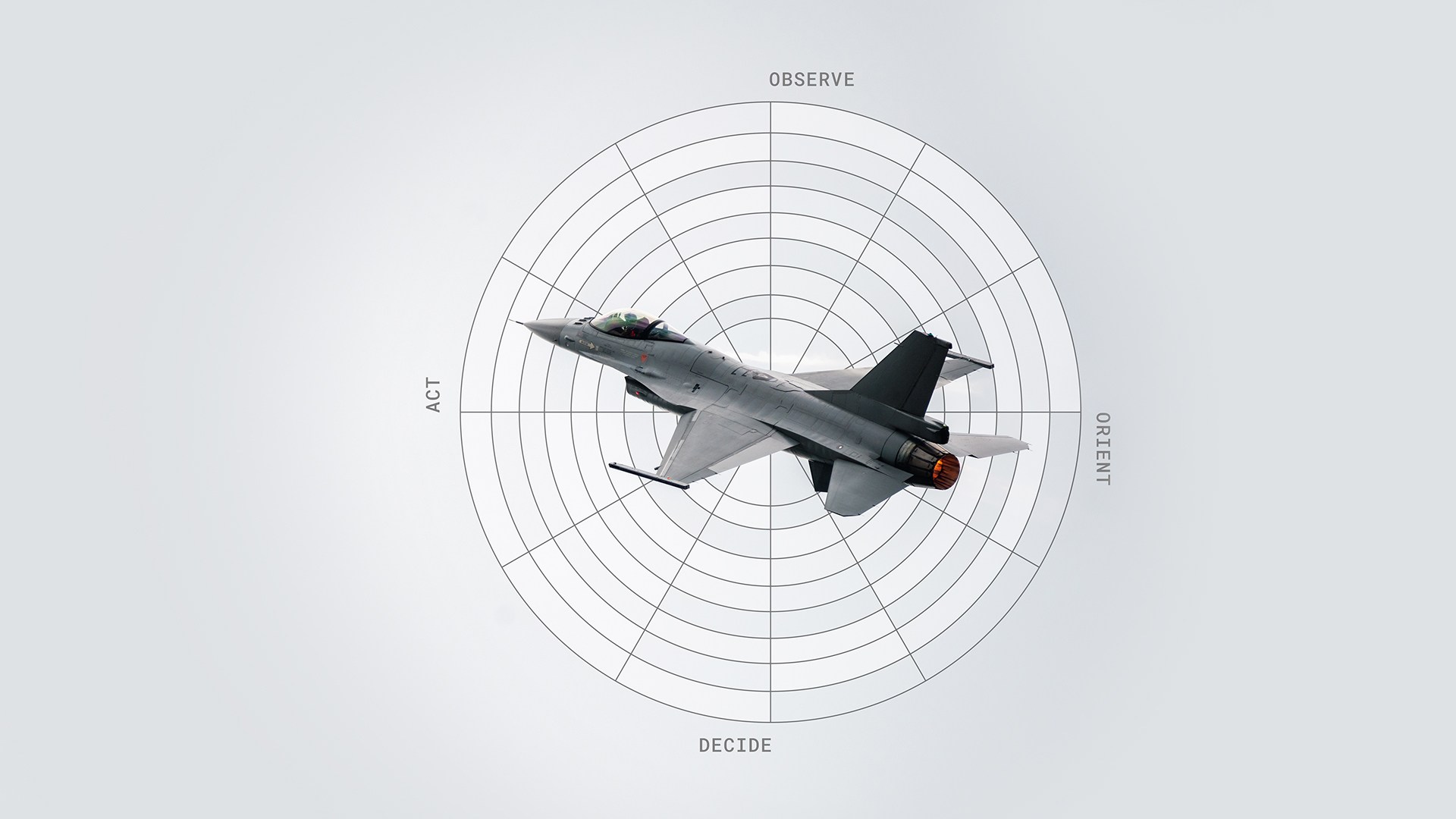
Observe. Orient. Decide. Act, a four-step decision-making model that allowed late commitment and decision-making during changing environments, which was particularly relevant to pilots operating in conflict.
We know this today as the OODA Loop.
Today, I believe we need to rethink the OODA Loop as it relates to the autonomous age.
When machines begin operating at machine speed, the OODA Loop can no longer be treated only as a process.
The OODA Loop must evolve into an architecture that depends less on accelerating a single kill chain and more on coordinating multiple OODA Loops across sensors, software, operators, networks, and effectors.
A Different Kind of Fight
Our forces increasingly face inexpensive unmanned systems that can arrive in numbers, approach from multiple directions and operate with increasing levels of autonomy.
That creates two problems simultaneously.
The first is speed.
Defenders must detect what is happening, understand it, determine what matters and respond before the threat completes its mission.
The second is economics.
We cannot sustainably defeat every inexpensive drone with an interceptor costing many times more. And we cannot assume that a single sensor, effector or standalone counter-unmanned aircraft system will be appropriate for every threat.
The question, then, is not simply how we make the OODA Loop faster.
It is how we architect the OODA Loop into the defense itself.
When the OODA Loop Becomes an Architecture
In an autonomous fight, Observe can mean multiple sensors detecting different aspects of the battlespace simultaneously.
Orient increasingly means software, AI and machine learning helping fuse those inputs, identify potential threats and present operators with information they can actually use.
Decide requires understanding not only whether something is a threat, but what response is appropriate and the tradeoffs associated with that choice.
And Act can no longer mean applying a single effector. It requires orchestrating effects across multiple capabilities as part of a coordinated response.
Electronic warfare may be appropriate for one threat, a kinetic interceptor for another, while directed energy would introduce a fundamentally different cost-per-engagement and magazine-depth equation, perhaps, making it the best option for yet another significantly different threat like drone swarms.
That means the modern OODA Loop increasingly looks less like a sequence performed by one person operating a single fixed-point system and more like a distributed architecture connecting sensors, decision aids, weapons pairing and scheduling, operators and effectors.
That is the thinking behind AV’s Halo_Shield™, a modular, scalable counter-UAS mission orchestration system that connects distributed sensors and effectors to rapidly detect, coordinate and defeat complex threats, including drone swarms, advanced UAS and subsonic cruise missiles.
Halo_Shield is focused on the tactical level of combat and supports the transmission of critical battlefield information to legacy command-and-control (C2) systems such as Integrated Battle Command System-Maneuver (IBCS-M).
The objective is not to create another standalone counter-UAS system. It is to connect sensing, artificial intelligence-enabled decision support and layered effects so commanders can understand what is happening and match the right response to the right threat at the right time and cost.
That’s what Halo_Shield does.
It offers mission orchestration capabilities that are critical to accelerating the OODA Loop for several reasons:
- Networking requirements and limitations: Addresses the constraints associated with IP-based radios and the networking demands of distributed operations. (Observe)
- Redundant transport-layer pathways: Provides multiple pathways to ensure distributed information reliably reaches the orchestration layer, even in degraded or contested environments. (Orient)
- Anti-access/area denial (A2/AD) readiness: Prepares forces to operate effectively in anti-access/area-denial environments where communications and connectivity may be disrupted or contested. (Decide)
- Decentralized mission command: Enables warfighters to exercise mission command and execute counter-UAS courses of action in a decentralized manner, reducing defeat timelines while establishing the foundation for collaborative autonomy threat requirements. (Act)
But an architecture diagram can only tell you so much.
Eventually, you have to put the architecture under pressure.
What T-REX 26-3 Taught Us
AV had the opportunity to exercise this approach at the Technology Readiness Experimentation (T-REX) 26-3 in Grand Forks, North Dakota, in late August.
We demonstrated this OODA Loop architecture in real time in an operationally relevant environment designed to identify capability gaps and gather feedback from warfighters before systems are fielded.
Proving Halo_Shield in that specific environment matters.
The value of an integrated architecture is not demonstrated simply because its individual components work. The real test comes when multiple sensors are generating information, different threats are appearing, operators are making decisions and different effects must be brought together under real-world friction and in a kill chain that can function at speed and against scale.:
And while the official data and results from T-REX 26-3 will be published in late October, I can anecdotally share that Halo_Shield performed exceptionally in this environment and showed that:
- The fundamentals are there: The system performs as intended. It is not perfect yet, but the foundational capabilities are present and working.
- It can handle complexity: The system can manage complex scenarios and continue operating as additional layers of complexity are introduced.
- The architecture can move at speed: It supports the rapid resolution of situations that require a high degree of context, allowing information to be processed and acted upon quickly.
- AI/ML can simplify the kill chain: AI enabled decision support simplifies critical steps in the C-UAS kill chain, reducing the burden on the operator and accelerating decision-making.
- It can handle greater threat loads: The system moves rapidly through each cycle of the kill chain, increasing its capacity to manage multiple threat UAS compared with traditional C-UAS approaches.
These results matter because the objective of counter-UAS is bigger than defeating a single drone.
It is managing the fight at scale.
It means seeing more of the battlespace sooner, understanding which threats matter, selecting the appropriate response and preserving scarce or expensive effects for the threats that actually require them.
In other words, the advantage isn’t merely completing the OODA Loop faster; it is building an architecture capable of running many OODA Loops simultaneously.
Faster Is Not the Same as Better
There is another lesson from Boyd that I believe becomes even more important as artificial intelligence enters the fight.
Speed matters.
But speed without understanding is not advantage.
As AI and machine learning help us observe and orient faster, there will be a temptation to assume the logical destination is removing people from the decision entirely.
I don’t believe that should be our default assumption.
Machine speed should not automatically mean removing human judgment.
Machine speed means detecting early, rapidly fusing multi-phenomenology sensing, receiving weapons-pairing and scheduling recommendations, evaluating a valid course of action and its tradeoffs, and sending that execution plan to effectors.
It means operating at the edge of “human on the loop” while recognizing that the autonomous phase is just around the corner.
AI can help operators understand complexity, prioritize information and make better decisions faster. But particularly around consequential actions, we must remain deliberate about human authority and the safeguards built into the architecture.
Sometimes the most important thing a system can give an operator isn’t the ability to shoot faster; it’s the information required to know whether to shoot at all.
That is a fundamentally different way of thinking about counter-UAS performance.
Detection range matters. Probability of kill matters. Cost per engagement matters.
At T-REX, we learned that decision quality, operator confidence and the ability to select the right effect under pressure were enabled by Halo_Shield moving information quickly.
We also learned that the operator’s problem changed once information from multiple sources arrived in a usable form and at speed. The question shifted from “Can we detect the threat?” to “Which threat deserves attention first, and which response preserves our options?”
The Lesson Across Generations
I often think about the connection between the problems my grandfather’s generation confronted and the ones we face today.
The Fighter Mafia questioned assumptions about what a fighter had to be.
Today, we should be willing to question assumptions about what an air-defense system has to be.
The answer to an increasingly autonomous threat cannot simply be another exquisite standalone system.
The architecture has to observe across multiple sources. It has to make sense of information quickly. It has to help humans make better decisions. And it has to provide multiple ways to act so that the economics of defense remain sustainable.
That is the OODA Loop for the autonomous age:
Observe: See sooner.
Orient: Understand faster.
Decide: Decide smarter.
Act: Apply the right effect.
My grandfather’s generation helped change the relationship between performance, affordability and scale in air combat.
Drones, AI, autonomy and directed energy are creating another such moment.
The technology is different. The threat is different.
But the imperative is remarkably familiar:
Question the assumptions. Move faster than the threat. And design differently enough to change the fight.
ABOUT THE AUTHOR
Mary Clum is President of Space, Cyber and Directed Energy at AV, bringing more than 25 years of leadership and operational experience across the defense, space, and technology sectors. Her career spans program management, systems analysis, operations, business development, and the development and delivery of highly technical products supporting the Department of War, Department of Energy, and other national security customers. She holds a B.A. in Political Science from the University of New Mexico and an M.S. in Project Management from the University of Southern California.
——
ABOUT AV — JOINING THE MISSION
AeroVironment (AV) is a defense technology company with a mission to invent and deliver advantage to U.S. and allied militaries. AV isn’t for everyone. We hire the curious, the relentless, the mission-obsessed.
AV doesn’t just build defense technology; we redefine what’s possible. As the premier autonomous systems company in the U.S., we deliver breakthrough capabilities across air, land, sea, space, and cyber. From autonomy-enabled drones and loitering munitions to integrated autonomy and space resilience, our technologies shape the future of warfare and protect those who serve.
Founded by legendary innovator Dr. Paul MacCready, AV has spent over 50 years pushing the boundaries of what unmanned systems can do. Our heritage includes seven platforms in the Smithsonian—but we’re not building history, we’re building what’s next.
If you’re ready to build technology that matters – with speed, scale, and purpose – come find your people.