
By Mary Clum, President of Space, Cyber and Directed Energy, AV
Every generation sees a small number of technologies move into military force structure and fundamentally change the dynamics of warfare.
Radar did it.
Uncrewed and autonomous aircraft did it.
Now, high-energy lasers are doing it.
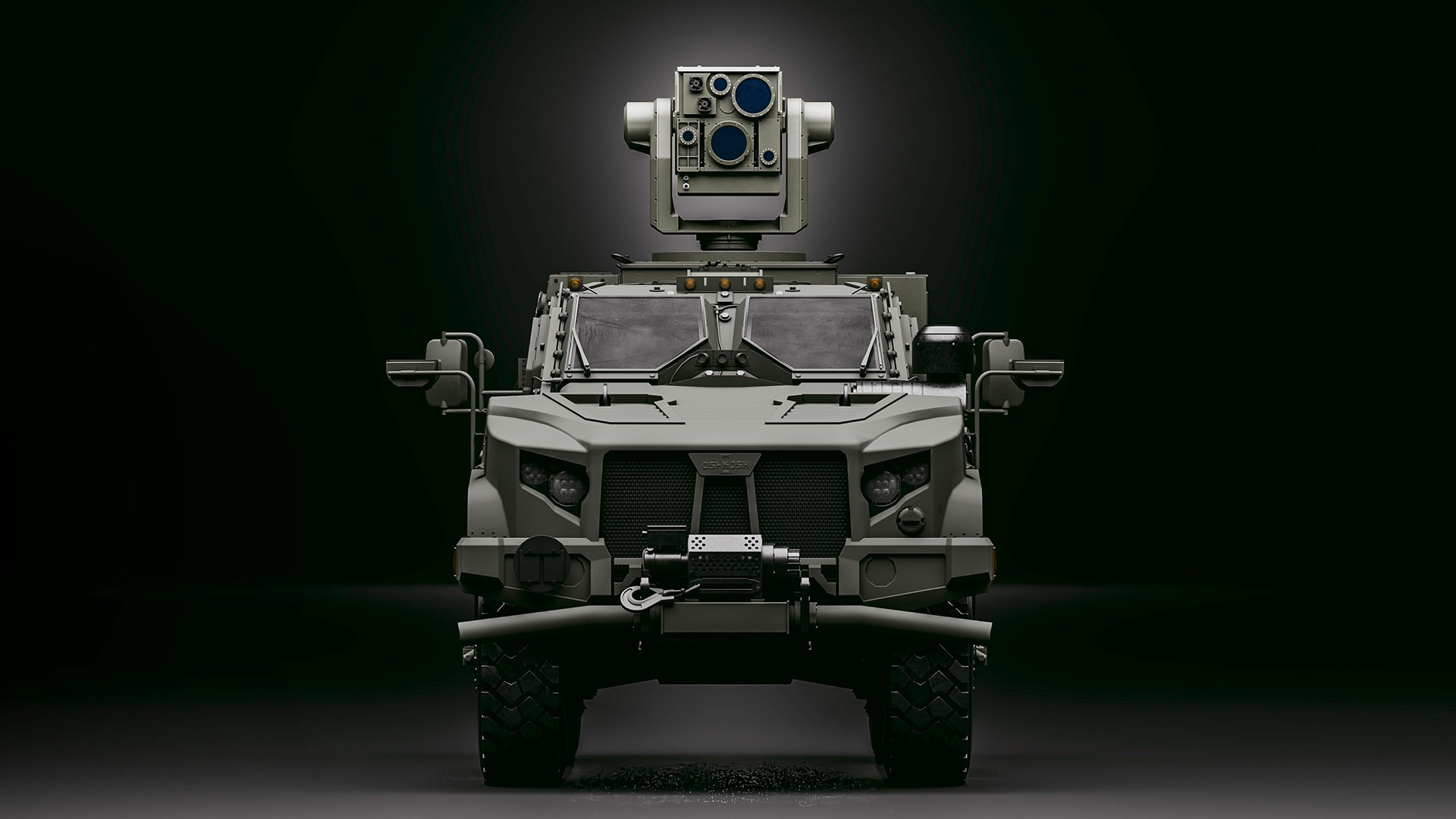
This week’s announcement that the United States Army has selected AV’s LOCUST® laser weapon system for its Enduring-High Energy Laser (E-HEL) program is a significant moment in American history.
The selection represents the first-ever production contract for directed energy systems in United States history, signaling a historic transition from prototype to production for laser weapon systems.
After decades of research, development and demonstration, lasers are ready to become part of how we defend the force and they have arrived at exactly the moment we need them.
We Have a Magazine Problem
The proliferation of inexpensive drones has fundamentally changed the economics of warfare.
An adversary no longer needs an exquisite aircraft or sophisticated missile to create a significant threat. Increasingly capable unmanned systems can be produced inexpensively and employed in large numbers, forcing defenders to respond again and again.
At the same time, recent conflicts have underscored the importance, and limits, of our inventories of sophisticated interceptors. Those weapons remain essential, but they are expensive, take time to manufacture and exist in finite quantities.
That creates an equation we cannot ignore.
We cannot afford to routinely expend scarce, high-value interceptors against every low-cost drone launched by our adversaries.
We need to change the dynamics of the engagement.
High-energy lasers can help do exactly that.
Thin the Herd. Preserve the Magazine.
The power of directed energy is not that a laser replaces every missile, gun or electronic-warfare system.
It is that it changes what those systems have to fight.
Think about a large group of unmanned aircraft systems approaching a defended position. Today, the defender may have to make difficult choices about when to employ finite kinetic weapons and against which targets.
Now, introduce high-energy lasers into that defensive architecture.
The laser can engage appropriate threats repeatedly at the speed of light without consuming a traditional munition with every shot. Combined with electronic warfare and other counter-UAS effects, directed energy can thin the herd before the remaining threats reach the layers where scarce kinetic interceptors are required.
That changes the battle.
If lasers and other lower-cost effects can defeat a meaningful portion of an incoming raid, commanders can preserve missiles for the sophisticated, hardened or time-critical threats that truly require them.
In a world where magazine depth matters as much as individual weapon performance, that is a profound advantage.
It is also why the right comparison isn’t laser versus missile.
The future is laser plus electronic warfare plus guns plus missiles, connected through sensors and command and control.
The objective is simple: use the most appropriate and affordable effect first and preserve the most capable, and scarce, effects for when they are needed most.
From Radar to Autonomy to Directed Energy
There is an important historical precedent for what is happening.
Radar transformed air defense not simply because it could detect an aircraft. Its real impact came when radar entered the force and became part of an integrated architecture connecting sensors, command and control, aircraft and weapons.
Decades later, unmanned aircraft followed a similar trajectory.
Their transformational moment wasn’t the first unmanned flight. It came when unmanned systems moved into military operations at scale. Today, increasingly autonomous aircraft have changed how militaries sense, target and fight. Inexpensive drones are changing the economics of warfare itself.
Directed energy has now reached its own inflection point.
The historic milestone is no longer proving that a laser can destroy a drone.
We have proven that.
The historic milestone is bringing lasers into the force structure and making them an enduring part of the architecture of air defense.
Lasers Are Ready
For decades, directed-energy programs were judged primarily on laser power and whether they could destroy a target under controlled conditions.
That is no longer the standard that matters.
A weapon has to work for the warfighter and it has to answer these questions before it can be truly operational at scale.
- Can soldiers operate it?
- Can it detect, track and defeat relevant threats?
- Can it perform outside the laboratory?
- Can it integrate with existing sensors and command and control?
- Can it operate across different platforms?
- Can industry manufacture and sustain it at scale?
Those are the thresholds separating promising technology from an operational weapon system.
They are also the thresholds AV has been working to cross with LOCUST.
We have proven LOCUST across fixed-site, mobile and maritime environments.
We rolled a palletized LOCUST system aboard the USS George H.W. Bush, powered it from the ship and we trained sailors to use it. After less than an hour of training, those sailors shot down 100-percent of the target presented during the demonstration.
We took LOCUST to White Sands Missile Range and conducted a counter-UAS laser engagement in coordination with the Department of War and Federal Aviation Administration in complex national airspace. That led to a DOW-FAA agreement that established how lasers can deployed safely and predictably in domestic airspace.
These were more than demonstrations of physics. They were demonstrations that prove the viability of lasers, specifically our LOCUST, for use at scale.
Scaling the Industrial Base
Introducing a new class of weapon into the force creates another responsibility: America must be able to build it at scale.
Technology without production capacity does not create deterrence.
That is why AV has invested ahead of the requirement.
We are investing more than $30 million to expand our Albuquerque, New Mexico, manufacturing operations, including the facilities where LOCUST is produced. The investment will further establish a vertically integrated, next-generation manufacturing campus expected to generate more than $670 million in economic impact over the next 10 years, boost production of mission-critical defense and space technologies, create more than 450 high-wage jobs, and enable AV to scale domestic production of directed energy systems and space-grade components that support national security and resilient supply chains.
We didn’t invest simply to prove that another laser could work.
We invested to build a weapon system that can be produced, fielded and scaled.
That distinction matters.
Recent conflicts have reminded us that America’s technological advantage must be matched by industrial capacity. We need both exquisite capabilities and the ability to produce sufficient quantities of the systems that protect our forces.
Directed energy can contribute to that equation from both sides: expanding defensive magazine depth while preserving the kinetic inventory we already have.
A New Air-Defense Equation
Transformational technologies rarely eliminate what came before them.
Radar didn’t eliminate pilots.
Autonomous aircraft haven’t eliminated crewed aircraft.
And lasers will not eliminate missiles, guns or electronic warfare.
They change the architecture around them.
Radar changed how we see.
Autonomy changed how we sense and operate at scale.
Directed energy changes the economics of how we defend.
That may ultimately be the most important contribution of laser weapons.
In an era of mass, autonomous threats and constrained interceptor inventories, victory will not simply go to the side with the most sophisticated individual weapon. It will increasingly depend on which side can generate and sustain combat power longer.
Lasers give the defender something fundamentally different: the ability to repeatedly remove threats without depleting a traditional magazine with every engagement.
Thin the herd with directed energy. Preserve kinetic weapons for the threats that require them. Give commanders greater magazine depth and more choices.
For decades, laser weapons represented the future.
Now they are ready for the force—and they can change the dynamics of air defense.
ABOUT THE AUTHOR
Mary Clum is President of Space, Cyber & Directed Energy at AV, bringing more than 25 years of leadership and operational experience across the defense, space, and technology sectors. Her career spans program management, systems analysis, operations, business development, and the development and delivery of highly technical products supporting the Department of War, Department of Energy, and other national security customers. She holds a BA in Political Science from the University of New Mexico and an MS in Project Management from the University of Southern California.
——
ABOUT AV — JOINING THE MISSION
AeroVironment (AV) is a defense technology company with a mission to invent and deliver advantage to U.S. and allied militaries. AV isn’t for everyone. We hire the curious, the relentless, the mission-obsessed.
AV doesn’t just build defense technology; we redefine what’s possible. As the premier autonomous systems company in the U.S., we deliver breakthrough capabilities across air, land, sea, space, and cyber. From autonomy-enabled drones and loitering munitions to integrated autonomy and space resilience, our technologies shape the future of warfare and protect those who serve.
Founded by legendary innovator Dr. Paul MacCready, AV has spent over 50 years pushing the boundaries of what unmanned systems can do. Our heritage includes seven platforms in the Smithsonian—but we’re not building history, we’re building what’s next.
If you’re ready to build technology that matters – with speed, scale, and purpose – come find your people.