
In his April 2026 comments to the House Armed Services Committee, Secretary of War Pete Hegseth made an important point about directed energy.
“The Department must reform its procurement processes, warfighting tactics, and policy limitations to ‘demystify’ Directed Energy weapons and facilitate their integration into the force structure,” he said.
The recently reported directed energy demonstration at White Sands Missile Range shows that strategy starting to take share in real time. During the event, Secretary Hegseth took the controls of AV’s LOCUST® laser weapon system and defeated a drone within minutes after a brief introduction to the system.
By directly participating in this kind of testing, Secretary Hegseth is doing more than observing another defense technology demonstration. He is helping demystify a class of weapons that many people still treat as futuristic, exotic, or experimental. For those of us who have spent years in this field, that matters.
It also tells us something important about the weapon itself.
Traditional air defense tests, especially kinetic interceptors, are rarely hands-on events for senior leaders.
I’ve been a part of many of these events over the years and they are usually tense, highly choreographed, heavily instrumented exercises. Control rooms fill with engineers, range safety personnel, test directors, operators, telemetry specialists, and program officials.
Everyone knows the stakes.
A target is launched. Radars acquire it. Fire-control systems calculate firing solutions. An interceptor leaves the rail. Then everyone waits to see what happened.
Senior leaders may attend. They may receive the briefing. They may watch the screens. But they usually do not pull the trigger.
That is not a criticism of kinetic interceptors. It is the nature of the weapon.
A missile shot is expensive, range-constrained, safety-intensive, and largely irreversible once launched. Before the test ever begins, there are extensive plans made around a potential misfire, a malfunction, or a debris event. The entire environment reflects the complexity and risk of putting a guided projectile into the air at high speed.
What happened recently at White Sands, where AV’s LOCUST directed energy laser weapon system was fired by senior Pentagon officials, including Hegseth, represents a different paradigm.
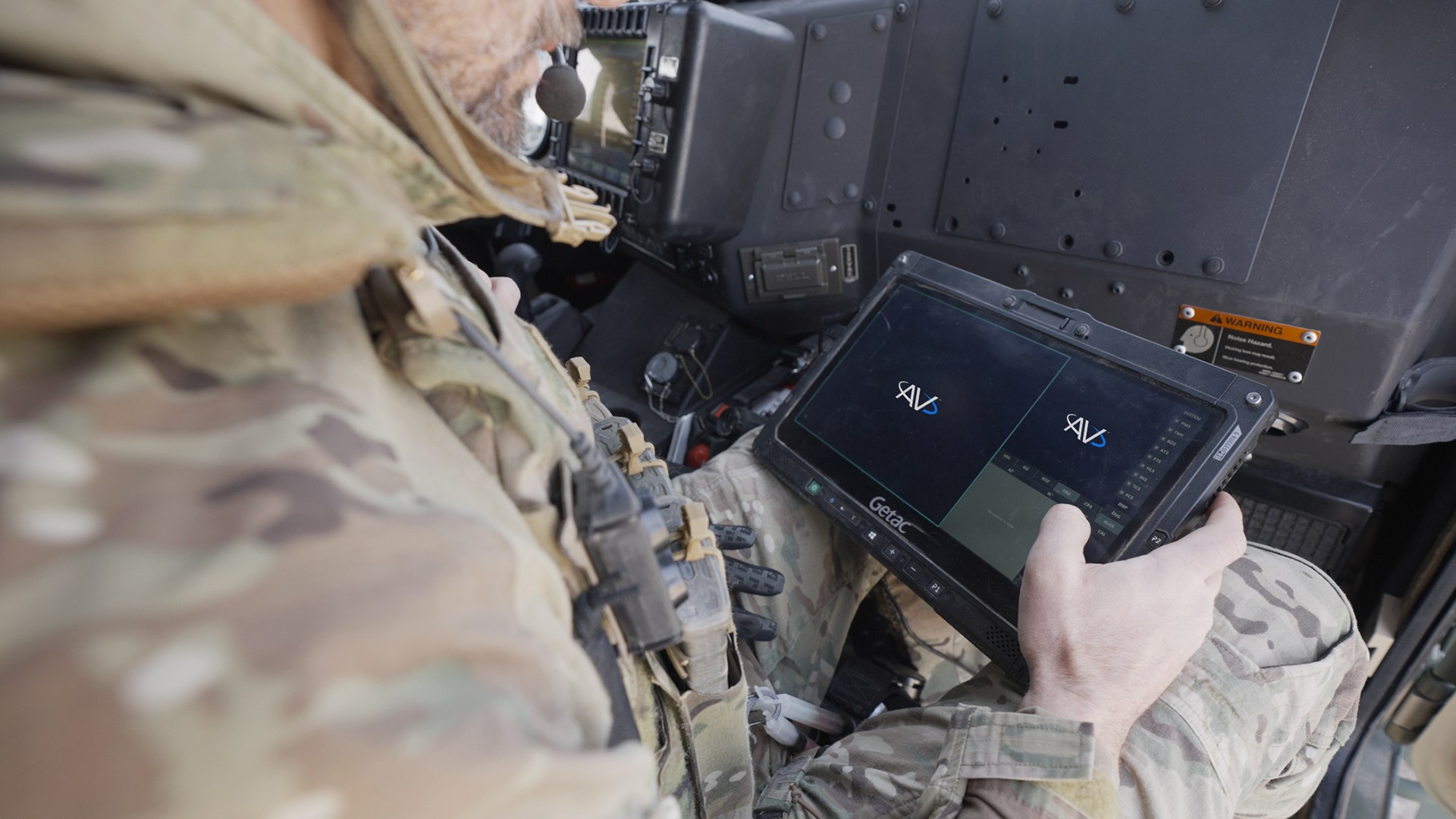
With directed energy, particularly AV’s LOCUST, senior leaders are not just watching an abstract engagement unfold on a screen. They can see the system. They can understand the engagement sequence. In some cases, they can directly participate in the act of operating the weapon by manipulating an intuitive XBOX™ gaming controller.
Seamless integration of automation and artificial intelligence algorithms effortlessly guides the user’s hand to snap to the target. That is profoundly different from the traditional air defense test environment.
And when you think about the drone threat, that difference matters.
The unmanned aircraft threat is not terrifying because every drone is sophisticated. It is terrifying because so many are not. Commercially available drones are cheap, accessible, adaptable, and increasingly lethal in the hands of hostile actors. They do not require deep pockets, years of training, or a traditional defense industrial base to acquire and employ.
That reality changes the problem.
A threat that is cheap, numerous, and easy to use cannot be defeated only by systems that are expensive, scarce, and difficult to employ at scale. The countermeasure has to match the character of the threat. It has to be affordable. It has to be repeatable. It has to be trainable. It has to be safe enough to use in complex environments. And it has to be available when the next drone appears, not just when the magazine has been reloaded.
That is where laser weapons, particularly AV’s LOCUST, are different.
A directed energy laser weapon is technically sophisticated, but the engagement can be operationally intuitive. The system tracks the target. Engagement safety zones are tightly managed. The beam is precisely pointed. The effect is delivered at the speed of light. If the operator needs to engage again, the weapon can fire again. There is no interceptor to reload after every shot and no missile debris field to manage in the same way.
These properties make laser weapons what I like to refer to as “unusually usable” for the C-UAS mission.
And usability matters.
It matters for training. It matters for confidence. It matters for safety. It matters for sustainment. It matters for cost. Most importantly, it matters for scale. A weapon that can be understood, trained, and operated repeatedly is a weapon that can move out of the demonstration lane and into the hands of warfighters.
We’ve proven LOCUST in the field numerous times, including when we rolled it onboard the USS Bush and trained sailors who then shot down 100 percent of their targets after less than an hour of training.
Having a laser weapon that is “unusually usable” also matters to the industrial base.
Secretary Hegseth was clear in his posture statement that the Department needs a stronger and more consistent demand signal for directed energy weapons, not just for a handful of prototypes, but for production in meaningful quantities.
That demand signal will not emerge if senior leaders, operators, acquisition officials, and policymakers continue to treat laser weapons as exotic technologies that only specialists can understand.
Demand comes from confidence.
Confidence comes from seeing the weapon work. It comes from understanding how it is employed. It comes from watching operators engage targets safely and repeatedly. And in some cases, it comes from experiencing the engagement first-hand.
That is why the image of senior leaders engaging directly with directed energy is more than a photo opportunity. It is part of the demystification process Secretary Hegseth described. The point is not that dignitaries like firing lasers. Of course they do.
The point is that they can.
When a system like AV’s LOCUST can be demonstrated safely, repeatedly, and credibly in front of senior defense leaders, it shows that directed energy is no longer just a technology to be explained by specialists in a control room. It is becoming a weapon that operators can understand by using.
For counter-UAS missions, that is exactly what the moment requires.
The drone threat is scaling. The demand signal for directed energy has to scale with it. And before the Department can buy laser weapons in meaningful numbers, it has to become comfortable treating them not as mysteries, but as practical air defense tools.
Demystifying directed energy does not start in a policy memo or a fancy PowerPoint slide; it starts at the trigger.
ABOUT THE AUTHOR
Aaron Westman is an engineer and leader specializing in counter-UAS and directed energy systems. He has played a key role advancing mobile laser weapon integration and operational deployment, supporting a variety of cross-domain capabilities that improve precision engagement and layered air defense.
JOIN THE AV MISSION
AV isn’t for everyone. We hire the curious, the relentless, the mission-obsessed. The best of the best.
We don’t just build defense technology—we redefine what’s possible. As the premier autonomous systems company in the U.S., AV delivers breakthrough capabilities across air, land, sea, space, and cyber. From AI-powered drones and loitering munitions to integrated autonomy and space resilience, our technologies shape the future of warfare and protect those who serve.
Founded by legendary innovator Dr. Paul B. MacCready, Jr., AV has spent over 50 years pushing the boundaries of what unmanned systems can do. Our heritage includes seven platforms in the Smithsonian—but we’re not building history, we’re building what’s next.
If you’re ready to build technology that matters—with speed, scale, and purpose—there’s no better place to do it than AV.